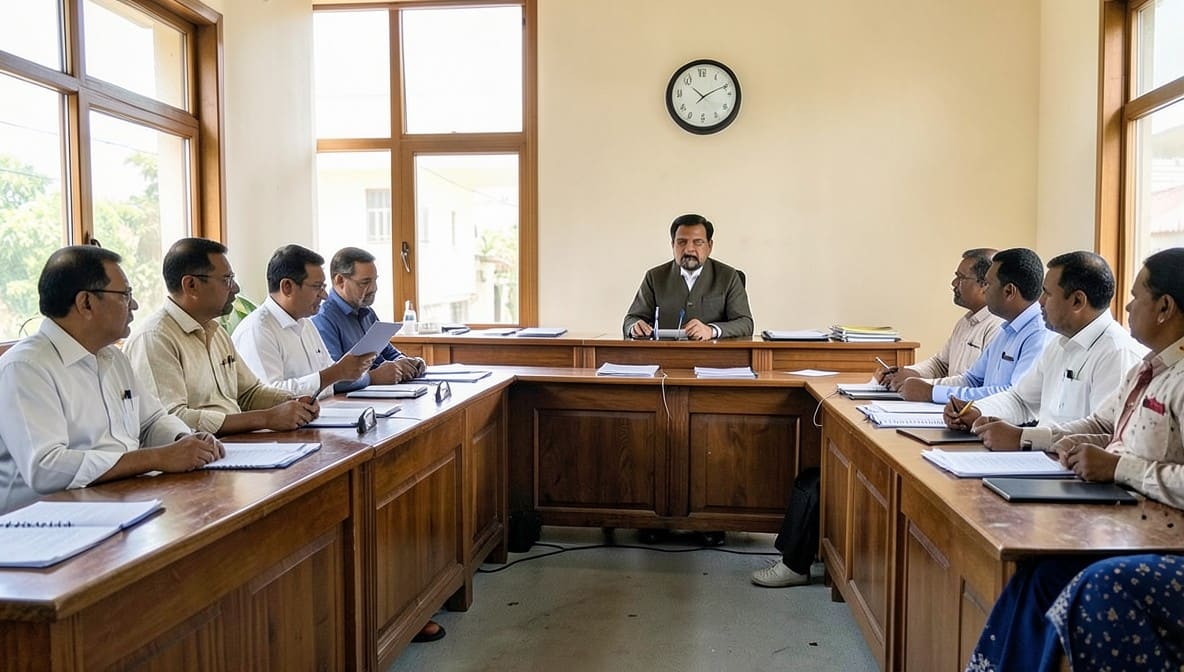
The Chhattisgarh High Court has issued a pivotal directive suspending the dismissal of motor accident claim petitions solely on grounds of limitation, pending final adjudication by the Supreme Court. This order resolves a batch of civil revisions challenging the jurisdiction of Motor Accident Claims Tribunals to condone delays in filing claims under Section 166 of the Motor Vehicles Act, 1988, and aligns lower tribunals with binding interim directions from the Apex Court.
Background & Facts
The Dispute
This batch of civil revisions arises from multiple motor accident claim petitions filed before various Motor Accident Claims Tribunals (MACTs) across Chhattisgarh. The petitioners, being claimants or their legal heirs, sought compensation under Section 166 of the Motor Vehicles Act, 1988, following fatal or injurious road accidents. However, in each case, the claim petitions were filed beyond the statutory limitation period prescribed under Section 166(3) of the Act, which mandates filing within two years from the date of the accident.
The respondents, comprising insurance companies and vehicle owners, objected to the maintainability of these petitions on the ground of limitation. They filed applications under Order 7 Rule 11 of the Code of Civil Procedure seeking rejection of the petitions at the threshold. The MACTs, however, rejected these objections, holding that sufficient cause had been shown for the delay and proceeded to entertain the claims by invoking principles analogous to Section 5 of the Limitation Act, 1963.
Key Facts
- The Motor Vehicles Act, 1988, under Section 166(3), prescribes a limitation period of two years for filing claims before the MACT.
- In all 37 consolidated cases, claim petitions were filed after the expiry of this two-year period.
- The delay ranged from several months to over five years in some instances.
- The claimants provided reasons such as ignorance of legal rights, illness, absence of legal representation, or delayed investigation by police in support of their delay.
- The MACTs, in each case, accepted these reasons and condoned the delay without requiring formal applications under Section 5 of the Limitation Act.
- The insurance companies and vehicle owners challenged these orders before the High Court through civil revisions.
Procedural History
- Dates of Accidents: Varying between 2018 and 2023 across the 37 cases
- Dates of Filing of Claim Petitions: Between 2020 and 2025, all beyond the two-year limitation period
- Dates of Objections by Respondents: Filed between 2021 and 2024 before respective MACTs
- Dates of MACT Orders: Between 2022 and 2025, all allowing petitions despite delay
- Dates of Civil Revisions Filed: Between January 2024 and March 2025 before the Chhattisgarh High Court
- 04.11.2025: Supreme Court, in ICICI Lombard General Insurance Company Limited v. Ayiti Navaneetha and others (SLP(C) Nos. 8412 - 8413/2023), issued interim directions that claim petitions shall not be dismissed solely on the ground of limitation under Section 166(3)
- 19.03.2026: Supreme Court, in Bhagirathi Dash v. Union of India (W.P.(C) No. 166/2024), directed further hearing on the issue of limitation and condonation of delay under Section 166(3)
- 08.04.2026: Chhattisgarh High Court delivered this common order disposing of all 37 revisions
The Parties' Positions
For the Applicants (Insurance Companies & Vehicle Owners)
- Argued that MACTs are statutory tribunals bound strictly by the provisions of the Motor Vehicles Act
- Contended that Section 166(3) contains an express limitation period with no provision for condonation of delay
- Asserted that invoking Section 5 of the Limitation Act is impermissible as it is not incorporated into the MV Act
- Claimed that allowing petitions despite delay violates the principle of legal certainty and prejudices the rights of insurers and owners
- Alleged violation of natural justice in several cases where objections were not properly heard
For the Non-Applicants (Claimants)
- Argued that the purpose of the MV Act is compensatory and humanitarian
- Maintained that technicalities of limitation should not defeat the rights of victims and their families
- Cited judicial trends favoring liberal interpretation of limitation in social welfare statutes
- Relied on the Supreme Court’s interim directions as binding precedent
Relief Sought
The applicants sought:
- Quashing of all MACT orders that entertained claim petitions beyond the limitation period
- Direction to reject all such petitions at the threshold
- Declaration that MACTs lack jurisdiction to condone delay under Section 166(3)
- Costs of litigation
The Legal Issue
The central question is whether the Motor Accident Claims Tribunal has the legal authority to condone delay in filing a claim petition under Section 166(3) of the Motor Vehicles Act, 1988, and whether principles under Section 5 of the Limitation Act, 1963, can be applied by the Tribunal in the absence of an express statutory provision.
Arguments Presented
For the Appellant/Petitioner
The applicants contended that the Motor Vehicles Act is a self-contained code, and Section 166(3) imposes a mandatory limitation period of two years without any provision for condonation. They relied on National Insurance Co. Ltd. v. Laxmi Narain Dhut and United India Insurance Co. Ltd. v. Laishram Jyotirmayee Devi to argue that statutory limitation periods in special statutes override general limitation laws. They emphasized that the 2019 amendment to the MV Act, which introduced stricter timelines for claim settlements, further indicated legislative intent to enforce strict compliance. The applicants also cited State of Haryana v. Bhajan Lal to argue that tribunals cannot assume powers not conferred by statute, and that condonation of delay without a statutory basis amounts to judicial legislation.
For the Respondent/State
The claimants, through their advocates, argued that the MV Act is a social welfare legislation designed to provide speedy and accessible compensation to accident victims. They relied on Smt. Sushila Devi v. Oriental Insurance Co. Ltd. and Rajesh Kumar v. National Insurance Co. Ltd. to assert that courts must adopt a liberal approach to limitation in such statutes. They emphasized that the Supreme Court’s interim order in ICICI Lombard v. Ayiti Navaneetha explicitly prohibits dismissal of claims solely on limitation grounds, and that the High Court is bound to follow such directions. They further argued that the absence of a condonation provision does not imply prohibition, and that tribunals, as quasi-judicial bodies, retain inherent power to prevent abuse of process and ensure justice.
The Court's Analysis
The Court undertook a comprehensive review of the statutory framework under the Motor Vehicles Act, 1988, and the evolving jurisprudence on limitation in social welfare statutes. It noted that while Section 166(3) prescribes a two-year limitation period, it does not contain an express bar on condonation, nor does it explicitly exclude the application of Section 5 of the Limitation Act.
"The Motor Vehicles Act, though a special statute, does not expressly prohibit the application of Section 5 of the Limitation Act. The absence of a specific provision for condonation does not equate to a legislative intent to deny it."
The Court emphasized that the Supreme Court’s interim order dated 04.11.2025 in ICICI Lombard v. Ayiti Navaneetha is binding and operates as a judicial directive to all subordinate courts and tribunals. The Apex Court had explicitly held that claim petitions "ought not to be dismissed at this stage solely on the ground of limitation." The Court further noted that the Supreme Court had listed the matter for final hearing in Bhagirathi Dash v. Union of India on 19.03.2026, indicating that the legal position remains sub judice.
The Court rejected the applicants’ argument that MACTs lack inherent jurisdiction to condone delay. It held that while MACTs derive their powers from statute, they are not devoid of equitable powers to prevent injustice, particularly where claimants are laypersons unfamiliar with legal procedures. The Court observed that the Tribunals’ approach of applying principles analogous to Section 5 was not an overreach but a reasonable exercise of discretion to ensure substantive justice.
The Court also addressed the allegation of violation of natural justice. It found that while some MACTs may have acted hastily, the overall pattern did not indicate systemic disregard for the rights of insurers or owners. The Court clarified that all objections - including those relating to limitation, liability, quantum, and evidence - remain open for adjudication at the final hearing stage.
The Verdict
The Chhattisgarh High Court dismissed all civil revisions. The Court directed that the Motor Accident Claims Tribunals may proceed with the adjudication of all pending claim petitions under Section 166 of the Motor Vehicles Act, 1988, but shall not pass any final award until the Supreme Court delivers its final judgment on the issue of limitation and condonation of delay. All contentions raised by the parties, including those relating to limitation, jurisdiction, and applicability of the Limitation Act, are preserved for final adjudication. Any interim orders previously operating in these matters are vacated. There shall be no order as to costs.
What This Means For Similar Cases
Delay Cannot Be a Ground for Automatic Dismissal
- Practitioners must now argue that limitation objections under Section 166(3) MV Act are not decisive at the threshold
- Claim petitions filed beyond two years must be heard on merits unless the Supreme Court rules otherwise
- Insurers cannot rely solely on limitation to seek rejection under Order 7 Rule 11 CPC
Tribunals Retain Discretion to Adjudicate on Merits
- MACTs may proceed with evidence recording, witness examination, and assessment of liability
- Quantum of compensation may be determined provisionally, but final award is stayed
- Parties must preserve all defenses - including contributory negligence, policy exclusions, and fraud - for final hearing
Strategic Implications for Practitioners
- Insurers should file detailed written statements addressing all substantive issues, not just limitation
- Claimants should file affidavits explaining delay with supporting documents (medical reports, police records, correspondence)
- All parties must monitor the Supreme Court’s final decision in Bhagirathi Dash v. Union of India and promptly notify the MACT upon its pronouncement