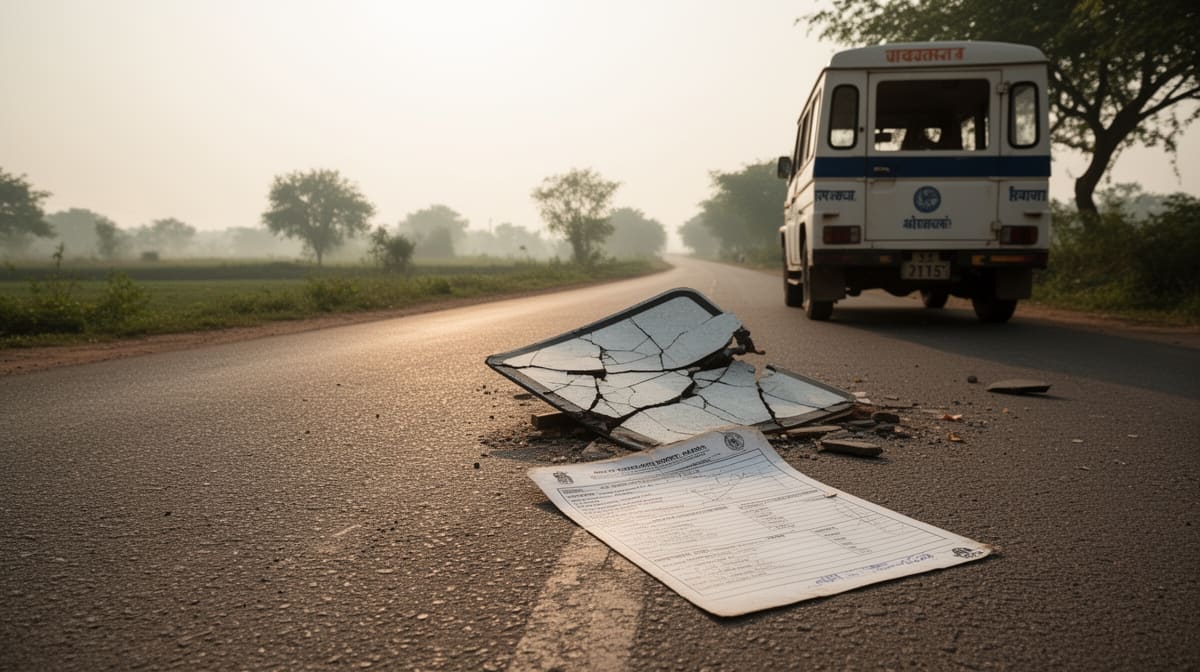
The Madhya Pradesh High Court has stayed final adjudication in pending motor accident claims pending the Supreme Court’s final determination on whether delays in filing claims under Section 166(3) of the Motor Vehicles Act, 1988 can be condoned. This interim direction ensures uniformity in adjudication while the apex court resolves a critical statutory interpretation issue affecting thousands of claimants nationwide.
Background & Facts
The Dispute
The present civil revision was filed by SBI General Insurance Company Ltd. challenging an order passed by the Motor Accident Claims Tribunal (MACT) that condoned a delay in filing a compensation claim under Section 166(3) of the Motor Vehicles Act, 1988. The claimant, Hakke Prjapati and others, sought compensation for injuries and death arising from a motor accident. The application was filed beyond the stipulated six-month limitation period, and the Tribunal condoned the delay under its inherent powers.
Key Facts
- The motor accident occurred on an unspecified date prior to the filing of the claim application.
- The claim application was filed before the MACT after the expiry of the six-month limitation period under Section 166(3) of the Motor Vehicles Act, 1988.
- The Claims Tribunal condoned the delay without citing any specific statutory provision permitting such condonation.
- The Insurance Company contended that Section 166(3) imposes a strict limitation of six months with no express provision for extension or condonation.
- The claimant did not allege any statutory obligation on the police to file a Detailed Accident Report (DAR) that could be treated as a claim application under Section 166(4).
Procedural History
- Date of accident: Not specified in judgment, but occurred prior to filing of claim.
- Date of claim application filing: Beyond six months from the date of accident; exact date not provided.
- Date of Tribunal order condoning delay: 17.01.2025.
- 25.02.2022: Notification inserting Clause 21 of Annexure XIII to Central Motor Vehicles Rules, mandating police to submit Detailed Accident Report (DAR) to the Claims Tribunal.
- 2023: Kerala High Court in Akshay Raj v. Ministry of Law and Legislative Department, 2023 LiveLaw (Ker) 50, held that DAR filed by police may be treated as a claim application under Section 166(4), thereby circumventing limitation.
- 2023: SLP (C) No. 9152/2023 filed in Supreme Court challenging Kerala HC’s view in Akshay Raj.
- 2023: SLP (C) Diary No. 23834/2023 filed challenging the same Kerala HC order.
- 2024: Madhya Pradesh High Court, in M.P. No. 3848/2024, examined whether DAR submission under Annexure XIII could be treated as a claim application.
- 04.11.2025: Supreme Court, in S.L.P. (Civil) No. 8412-8413, directed that no claim petition shall be dismissed on ground of limitation pending final decision on condonability.
- 01.07.2026: Present civil revision decided by the Madhya Pradesh High Court.
Relief Sought
The Insurance Company sought setting aside of the Tribunal’s order dated 17.01.2025 condoning delay, and a direction that all pending claims filed beyond six months be dismissed outright as barred by limitation.
The Legal Issue
The central question is whether Section 166(3) of the Motor Vehicles Act, 1988, which prescribes a six-month limitation period for filing claims, permits condonation of delay under Section 5 of the Limitation Act, 1963, or whether the limitation is absolute and non-extendable.
Arguments Presented
For the Appellant/Petitioner
The Insurance Company argued that Section 166(3) is a special provision with a clear, unambiguous limitation period of six months, and no express provision exists for condonation of delay. It relied on the principle of expressio unius est exclusio alterius - that the absence of a condonation clause indicates legislative intent to exclude it. It further cited pending Supreme Court proceedings in Cholamandalam MS General Insurance Co. Ltd. v. Shreelakshmi T & Others and Akshay Raj to argue that the issue is sub judice and requires uniformity.
For the Respondent/State
The respondents did not file a separate written submission. However, the Tribunal’s order, which was challenged, implicitly relied on the Kerala High Court’s reasoning in Akshay Raj, suggesting that the statutory duty of police to file a Detailed Accident Report under Annexure XIII to the Central Motor Vehicles Rules may be treated as a deemed claim application under Section 166(4), thereby rendering the limitation period inapplicable.
The Court's Analysis
The Court acknowledged that the issue of condonability of delay under Section 166(3) is currently under consideration by the Supreme Court in multiple pending appeals, including Cholamandalam MS General Insurance Co. Ltd. v. Shreelakshmi T & Others and Akshay Raj. The Court noted that the Kerala High Court had previously held that the police’s statutory obligation to file a Detailed Accident Report under Clause 21 of Annexure XIII to the Central Motor Vehicles Rules could be treated as a claim application under Section 166(4), thereby bypassing the six-month limitation.
"This Court was initially of the view that... mere pendency of the matters before the Supreme Court relating to applicability of Limitation Act would not be sufficient ground to interfere in the matter."
However, the Court revised its stance in light of the Supreme Court’s subsequent order dated 04.11.2025 in S.L.P. (Civil) No. 8412-8413, which explicitly directed that no claim petition shall be dismissed on the ground of limitation while the matter is pending before the apex court. The Court held that allowing final awards to be passed in the interim would create irreconcilable conflicts once the Supreme Court delivers its final ruling.
The Court emphasized that the statutory duty of police to submit the Detailed Accident Report under Annexure XIII is a material factor in determining whether the claim application was effectively filed within time. The Court concluded that until the Supreme Court resolves whether Section 166(3) is absolute or subject to condonation, and whether DAR constitutes a deemed application, no final award can be passed.
The Verdict
The revision petition is dismissed with directions. The Claims Tribunal shall proceed with the trial of pending claims but shall not pass any final award until the Supreme Court conclusively decides the issue of condonability of delay under Section 166(3) of the Motor Vehicles Act, 1988. The Tribunal is bound to follow the Supreme Court’s final ruling, and if the delay is held condonable, it may then pass its award. If not, the claim shall stand dismissed.
What This Means For Similar Cases
Delay Cannot Be Automatically Dismissed
- Practitioners must now argue that pending claims filed beyond six months cannot be dismissed summarily on limitation grounds while the Supreme Court’s decision is pending.
- Courts and Tribunals across India are bound by the Supreme Court’s 04.11.2025 direction to refrain from dismissal on limitation.
DAR as Deemed Application Remains a Viable Argument
- Where a Detailed Accident Report was filed by police under Annexure XIII, claimants may still argue that the application was effectively made within time under Section 166(4).
- Legal teams should preserve all DAR submissions and police records as critical evidence in pending claims.
Uniformity in Adjudication Is Mandated
- All pending claims nationwide must await the Supreme Court’s final ruling.
- Lawyers must monitor the outcome of S.L.P. (C) No. 9152/2023 and S.L.P. (C) Diary No. 23834/2023 for binding precedent.