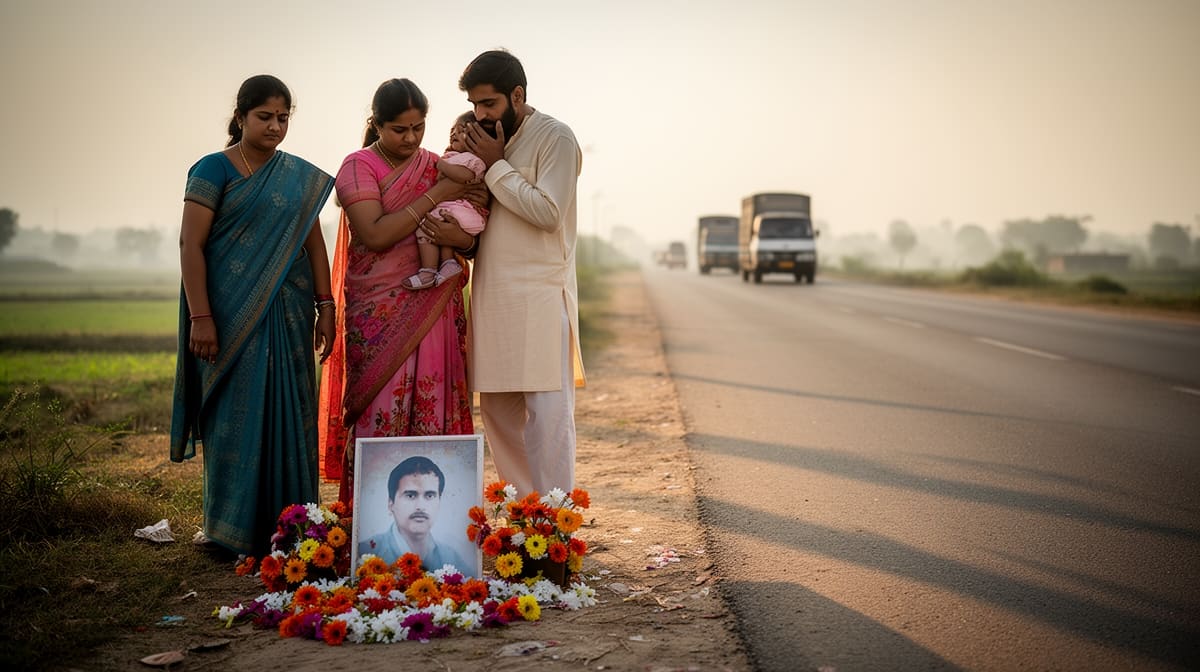
The Orissa High Court has significantly refined the methodology for calculating compensation in motor accident claims involving the death of a minor, emphasizing that conventional heads of damages must be aggregated into a single consolidated award rather than bifurcated. This clarification resolves longstanding inconsistencies in tribunal practice and aligns with the Supreme Court’s evolving jurisprudence on non-pecuniary loss.
Background & Facts
The Dispute
The claim arose from the fatal motor accident of Tirthabasi Naik, a 15-year-old school-going student, on 15 June 2016 in Keonjhar, Odisha. The deceased was struck by an auto-rickshaw bearing registration OD-09-E-2388, resulting in his immediate death. A charge sheet was filed under Section 304A IPC, and the deceased’s parents (Respondents 1 - 3) filed a claim petition under Section 166 of the Motor Vehicles Act, 1988 against the vehicle owner and its insurer.
Procedural History
- 2017: Claim petition filed before the 4th Motor Accident Claims Tribunal, Keonjhar
- 2025: Tribunal awarded Rs. 6,35,000/-, comprising:
- Rs. 5,40,000/- for loss of dependency (Rs. 30,000 p.a. × multiplier 18)
- Rs. 15,000/- for funeral expenses
- Rs. 80,000/- for filial consortium (Rs. 40,000/- each to mother and father)
- 2026: Insurance company appealed to the Orissa High Court challenging only the quantum of general damages
Relief Sought
The insurer sought reduction of the compensation amount, arguing that the tribunal erred in awarding separate sums for filial consortium to each parent, thereby inflating the total. The claimants sought confirmation of the tribunal’s award.
The Legal Issue
The central question was whether filial consortium damages in a motor accident claim involving a minor’s death must be awarded as separate sums to each parent, or whether such conventional heads - filial consortium, funeral expenses, and loss of estate - must be aggregated into a single consolidated award under Section 166 of the Motor Vehicles Act.
Arguments Presented
For the Appellant
The insurer relied on Shri Ram General Insurance Co. Ltd. v. Bhagat Singh Rawat and National Insurance Co. Ltd. v. Pranay Sethi to argue that the Supreme Court has consistently directed tribunals to award a single, consolidated sum for general damages under conventional heads. It contended that splitting Rs. 80,000/- into Rs. 40,000/- per parent was a mechanical application of outdated norms and violated the principle of proportionality.
For the Respondents
The claimants argued that each parent suffers distinct emotional loss and that separate awards reflect the individualized nature of grief. They cited lower court precedents where dual awards were upheld, asserting that the tribunal’s approach was fact-sensitive and justified.
The Court's Analysis
The Court undertook a doctrinal review of the Supreme Court’s jurisprudence on general damages. It emphasized that Section 166 does not mandate itemized awards but requires just and equitable compensation. The Court distinguished between pecuniary loss (loss of dependency) and non-pecuniary loss (general damages), noting that the latter must be assessed holistically.
"The principle laid down in Pranay Sethi is not merely procedural but substantive: the object is to provide a fair, not a fragmented, compensation for non-pecuniary loss."
The Court held that awarding Rs. 40,000/- to each parent created an artificial duplication of heads that had no statutory basis. It further noted that the Rs. 15,000/- for funeral expenses and Rs. 80,000/- for filial consortium were both conventional heads under the same category and should be merged. Applying the 10% uplift per three years as mandated in Pranay Sethi, the Court recalculated the consolidated general damages at Rs. 91,000/-, replacing the original Rs. 95,000/-.
The Court also affirmed the multiplier of 18 for a 15-year-old minor, citing Sarla Verma, and upheld the notional income of Rs. 30,000/- per annum as reasonable for a school-going child in rural Odisha.
The Verdict
The appellant insurer won in part. The Orissa High Court modified the compensation from Rs. 6,35,000/- to Rs. 6,31,000/- by consolidating general damages into a single sum of Rs. 91,000/-. The right of recovery against the owner was upheld. The insurer must pay the modified amount with 6% simple interest from 20 September 2016.
What This Means For Similar Cases
General Damages Must Be Consolidated
- Practitioners must now argue for a single consolidated amount covering funeral expenses, loss of consortium, and loss of estate - never as separate line items
- Tribunals must avoid mechanical multiplication of heads, even for dual claimants (e.g., both parents)
- Any attempt to itemize these heads will be reversed on appeal
Multiplier and Notional Income Standards Are Fixed
- For minors aged 15 - 18, multiplier 18 remains the default unless exceptional circumstances exist
- Notional income of Rs. 30,000/- per annum is now a recognized benchmark for school-going minors in non-metropolitan areas
- Future prospect adjustments must be explicitly stated and justified
Interest and Uplift Apply Uniformly
- The 10% uplift per three years from date of accident, as per Pranay Sethi, is mandatory for all claims pending over a decade
- Interest must run from the date of accident, not from date of filing
- Insurers must calculate revised amounts proactively to avoid appellate modification