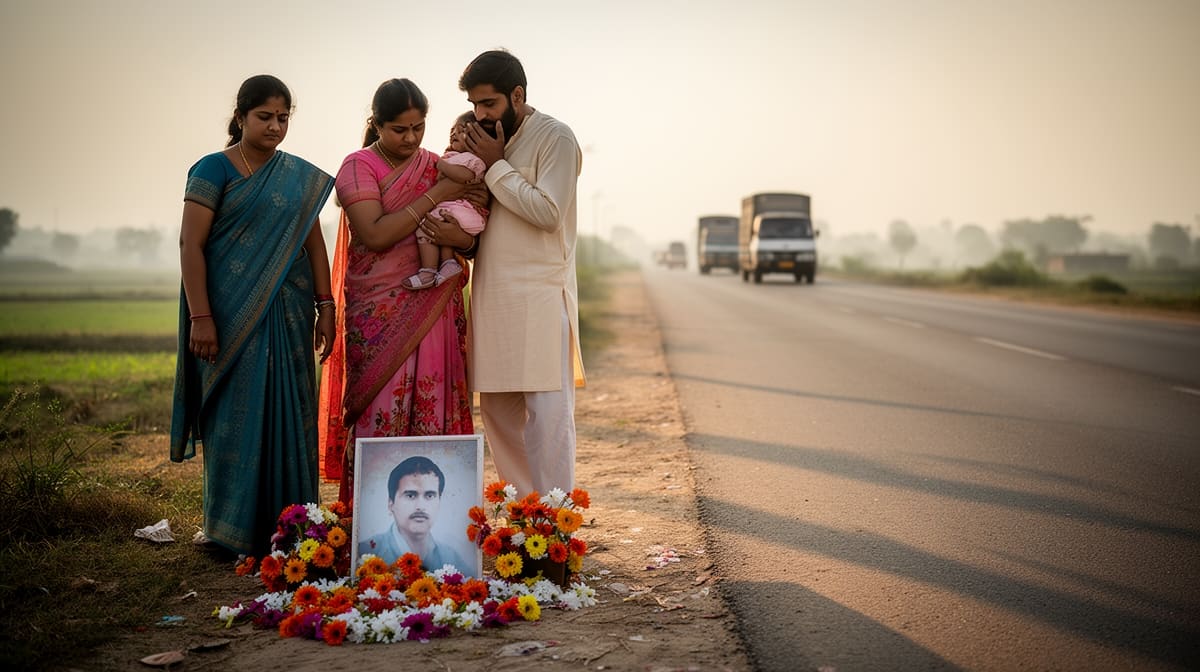
The Punjab and Haryana High Court has significantly clarified the legal framework for awarding compensation in motor accident cases involving the death of minor children, emphasizing that the loss of a child’s love, companionship, and emotional support cannot be reduced to mere economic metrics. This judgment redefines how courts must assess non-economic damages under the Motor Vehicles Act, 1988, particularly in cases where no formal income documentation exists.
Background & Facts
The Dispute
The case arose from a fatal motor accident on 10 November 2015, when Rohan Kumar, a 17½-year-old boy, fell from a trolley attached to a tractor while returning from agricultural work. He died at the spot. The tractor, bearing registration number HR-14L-3613, was driven by Dharambir Singh, respondent No.1. Rohan’s father, Surender Kumar, and mother filed a claim petition under Section 166 of the Motor Vehicles Act, 1988, seeking compensation for his death.
Procedural History
- 10 November 2015: Accident occurred; FIR registered with incorrect tractor registration number (HR-14L-2513).
- 28 February 2017: Motor Accident Claims Tribunal awarded Rs.10,22,000/- as compensation, including Rs.25,000 each for loss of love and affection and funeral expenses.
- 2017 & 2023: Appellant Insurance Company filed appeal (FAO-8506-2017); claimants filed cross-objections (XOBJC-48-2023) seeking enhancement.
- 9 February 2026: Punjab and Haryana High Court heard both matters together and delivered a common judgment.
Relief Sought
The appellant-insurance company sought to set aside the award, arguing that the deceased was a gratuitous passenger, the vehicle was used for non-agricultural purposes, and the registration number discrepancy invalidated the claim. The claimants sought enhancement of compensation, particularly on account of future prospects, loss of consortium, and loss of estate.
The Legal Issue
The central question was whether the compensation for the death of an unmarried minor child must include a reasonable award for filial consortium, and if so, how should the deceased’s income be assessed in the absence of documentary proof, particularly in light of evolving Supreme Court precedents on future prospects and conventional heads of compensation.
Arguments Presented
For the Appellant
The insurance company contended that liability was extinguished because: (i) the deceased was seated in the trolley, which constituted a breach of policy conditions restricting occupancy to the driver only; (ii) the tractor was being used for non-agricultural purposes; and (iii) the discrepancy in the registration number in the FIR rendered the claim fraudulent. It relied on judgments from Uttarakhand, Karnataka, Andhra Pradesh, Madhya Pradesh, and the Supreme Court in National Insurance Co. Ltd. v. Chinnamma to argue that policy exclusions applied.
For the Respondents
The claimants argued that the tractor and trolley were used for transporting rice straw - an agricultural activity - and that the deceased was not a gratuitous passenger but a family member assisting in farm work. They relied on Fahim Ahmad v. United India Insurance Co. to establish that agricultural use of a tractor with a trolley does not breach policy terms. They also contended that the Tribunal’s income assessment of Rs.6,000/month was too low and that the award for loss of consortium and future prospects was inadequate under Pranay Sethi and Magma General Insurance.
The Court's Analysis
The Court undertook a meticulous review of the evidence and legal principles governing compensation under the Motor Vehicles Act. It rejected the insurer’s contention that the deceased was a gratuitous passenger, holding that the trolley was an integral part of the agricultural operation and that Rohan’s presence was incidental to family labor. The Court emphasized that the tractor’s use was not commercial but familial and agricultural, aligning with Fahim Ahmad.
"The presence of the deceased in the trolley, in the course of agricultural operations, cannot, in the facts of the present case, be equated with that of a gratuitous passenger."
Regarding the registration number discrepancy, the Court found the explanation - given by a grieving father in shock - credible and natural. The consistent identification of the driver, corroborated by police investigation and independent witnesses, negated any suggestion of fraud.
On compensation calculation, the Court critically examined the Tribunal’s application of Sarla Verma and Pranay Sethi. It held that the Tribunal erred in applying a 50% addition for future prospects, which is reserved for salaried employees under 40. Since Rohan was a laborer without formal employment, the correct addition was 40%. The Court also rejected the Tribunal’s use of minimum wage as an absolute standard, citing Chandra @ Chanda v. Mukesh Kumar Yadav, and instead assessed monthly income at Rs.8,000 based on the nature of employment and regional economic conditions.
Crucially, the Court invoked Magma General Insurance v. Nanu Ram to affirm that filial consortium is a distinct and compensable head of damage. It held that the loss of a child’s love, affection, and companionship warrants a substantial award, and that the Tribunal’s Rs.25,000 for "loss of love and affection" was inadequate. Following Pranay Sethi, the Court awarded Rs.40,000 each to the father and mother, totaling Rs.80,000 for filial consortium.
The Court also enhanced funeral expenses from Rs.25,000 to Rs.25,000 (retained) and awarded Rs.15,000 for loss of estate, as per Pranay Sethi’s revised conventional heads.
The Verdict
The claimants won. The Court dismissed the insurance company’s appeal and allowed the cross-objections, enhancing the compensation from Rs.10,22,000 to Rs.13,29,600. It held that filial consortium must be awarded separately and meaningfully, future prospects for self-employed minors must be calculated at 40%, and income assessments must be grounded in realistic economic context, not rigid minimum wage benchmarks.
What This Means For Similar Cases
Filial Consortium Is a Mandatory Head of Compensation
- Practitioners must now specifically plead and argue for filial consortium in cases involving the death of minor children, even if parents are not financially dependent.
- Awards of Rs.40,000 per parent are now the baseline under Magma General Insurance, subject to 10% escalation every three years.
- Courts cannot substitute "loss of love and affection" with vague or nominal sums; it must be quantified as a distinct head.
Income Assessment Must Be Contextual, Not Mechanical
- In the absence of income documents, courts must use a reasonable, fact-based estimate - not merely minimum wage - as the starting point.
- For self-employed minors or informal workers under 40, a 40% addition for future prospects applies, not 50%.
- Multiplier of 18 remains applicable for ages 17 - 20, but must be applied to the correct multiplicand.
Agricultural Use of Tractors with Trailers Is Presumed Lawful
- Carrying agricultural produce (e.g., rice straw, vegetables) on a tractor-trolley does not constitute commercial use or policy breach.
- Insurers must prove actual commercial hiring or deviation from agricultural purpose; mere presence of a trolley is insufficient.
- Policy exclusions based on seating capacity cannot override the natural use of agricultural machinery in rural labor contexts.