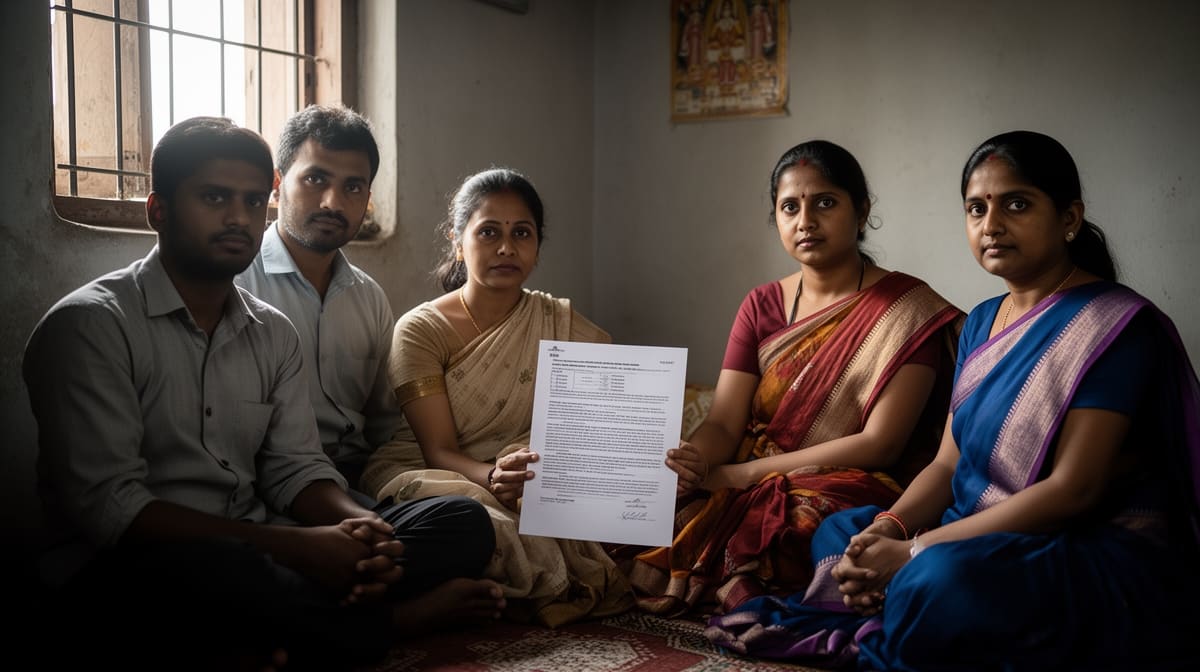
The Punjab and Haryana High Court has significantly expanded the scope of compensation in motor accident claims by recognizing that married children, regardless of their marital status or economic independence, are entitled to damages for loss of consortium due to the death of a parent. This ruling redefines dependency beyond financial support to include emotional, psychological, and gratuitous service-based bonds under Indian familial norms.
Background & Facts
The Dispute
The appellants, legal heirs of Ram Chandra Paswan @ Ram Chaudhary, filed an appeal seeking enhancement of compensation awarded by the Motor Accident Claims Tribunal following the deceased’s death in a motor vehicle accident on 19.09.2016. The accident occurred when the bus bearing registration No. PB-10FF-5241, driven by respondent No. 3-Gurjant Singh, collided with the deceased’s vehicle. The Tribunal found the driver negligent and held the owner of the bus (respondent No. 1) and its insurer (respondent No. 4) liable.
Key Facts
- The deceased, Ram Chandra Paswan @ Ram Chaudhary, was 56 years old at the time of death on 19.09.2016
- He was employed at Shri Ram Flour Mill, Jagraon, though income proof was lacking
- The appellants include his widow (Claimant No. 1) and seven children: four married sons (Claimants No. 2 - 5) and three unmarried children (Claimants No. 6 - 8)
- The Tribunal initially assessed the deceased’s monthly income at Rs. 5,000, applying a 1/4th deduction for personal expenses
- Only Claimants No. 1, 6, 7, and 8 were held entitled to compensation; married children (No. 2 - 5) were excluded
- Total compensation awarded: Rs. 4,25,000 (Rs. 4,05,000 for loss of dependency + Rs. 20,000 for funeral and affection-related expenses)
Procedural History
- 19.09.2016: Motor accident resulting in death of Ram Chandra Paswan
- 21.04.2017: Motor Accident Claims Tribunal awards Rs. 4,25,000 compensation
- 15.12.2018: Appeal filed before the High Court (FAO-3566-2018)
- 16.03.2026: Hearing concluded; judgment delivered
- 16.03.2026: Application for condonation of delay (CM-12443-CII-2018) allowed; 86-day delay condoned
The Parties' Positions
For the Appellants: Argued that the Tribunal erred in excluding married children from compensation, undervaluing income, applying excessive deduction for personal expenses, and underawarding loss of consortium and funeral expenses. Relied on National Insurance Co. Ltd. v. Birender and Sarla Verma v. DTC.
For the Respondents: Accepted notice but did not contest the legal principles raised. No substantive counter-arguments presented against the legal precedents cited.
Relief Sought
- Enhancement of compensation to reflect true income and dependency
- Inclusion of all eight claimants, including married children
- Increase in loss of consortium award to Rs. 48,400 per claimant
- Increase in funeral and loss of estate compensation to Rs. 18,150 each
- Interest at 6% per annum from date of appeal filing
The Legal Issue
The central question was whether married children are entitled to compensation for loss of consortium upon the death of a parent under the Motor Vehicles Act, and whether the Tribunal erred in applying a 1/4th deduction for personal expenses and undervaluing the deceased’s income.
Arguments Presented
For the Appellant
The appellants relied on National Insurance Company Limited v. Birender (2020) 11 SCC 356, which held that marital status alone cannot disqualify children from claiming compensation. They argued that dependency in Indian families extends beyond financial support to include emotional, psychological, and domestic services. They further cited Sarla Verma v. Delhi Transport Corporation (2009) 3 RCR (Civil) 77 to argue that a 1/5th deduction, not 1/4th, is appropriate for families with multiple dependents. They also invoked Magma General Insurance Co. Ltd. v. Nanu Ram (2018) 18 SCC 130 and National Insurance Co. Ltd. v. Pranay Sethi (2017) 4 RCR (Civil) 1009 to assert that loss of consortium must be awarded separately and at updated rates.
For the Respondent
The respondents accepted notice but did not file any written submissions or contest the legal principles cited by the appellants. The Assistant Advocate General and counsel for the insurer merely acknowledged service without opposing the legal contentions.
The Court's Analysis
The Court undertook a comprehensive review of the Tribunal’s reasoning and found multiple errors in both factual appreciation and legal application. First, the exclusion of married children was held to be legally untenable. The Court emphasized that Indian familial structures are not defined by Western notions of economic independence.
"Even though, the children may be married, still the parents shower their love and affection upon them and there is dependency of the children upon the parents, which may not be financial, many a times, but however, the same may be gratuitous service dependency, physical dependency, emotional dependency, psychological dependency, and so on and so forth, which can never be equated in terms of money."
The Court further held that National Insurance Co. Ltd. v. Birender squarely applies, and any distinction based on marital status violates the principle of equal protection under the law.
Regarding income assessment, the Court rejected the Tribunal’s valuation of Rs. 5,000 per month, noting that it fell below the minimum wage prevalent in Punjab in 2016. The Court fixed the deceased’s monthly income at Rs. 7,000, consistent with statutory minimum wage norms. A 10% addition for future prospects was applied, yielding Rs. 7,700 per month.
The Court corrected the deduction for personal expenses from 1/4th to 1/5th, as mandated by Sarla Verma, given the presence of eight dependents. This yielded a net monthly dependency of Rs. 6,160, or Rs. 73,920 annually.
On loss of consortium, the Court held that each claimant is entitled to an individual award. Citing Pranay Sethi, it enhanced the base amount from Rs. 40,000 to Rs. 48,400 per claimant, accounting for inflation over nine years since the judgment’s precedent. The total consortium award for eight claimants was Rs. 3,87,200.
For funeral and loss of estate, the Court applied the same inflation-adjusted rate of Rs. 18,150 each, as per evolving judicial standards.
The Verdict
The appeal was allowed. The Tribunal’s award of Rs. 4,25,000 was set aside. The total compensation was recalculated at Rs. 10,88,780, comprising Rs. 6,65,280 for loss of dependency, Rs. 3,87,200 for loss of consortium, Rs. 18,150 for loss of estate, and Rs. 18,150 for funeral expenses. The enhanced compensation payable to the appellants is Rs. 6,63,780 (the difference between the new total and the original award). Appellant-claimant No. 1 (widow) is entitled to Rs. 3,13,780, while claimants No. 2 to 8 are each entitled to Rs. 50,000. Interest at 6% per annum shall accrue from 15.12.2018 (date of appeal filing) until realization. The order dated 21.04.2017 is modified accordingly.
What This Means For Similar Cases
Married Children Cannot Be Excluded from Loss of Consortium Claims
- Practitioners must now argue that marital status is irrelevant in determining dependency under the Motor Vehicles Act
- Evidence of emotional or domestic dependency need not be quantified - judicial notice of Indian familial norms suffices
- Tribunals must apply National Insurance Co. Ltd. v. Birender as binding precedent
Income Must Be Assessed Against Minimum Wage Floor
- Where income proof is lacking, courts must use minimum wage as the baseline, not arbitrary low estimates
- Future prospects of 10% must be added for deceased under 58 years of age
- Deduction for personal expenses must be 1/5th for families with five or more dependents
Loss of Consortium Is an Individual Right
- Each dependent is entitled to a separate, full award for loss of consortium
- The base amount must be updated for inflation using Pranay Sethi’s 10% increment every three years
- Funeral and loss of estate amounts must be separately awarded and similarly adjusted