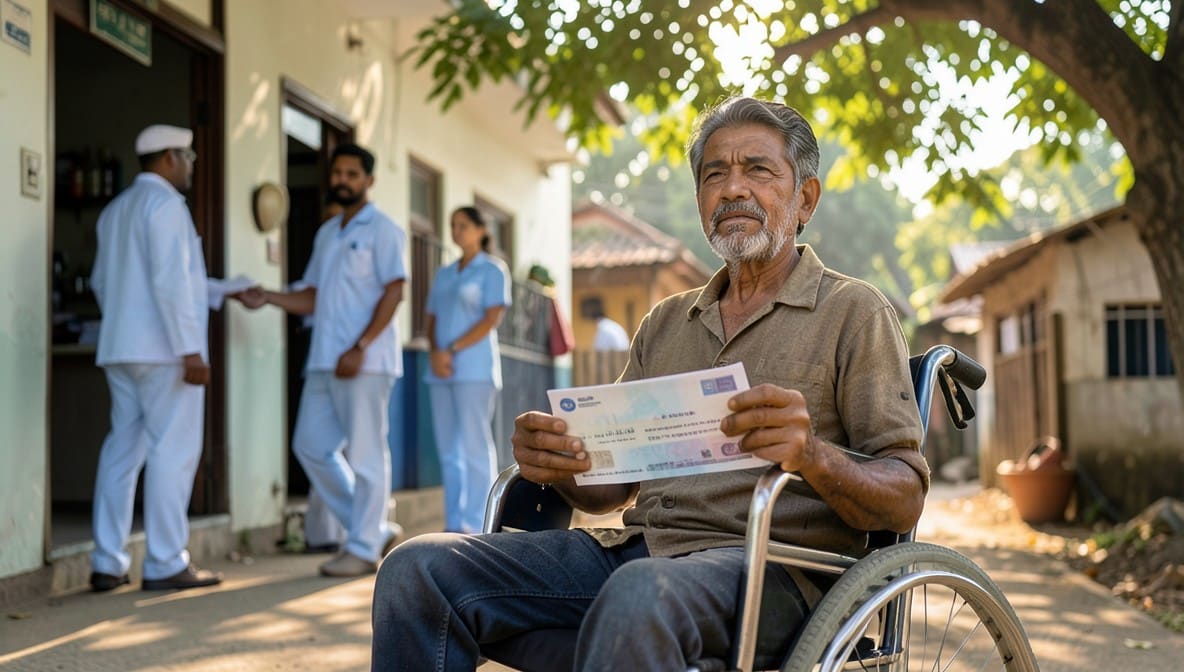
The Allahabad High Court has clarified that while depositing a portion of compensation awarded by the Railway Claims Tribunal may serve long-term interests, such discretion cannot be mechanically applied without accounting for the claimant’s immediate financial hardship. In a case involving catastrophic injury, the Court modified the Tribunal’s order to ensure timely access to a substantial portion of the award.
Background & Facts
The Dispute
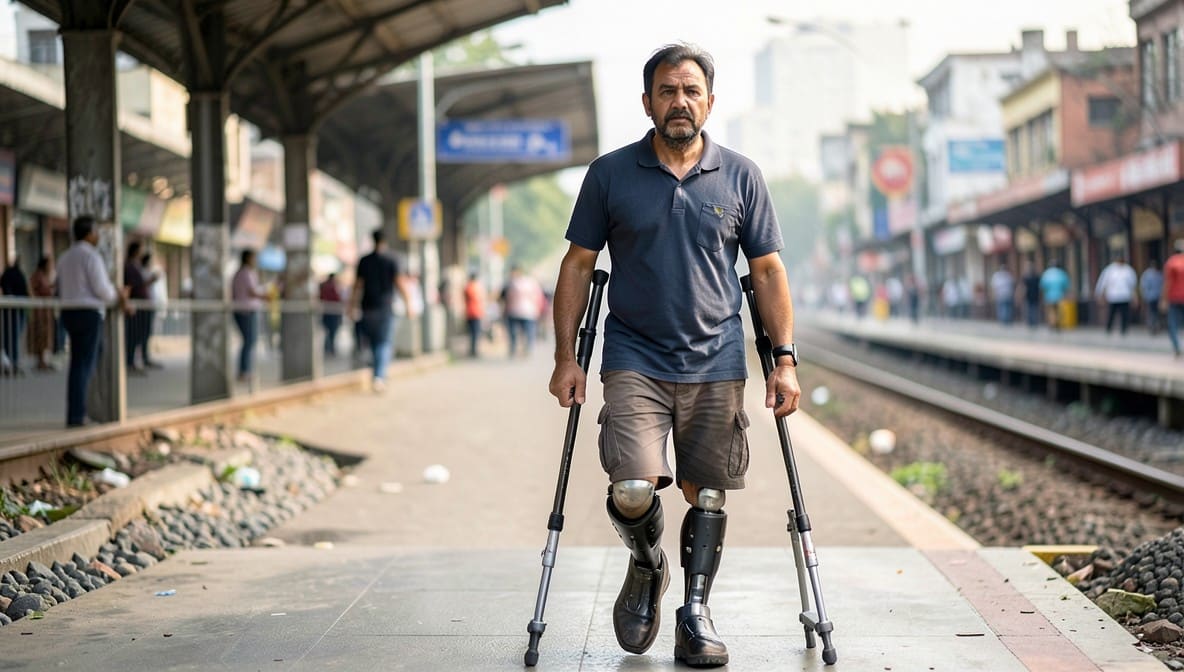
The petitioner, Mangla Prasad Bind, was travelling on an Indian Railways train from Ahimanpur Railway Station to Raja Talab Railway Station on 23.06.2017, holding a second-class general ticket (No. 35498380). While the train was in motion near Kachhwa Railway Station, a sudden jerk and overcrowding caused him to fall from the train. As a result of the fall, he sustained severe injuries leading to bilateral above-knee amputations.
Key Facts
- The petitioner was a daily wage earner with no independent source of income prior to the accident.
- He filed a claim petition under Section 16 of the Railway Claims Tribunal Act, 1987 on 20.12.2017 before the Gorakhpur Bench of the Railway Claims Tribunal.
- The matter was later transferred to the newly established Varanasi Bench and numbered as Case No. OA/Ilu/BSB/794/2024.
- The Tribunal, after recording evidence and hearing arguments, passed an award on 19.12.2025 granting compensation of Rs. 8,00,000.
- The Tribunal directed that 10% of the award (Rs. 80,000) be released immediately to the petitioner, while the remaining 90% (Rs. 7,20,000) be deposited in a fixed deposit receipt for the benefit of his legal heirs.
- The petitioner, who requires lifelong medical care, prosthetics, and rehabilitation, has no means to sustain himself on the released 10%.
- No appeal or challenge was filed by the Union of India against the award.
Procedural History
- 23.06.2017: Accident occurred during train journey.
- 20.12.2017: Claim petition filed before Gorakhpur Bench of Railway Claims Tribunal.
- 2024: Case transferred to Varanasi Bench and renumbered as OA/Ilu/BSB/794/2024.
- 19.12.2025: Railway Claims Tribunal awarded Rs. 8,00,000; directed release of 10% and deposit of 90% in fixed deposit.
- 2026: Writ Petition No. 20188 of 2026 filed before Allahabad High Court challenging the deposit of 90%.
- 26.05.2026: Hearing before Justice Vikas Budhwar; petition decided on record without additional affidavits.
Relief Sought
The petitioner sought modification of the Tribunal’s order to release the entire Rs. 8,00,000 award immediately, arguing that the 10% release is inadequate for his medical, rehabilitative, and subsistence needs.
The Legal Issue
The central question was whether the Railway Claims Tribunal may, as a matter of routine, direct deposit of 90% of a compensation award in a fixed deposit, even when the claimant is severely disabled and has no other means of support, and whether the High Court has jurisdiction to modify such an order when no appeal has been filed by the railway.
Arguments Presented
For the Petitioner
Learned counsel submitted that the petitioner, having suffered bilateral above-knee amputations, is permanently disabled and dependent on the compensation for survival. The 10% release (Rs. 80,000) is insufficient to cover prosthetic limbs, physiotherapy, home modifications, and daily living expenses. The Tribunal’s order, while ostensibly protective, effectively denies the claimant access to the bulk of the award he is legally entitled to. The petitioner has no pending litigation against the award, and the Union has not challenged it, making the deposit arbitrary and disproportionate.
For the Respondent
The counsel for the Union of India conceded that no appeal had been filed against the award and that the deposit of 90% was made in the interest of the claimant’s legal heirs. He argued that the practice of depositing a majority of compensation in fixed deposits is standard in cases involving serious injury or death, to ensure long-term financial security. He submitted that the Tribunal’s discretion should not be interfered with absent a legal error.
The Court's Analysis
The Court acknowledged the general practice of depositing a portion of compensation in fixed deposits to safeguard the claimant’s future interests, particularly in cases of death or permanent disability. However, it emphasized that such a practice cannot be applied as a rigid rule. The Court observed that the Tribunal’s discretion must be exercised with sensitivity to the claimant’s present circumstances.
"The claimant whose right arm was amputated from shoulder joint on who certain dependency may also be claimed cannot be forced to litigate for years to earn an award of compensation and then be made to wait for further years to receive that compensation owing to exercise of discretion by the Court, ostensibly in the interest of such claimant."
The Court noted that the Union had not challenged the award, indicating acceptance of liability and entitlement. The petitioner’s dire financial condition, lack of alternative income, and immediate medical needs rendered the 90% deposit unjustified. The Court held that while long-term security is legitimate, it cannot override the claimant’s right to immediate access to funds necessary for survival and rehabilitation.
The Court further clarified that the Tribunal’s order was not legally flawed but was factually disproportionate in this case. The High Court, exercising its writ jurisdiction under Article 226 of the Constitution, has the power to modify such orders where the outcome is manifestly inequitable.
The Verdict
The writ petition was allowed in part. The Court modified the Railway Claims Tribunal’s award dated 19.12.2025 as follows: 50% of the awarded amount (Rs. 4,00,000) along with proportionate interest shall be released to the petitioner within four weeks of production of the certified copy of this order. The remaining 50% (Rs. 4,00,000) shall be invested in a fixed deposit in a nationalized bank for a period of three years. Any amount already paid under the Tribunal’s order shall be adjusted against the released amount. The order is independent of the petitioner’s right to seek enhancement.
What This Means For Similar Cases
Immediate Needs Override Mechanical Deposit Rules
- Practitioners must now argue that depositing more than 50% of a compensation award in fixed deposits is prima facie unreasonable when the claimant is permanently disabled and lacks independent income.
- The burden shifts to the respondent to justify why a larger portion should be withheld, especially when no appeal is pending.
High Court Can Modify Tribunal Awards Under Article 226
- Even where no statutory appeal lies, the High Court may intervene under writ jurisdiction if the Tribunal’s order results in manifest injustice.
- This opens a new avenue for claimants in railway accident cases to seek immediate relief without waiting for appellate review.
Documentation of Financial Hardship Is Critical
- Petitioners must submit medical reports, rehabilitation cost estimates, and proof of loss of income to substantiate claims of dire need.
- Courts will now expect such evidence to be part of the record when challenging deposit orders.