In a significant order addressing the balance between cyber fraud investigation and individual financial rights, the Telangana High Court has directed banks to unfreeze a petitioner's savings accounts while retaining only the disputed transaction amounts. This judgment clarifies that blanket freezes on entire accounts are impermissible when only specific unauthorized transactions are under dispute, offering crucial guidance for victims of online financial fraud.
Background & Facts
The Dispute
The petitioner, Prashant Madhukar Suralkar, held savings accounts with State Bank of India (SBI) and HDFC Bank at their Telhara branches in Maharashtra. On 30 December 2021, his HDFC Bank account received a credit of Rs.4,000 as a reward for participating in an online game. Subsequently, he transferred Rs.1,436 from his HDFC account to his SBI account. Following these transactions, both banks froze his accounts entirely, allegedly due to suspicions of unauthorized activity.
Key Facts
- The petitioner maintained Savings Bank Account No. 32437548715 with SBI, Telhara Branch
- He also held Savings Bank Account No. 501007724027075 with HDFC Bank, Telhara Branch
- On 30.12.2021, Rs.4,000 was credited to his HDFC account as an online game reward
- The petitioner transferred Rs.1,436 from HDFC to SBI on the same day
- Both banks froze the accounts entirely, not just the disputed amounts
- The petitioner sought to operate his accounts except for the disputed Rs.4,000 and Rs.1,436
Procedural History
- 2026: The petitioner filed WP No. 13820 of 2026 before the Telangana High Court
- 29.04.2026: I.A. No. 1 of 2026 (interim application) was filed under Section 151 of the Code of Civil Procedure (CPC) seeking directions to unfreeze accounts
- The matter came up for hearing before Justice Renuka Yara
Relief Sought
The petitioner sought:
- Directions to respondent Nos. 4 and 5 (SBI and HDFC Bank) to defreeze his savings accounts
- Permission to operate the accounts without restrictions, except for the disputed amounts of Rs.4,000 and Rs.1,436
- Interim relief pending disposal of the main writ petition
The Legal Issue
The central question was whether banks, during cyber fraud investigations, can freeze entire bank accounts when only specific unauthorized transactions are under dispute, or whether they must restrict the freeze to only the disputed amounts under principles of proportionality and natural justice.
Arguments Presented
For the Petitioner
- The petitioner contended that freezing entire accounts for disputed amounts of Rs.4,000 and Rs.1,436 was disproportionate and unjust
- He argued that he should be permitted to operate his accounts for legitimate transactions while cooperating with the investigation
- The freeze caused undue hardship, preventing access to his own funds for essential expenses
- Reliance was placed on principles of natural justice and proportionality in financial regulations
For the Respondents
(Note: The judgment does not record detailed arguments from the respondents, including the banks or the State. The Court proceeded based on the petitioner's submissions and the facts presented.)
The Court's Analysis
The Court examined the petitioner's request in light of Section 151 CPC, which empowers courts to pass orders necessary for the ends of justice or to prevent abuse of process. While the judgment does not engage in extensive legal reasoning, it implicitly applies the following principles:
-
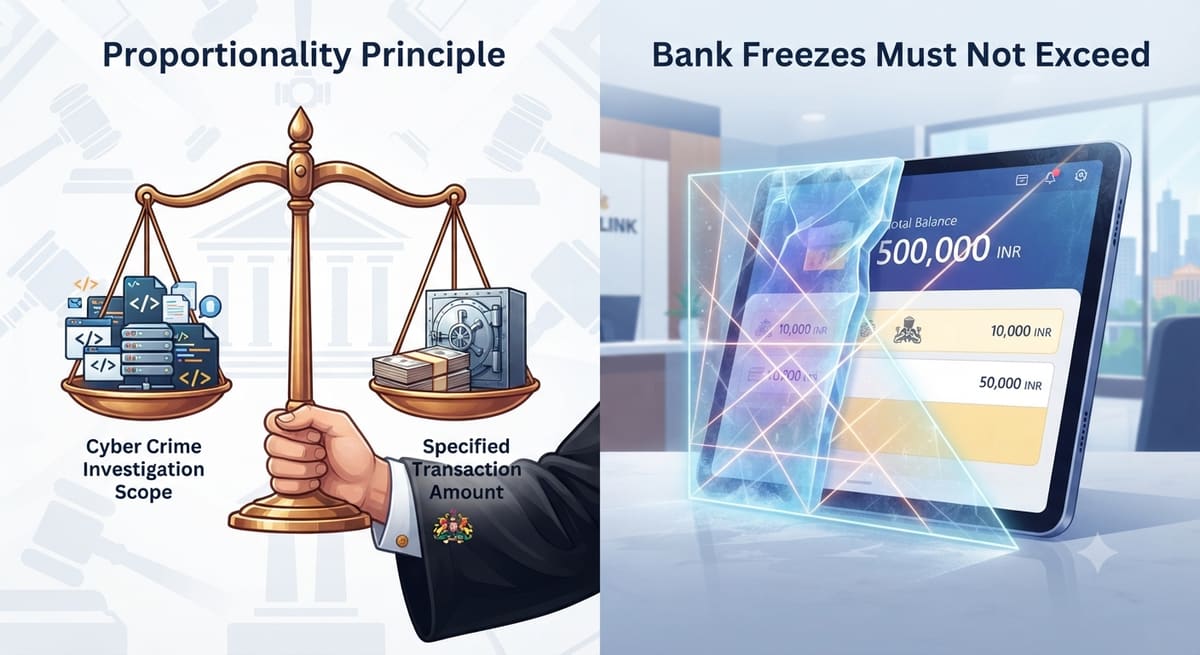
Proportionality: The Court recognized that blanket freezes on entire accounts are disproportionate when only specific transactions are disputed. The direction to unfreeze accounts except for the disputed amounts reflects this principle.
-
Victim Rights: The order underscores that victims of cyber fraud should not be penalized beyond the scope of the disputed transaction. Freezing entire accounts could deprive individuals of access to legitimate funds, causing financial hardship.
-
Banking Regulations: While banks have a duty to prevent unauthorized transactions, this duty must be balanced against the rights of account holders. The Court's direction implies that banks must act judiciously and avoid overreach in freezing accounts.
"In view of the facts and circumstances, respondent Nos. 4 and 5 are directed to unfreeze the petitioner's account, barring the amount involved in unauthorized transactions i.e., Rs.4,000/- and Rs.1,436/-."
The Court's order is brief but significant, as it sets a precedent for how banks and courts should handle account freezes in cases of suspected cyber fraud. It emphasizes that only the disputed amounts can be withheld, not the entire account balance.
The Verdict
The Court allowed the interim application and directed:
- Respondent Nos. 4 and 5 (SBI and HDFC Bank) to unfreeze the petitioner's savings accounts
- The banks were permitted to retain only the disputed amounts of Rs.4,000 and Rs.1,436
- The petitioner was granted permission to operate his accounts for all other transactions
- The order was passed pending disposal of the main writ petition (WP No. 13820 of 2026)
What This Means For Similar Cases
Banks Must Exercise Proportionality in Freezing Accounts
- Blanket freezes are impermissible: Banks cannot freeze entire accounts when only specific transactions are under dispute. The freeze must be limited to the disputed amounts.
- Victim cooperation: Account holders must be permitted to access legitimate funds while investigations are ongoing. This balances fraud prevention with individual rights.
- Legal recourse: Victims of disproportionate freezes can approach courts under Section 151 CPC for interim relief, as demonstrated in this case.
Cyber Fraud Investigations Must Respect Natural Justice
- Due process: Banks and law enforcement agencies must follow due process before freezing accounts. Arbitrary actions can lead to legal challenges.
- Transparency: Banks should communicate clearly with account holders about the reasons for freezes and the scope of restrictions.
- Timely resolution: Prolonged freezes without resolution can violate account holders' rights, and courts may intervene to expedite investigations.
Practical Implications for Account Holders
- Document transactions: Account holders should maintain records of all transactions, especially those involving rewards, gifts, or third-party credits, to dispute unauthorized freezes.
- Seek legal remedies: If banks freeze accounts disproportionately, account holders can file interim applications under Section 151 CPC for relief.
- Cooperate with investigations: While seeking relief, account holders should cooperate with banks and cyber crime cells to resolve disputes expeditiously.
This judgment serves as a critical reminder that while banks must prevent fraud, they cannot infringe on account holders' rights through overbroad measures. Courts will intervene to ensure fairness in cyber fraud investigations.