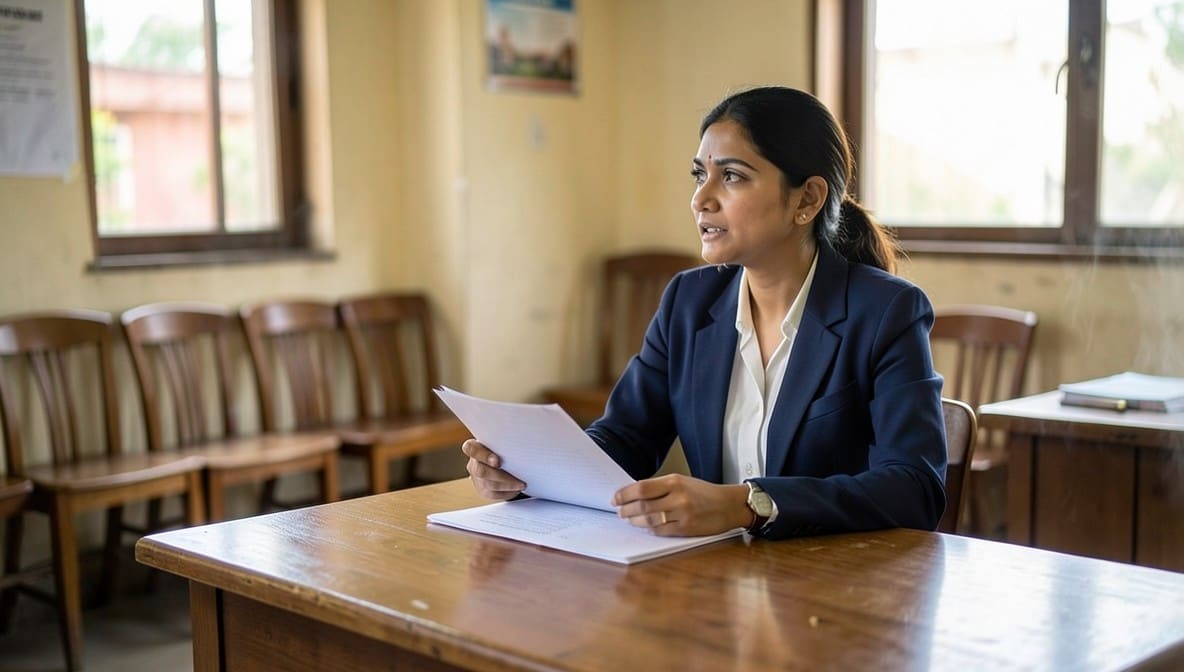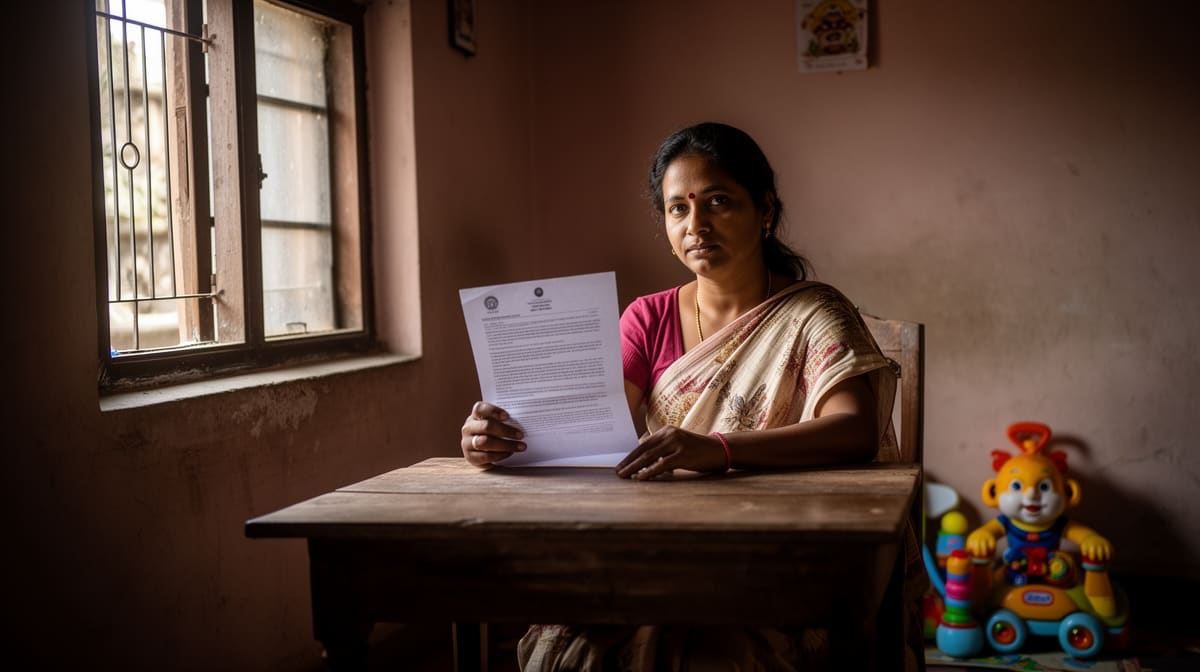
The Madhya Pradesh High Court has clarified that failure by a respondent to cross-examine witnesses or present rebuttal evidence in proceedings under Section 144 of the Bharatiya Nagarik Suraksha Sanhita, 2023, cannot justify dismissal of an application for maintenance or protection on grounds of procedural technicality. This ruling reinforces the principle that substantive justice must prevail over formalistic requirements in domestic violence matters.
Background & Facts
The Dispute
The petitioner, Smt. Mamta Chauhan, filed an application under Section 144 of the Bharatiya Nagarik Suraksha Sanhita, 2023 (BNSS), before the Family Court, Bhopal, seeking protection from domestic cruelty and maintenance. She alleged that her husband, the respondent Aman Chauhan, subjected her to mental and emotional abuse through repeated demands for dowry, verbal harassment, and refusal to provide basic necessities. She claimed to have been living separately from the respondent since early 2023 due to this sustained cruelty.
Key Facts
- The petitioner filed the application on 15.08.2024 (MJCR No. 1254/2024)
- She appeared as AW-1 and testified about the cruelty, dowry demands, and her separation from the respondent
- Her father, Ramsharik, appeared as AW-2 and corroborated her account of the marital discord and her departure from the matrimonial home
- The respondent filed a reply to the application but did not appear for the hearing on 14.02.2026
- No cross-examination of AW-1 or AW-2 was conducted by the respondent
- No rebuttal evidence was adduced by the respondent
- The Family Court dismissed the application on 14.02.2026, holding that the petitioner had not filed a written complaint with the police
Procedural History
- 15.08.2024: Application filed under Section 144 BNSS before Family Court, Bhopal (MJCR No. 1254/2024)
- 14.02.2026: Family Court dismissed the application for want of police complaint, despite unchallenged testimony
- 21.03.2026: Criminal Revision No. 1525/2026 filed before the High Court of Madhya Pradesh, Jabalpur
- 21.04.2026: Hearing concluded before Justice Dwarka Dhish Bansal
Relief Sought
The petitioner sought setting aside of the Family Court’s order dated 14.02.2026 and direction to the Family Court to decide the application under Section 144 BNSS afresh, based on the unchallenged evidence presented.
The Legal Issue
The central question was whether the Family Court could dismiss an application under Section 144 of the BNSS solely on the ground of absence of a written police complaint, when the petitioner’s testimony and that of a corroborating witness remained unchallenged and no rebuttal evidence was offered by the respondent.
Arguments Presented
For the Petitioner
Learned counsel for the petitioner relied on Sunita Kachwaha v. Anil Kachwaha (2014) 16 SCC 715, arguing that the requirement of a police complaint is not a precondition for maintaining an application under Section 144 BNSS. He emphasized that the petitioner’s oral testimony, supported by her father, was credible and uncontradicted. The failure of the respondent to cross-examine or present rebuttal evidence, he submitted, amounted to a waiver of the right to challenge the evidence, and the Family Court erred in ignoring the settled principle that unchallenged evidence must be accepted as true.
For the Respondent
The respondent did not appear before the High Court and did not file any written submissions. His absence during the Family Court proceedings and failure to cross-examine witnesses constituted a waiver of his right to contest the evidence.
The Court's Analysis
The Court observed that the respondent, despite filing a reply, deliberately chose not to appear for the hearing and did not cross-examine either of the two witnesses examined by the petitioner. The Family Court’s dismissal of the application on the sole ground of absence of a police complaint was found to be legally unsustainable.
"Since the respondent did not even cross examine the aforesaid two witnesses and did not adduce any evidence in rebuttal, therefore, the Family Court ought to have considered the case of the petitioner in the light of decision of Hon'ble Supreme Court in the case of Vidhyadhar vs. Manikrao and another, (1999) 3 SCC 573."
The Court cited Vidhyadhar v. Manikrao to affirm that when a party fails to cross-examine witnesses or present contrary evidence, the testimony of the opposing party must be accepted as true in the absence of any reason to doubt its credibility. The Court held that the Family Court’s reliance on the absence of a police complaint was misplaced, as Section 144 BNSS does not mandate such a complaint as a condition precedent. The Court further noted that the purpose of Section 144 is to provide immediate relief in cases of domestic cruelty, and procedural rigidity cannot defeat substantive justice.
The Verdict
The High Court set aside the Family Court’s order dated 14.02.2026 and remanded the matter for fresh adjudication under Section 144 BNSS. The Family Court was directed to restore the application to its original number, issue fresh summons to the respondent to secure his presence, and decide the matter afresh without being influenced by the impugned order. The Court emphasized that the unchallenged testimony of the petitioner and her father must be given due weight in the fresh proceedings.
What This Means For Similar Cases
Unchallenged Testimony Must Be Accepted
- Practitioners must argue that failure to cross-examine or rebut testimony constitutes an admission of its truth under Section 144 BNSS
- Courts cannot dismiss applications on technical grounds like absence of police complaint when evidence is unchallenged
- The burden shifts to the respondent to actively contest evidence; silence or absence cannot be used to penalize the petitioner
Procedural Flexibility in Domestic Violence Matters
- Section 144 BNSS is a remedial provision meant for swift relief; rigid adherence to procedural formalities undermines its purpose
- Oral testimony supported by a corroborative witness is sufficient to establish a prima facie case
- Family Courts must prioritize substance over form, especially when the respondent is absent or uncooperative
Strategic Implications for Advocates
- In cases where the respondent is absent, file an application under Section 144 BNSS with detailed affidavits and witness statements
- Highlight the absence of cross-examination and rebuttal evidence in written submissions
- Cite Vidhyadhar v. Manikrao and Sunita Kachwaha to reinforce that police complaints are not mandatory
- Seek remand rather than direct relief, as appellate courts are reluctant to decide factual matters de novo