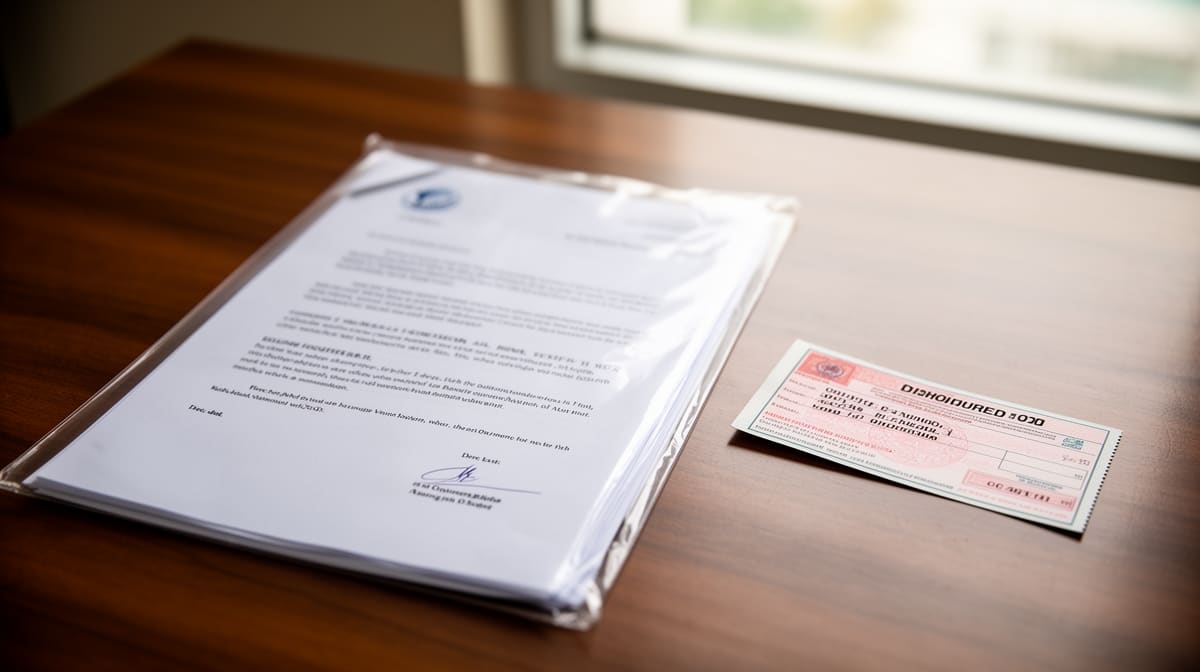
The Bombay High Court has reaffirmed that a cheque issued as a refund for unreturned consideration under a subsisting sale agreement, when dishonoured for insufficient funds, constitutes a legally enforceable debt under Section 138 of the Negotiable Instruments Act. The judgment underscores the weight of statutory presumptions and the burden on the accused to rebut them with credible evidence.
Background & Facts
The Dispute
The dispute arose from a sale agreement dated 24.05.2016 between the Applicant (Accused) and Respondent No.1 (Complainant) for the sale of a double bedroom flat measuring 106.12 sq.mtrs. in Survey No.407/2, Village Ambrina, Socorro, Bardez-Goa. The Complainant paid Rs.20,00,000/- as part payment towards the sale consideration, with the balance of Rs.10,00,000/- to be paid upon handover of possession.
Key Facts
- The Agreement for Sale stipulated that possession of the flat was to be handed over by the Applicant on or before 30.06.2016.
- The Applicant failed to deliver possession by the stipulated date despite repeated demands.
- On 13.07.2017, the Applicant issued a cheque drawn on RBL Bank Ltd., Porvorim Branch, for Rs.20,00,000/- in favour of the Complainant.
- The cheque was presented for encashment and returned on 17.07.2017 with the remark "funds insufficient".
- The Complainant issued a statutory demand notice dated 19.07.2017, demanding payment within 15 days.
- The Applicant did not respond to the notice or make any payment.
- The Complainant filed a criminal complaint under Section 138 of the Negotiable Instruments Act on 25.07.2017.
- The Applicant never denied his signature on the cheque.
- The Applicant did not produce any evidence to substantiate his claim that the cheque was forcibly taken.
Procedural History
- 24.05.2016: Agreement for Sale executed.
- 30.06.2016: Deadline for possession handover expired.
- 13.07.2017: Cheque issued by Applicant.
- 17.07.2017: Cheque dishonoured by bank.
- 19.07.2017: Statutory demand notice issued.
- 25.07.2017: Criminal complaint filed before IIIrd Additional JMFC, Margao.
- 30.11.2021: IIIrd Additional JMFC, Margao convicted the Applicant under Section 138 NI Act; ordered payment of Rs.21,40,000/- (Rs.19,40,000/- as compensation + Rs.2,00,000/- additional compensation) and in default, 3 months simple imprisonment.
- 08.06.2022: Additional Sessions Judge, South Goa, dismissed Criminal Appeal No.51/2021, upholding conviction.
- 17.04.2026: Criminal Revision Application No.7/2023 dismissed by Bombay High Court.
The Parties' Positions
For the Applicant (Petitioner)
- Argued that the Agreement for Sale was still valid and subsisting.
- Claimed the cheque was forcibly taken by the Complainant when the flat was ready for handover.
- Asserted that no liability existed because the Complainant had not paid the balance Rs.10,00,000/-.
- Contended that the statutory presumptions under Sections 118 and 139 NI Act were rebutted.
For the Respondent (Complainant)
- Maintained that the Applicant breached the Agreement by failing to deliver possession.
- Stated the cheque was issued as a refund of the Rs.20,00,000/- already paid.
- Emphasized that the Applicant never disputed his signature on the cheque.
- Highlighted that the Applicant failed to reply to the statutory notice.
- Argued that the defence of forcible taking was unsupported by evidence and inconsistent with conduct.
Relief Sought
The Applicant sought quashing of the conviction and sentence under Section 138 NI Act, setting aside the order of the JMFC and Sessions Court, and release from liability to pay compensation or undergo imprisonment.
The Legal Issue
The central question was whether a cheque issued as a refund for unreturned sale consideration, following breach of a sale agreement, constitutes a legally enforceable debt under Section 138 of the Negotiable Instruments Act, and whether the statutory presumptions under Sections 118 and 139 can be rebutted by an unsubstantiated claim of forcible taking.
Arguments Presented
For the Appellant/Petitioner
The Applicant relied on the validity of the Agreement for Sale to argue that no debt arose because the Complainant had not fulfilled his obligation to pay the balance Rs.10,00,000/-. He claimed the cheque was taken by force and not issued voluntarily, thereby negating the presumption of liability under Section 139. He further contended that the absence of a cancellation notice rendered the cheque non-representative of any enforceable obligation. He cited no evidence to support the claim of forcible taking and did not challenge the authenticity of his signature.
For the Respondent/State
The Complainant argued that the cheque was issued as a refund for the Rs.20,00,000/- paid, following the Applicant’s failure to perform under the Agreement. He emphasized that the Applicant admitted to issuing the cheque and never denied his signature. The failure to reply to the statutory notice, coupled with the absence of any corroborative evidence for the forcible taking claim, rendered the defence legally insufficient. He relied on Rangappa v. Mohan and Santan Financers to establish that once signature is admitted, the burden shifts to the accused to rebut the presumption of liability.
The Court's Analysis
The Court began by recalling the settled principle that revisional jurisdiction under Section 397 CrPC is not an appellate forum and cannot be used to reappreciate evidence unless the findings are perverse or suffer from a manifest error of law. The Court cited State of Gujarat v. Afrose Mohammed Hasanfatta, Munna Devi v. State of Rajasthan, and State v. R. Soundirarasu to affirm that concurrent findings of two courts merit high deference.
The Court noted that the Applicant did not dispute his signature on the cheque, nor did he deny its issuance to the Complainant. Under Section 139 of the Negotiable Instruments Act, a presumption arises that the cheque was issued for the discharge of a legally enforceable debt or liability. The Court held that the Applicant’s defence - that the cheque was forcibly taken - was not only unsupported by any evidence but also inconsistent with his conduct. Had the cheque been taken by force, a prudent person would have immediately responded to the statutory notice or lodged a police complaint.
"In the light of these facts, learned JMFC has observed that the defence of the Applicant does not meet the standard of preponderance of probability. Moreover, the statutory notice was not replied by the Respondent No.1. Applying the test of a prudent person, if it were the case of the Applicant that the cheque was forcibly taken away from him, then he ought to have replied to the statutory notice at the very outset setting up his case."
The Court further observed that the cheque was issued after the breach of contract and clearly functioned as a refund mechanism. The Complainant had already paid Rs.20,00,000/- and was entitled to its return upon non-performance. The dishonour of the cheque thus established a prima facie case of liability. The Applicant’s failure to rebut the statutory presumptions under Sections 118 and 139 rendered the conviction legally sustainable.
Regarding sentencing, the Court found the award of Rs.21,40,000/- (Rs.19,40,000/- compensation + Rs.2,00,000/- additional compensation) proportionate to the gravity of the offence and within the permissible limits under Section 138. The Court noted that the trial court had exercised discretion by avoiding imprisonment and opting for compensation, which was appropriate.
The Verdict
The Criminal Revision Application was dismissed. The conviction and sentence under Section 138 of the Negotiable Instruments Act were upheld. The Applicant is directed to pay Rs.21,40,000/- to the Complainant as compensation, with the additional compensation of Rs.2,00,000/- included. In default of payment, the Applicant shall undergo simple imprisonment for three months. The suspension of sentence previously granted is set aside. The Applicant’s deposits of Rs.6,00,000/- made before the trial and High Court shall be disbursed to the Complainant. Execution of the sentence is permitted, subject to a four-week stay granted for filing a petition in the Supreme Court.
What This Means For Similar Cases
Statutory Presumptions Are Not Easily Rebutted
- Practitioners must advise clients that mere allegations of coercion or forcible taking, without corroboration or contemporaneous complaint, will not rebut the presumption under Section 139 NI Act.
- Silence in response to a statutory notice is fatal to a defence under Section 138.
Cheques as Refunds Are Covered Under Section 138
- A cheque issued to refund an advance payment following breach of contract qualifies as a legally enforceable debt.
- The existence of a subsisting contract does not negate liability under Section 138 if the cheque is issued to discharge a financial obligation arising from the breach.
Conduct Matters More Than Claims
- Courts will assess credibility based on conduct: failure to respond to notice, failure to report coercion to police, and failure to challenge signature all weigh heavily against the accused.
- Defence strategies must be evidence-based; speculative assertions will not suffice.