The Bombay High Court has reaffirmed that a cheque dishonoured due to 'Account Blocked' can constitute an offence under Section 138 of the Negotiable Instruments Act, provided the complainant establishes a prima facie case of insufficient funds at the time of presentation. This judgment clarifies the scope of dishonour under the Act and reinforces the burden on the drawer to rebut the statutory presumption.
Background & Facts
The Dispute
The respondent, a Chartered Accountant, engaged the revisionist, a businessperson, for professional financial services including audit, income tax return filing, and digital signature certification. The parties agreed on professional fees of Rs. 2,50,000. To secure payment, the revisionist handed over a signed blank cheque bearing Cheque No. 036302 dated 06.12.2016 drawn on Punjab National Bank. The respondent later filled in the amount, date, and payee details and presented the cheque for encashment.
Key Facts
- The revisionist admitted to signing the cheque but claimed it was given as security, not for immediate payment.
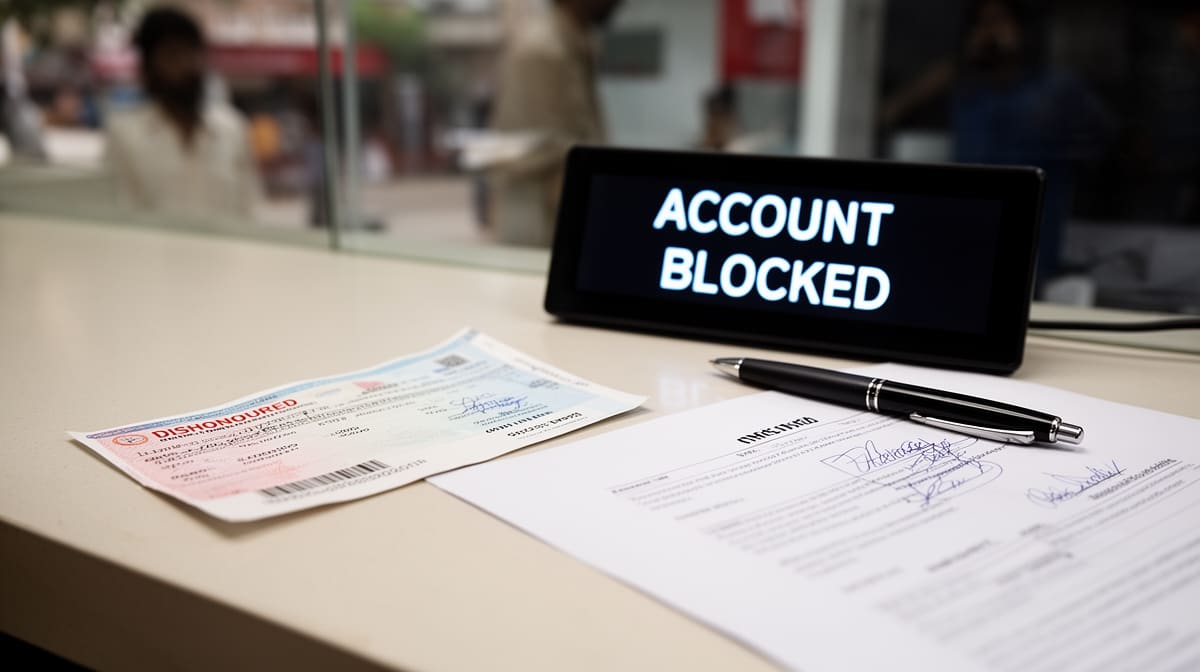
- The cheque was presented on 07.12.2016 and dishonoured on 08.12.2016 with the bank’s remark: "Account Blocked".
- The respondent claimed outstanding dues of Rs. 2,81,000, of which Rs. 2,50,000 was the agreed fee.
- The respondent produced documentary evidence: Exhibits 48 and 49 (income tax filings and 3CB/3CD forms), and Exhibit 50 (balance sheet showing sundry debtors).
- The revisionist did not dispute the authenticity of these documents or deny the professional relationship.
- The respondent issued a statutory legal notice dated 19.12.2016 via registered post, received by the revisionist on 21.12.2016.
- No payment was made within 15 days of notice, prompting the filing of S.C.C. No. 536 of 2017.
Procedural History
- 06.12.2016: Cheque issued and later presented for payment.
- 08.12.2016: Cheque dishonoured by bank with remark "Account Blocked".
- 19.12.2016: Statutory legal notice issued.
- 21.12.2016: Notice received by revisionist.
- 11.01.2022: J.M.F.C., Aurangabad convicted revisionist under Section 138 NI Act, sentenced to pay Rs. 4,72,000 as fine, with Rs. 3,43,972 as compensation.
- 10.10.2025: Sessions Judge, Aurangabad dismissed Criminal Appeal No. 9 of 2022, upholding conviction.
- 16.03.2026: Bombay High Court dismissed Criminal Revision Application No. 333 of 2025.
The Parties' Positions
For the Revisionist (Appellant)
- Argued the cheque was a security instrument, not for discharge of an existing debt.
- Claimed the cheque was blank and its contents were filled by the complainant, constituting misuse.
- Contended that "Account Blocked" is not a recognised ground for dishonour under Section 138.
- Asserted that the complainant failed to prove the existence of a legally enforceable debt beyond reasonable doubt.
- Highlighted the complainant’s inability to recall the exact date of cheque issuance or discussion.
For the Respondent (Complainant)
- Maintained that the cheque was issued for payment of professional fees, which were due and payable.
- Submitted that the documents (Exhibits 48, 49, 50) substantiated the services rendered and the outstanding amount.
- Argued that the revisionist failed to rebut the presumption under Section 138.
- Stated that the revisionist did not contest the documents or raise the "Account Blocked" defence before the trial or appellate court.
Relief Sought
The revisionist sought quashing of the conviction and sentence, arguing that the proceedings were legally unsustainable due to absence of a legally enforceable debt, misuse of a blank cheque, and non-applicability of Section 138 where the bank’s remark was "Account Blocked".
The Legal Issue
The central question was whether dishonour of a cheque due to "Account Blocked" constitutes an offence under Section 138 of the Negotiable Instruments Act, when the complainant establishes a prima facie case that the drawer had insufficient funds at the time of presentation, and whether the statutory presumption under Section 138 can be rebutted by mere assertion that the cheque was given as security.
Arguments Presented
For the Appellant/Petitioner
The revisionist relied on M/s. ND Developers Private Ltd. v. Ritesh Raushan and Standard Chartered Bank v. State of Maharashtra to argue that "Account Blocked" is not a recognised ground for dishonour under Section 138. He contended that the cheque was a security instrument, and since the complainant filled in the details, it was an act of misuse. He further argued that the complainant’s vague testimony on dates and the discrepancy between the claimed debt (Rs. 2,81,000) and the cheque amount (Rs. 2,50,000) created reasonable doubt. He asserted that the burden of proof under Section 138 had been discharged by showing the cheque was not for immediate payment.
For the Respondent/State
The respondent relied on Challani Rank Jewellery v. Ashok Kumar Jain and Laxmi Dyechem v. State of Gujarat to argue that "Account Blocked" is a species of the genus "insufficient funds" under Section 138. He submitted that the revisionist failed to produce any evidence to rebut the presumption of liability, and that the documents proving professional services were unchallenged. He emphasized that the revisionist’s silence before the lower courts on the "Account Blocked" issue precluded raising it for the first time in revision.
The Court's Analysis
The Court began by recalling the limited scope of revision under Section 397 CrPC, as articulated in Amit Kapoor v. Ramesh Chander: revision is not a forum for reappreciating evidence but for correcting patent errors, perversity, or illegality.
The Court noted that the revisionist admitted signing the cheque and did not dispute the professional relationship or the documents proving services rendered. The complainant’s evidence, including income tax filings and balance sheets, established a prima facie debt. The Court held that the revisionist’s claim that the cheque was given as security was unsupported by any contemporaneous documentation or testimony.
"If cheque is duly signed by the drawer, it is immaterial as to who fills up the remaining contents of the cheque."
The Court relied on Bir Singh v. Mukesh Kumar to reject the argument of misuse of a blank cheque, holding that the drawer’s signature alone triggers the presumption under Section 138.
Regarding the "Account Blocked" remark, the Court examined Laxmi Dyechem v. State of Gujarat and Challani Rank Jewellery, concluding that such a remark, when accompanied by evidence of insufficient funds, falls within the genus of dishonour contemplated under Section 138. The Court observed:
"The genus of the crime is any one of the contingencies envisaged under Sec. 138 of NI Act. If the complaint discloses that dehors of account block or account freeze and even otherwise, the cheque could not have been passed due to want of fund in the account, the drawer of the cheque cannot take umbrage under the fact that his account is blocked or frozen."
The Court further noted that the revisionist had not raised the "Account Blocked" defence before the trial or appellate court, nor produced any bank official or evidence to substantiate his claim. The failure to rebut the statutory presumption, coupled with the unchallenged documentary evidence, rendered the conviction sustainable.
The Verdict
The revisionist’s appeal was dismissed. The Bombay High Court upheld the conviction under Section 138 of the NI Act, affirming the fine of Rs. 4,72,000 and compensation of Rs. 3,43,972 payable to the complainant. The Court granted a stay on the implementation of the order for six weeks to enable the revisionist to approach the Supreme Court.
What This Means For Similar Cases
Dishonour Due to "Account Blocked" Is Not a Defence If Funds Were Insufficient
- Practitioners must now argue that "Account Blocked" is not a standalone defence under Section 138 if the complainant proves the account lacked sufficient funds at the time of presentation.
- The burden shifts to the drawer to prove that the account had adequate funds despite the block, which is rarely feasible.
Blank Signed Cheques Are Not a Shield Against Liability
- A signed blank cheque, even if filled by the payee, triggers the presumption under Section 138.
- Mere assertion that the cheque was given as security is insufficient; corroborative evidence is mandatory.
Failure to Raise Defence Below Bars Reliance in Revision
- Defences not raised before trial or appellate courts cannot be introduced for the first time in revision.
- Courts will not entertain belated technical objections that could have been addressed earlier.
Documentary Evidence Trumps Vague Oral Testimony
- Where documents like tax filings, balance sheets, and service records are unchallenged, courts will rely on them to establish the existence of a legally enforceable debt.
- Vagueness in the complainant’s testimony on dates does not automatically invalidate the case if documentary proof exists.
The Statutory Presumption Is Powerful - And Easily Triggered
- The moment a signed cheque is produced and dishonoured, the presumption of liability arises.
- The drawer must present credible, specific evidence to rebut it - mere denial or speculation will not suffice.