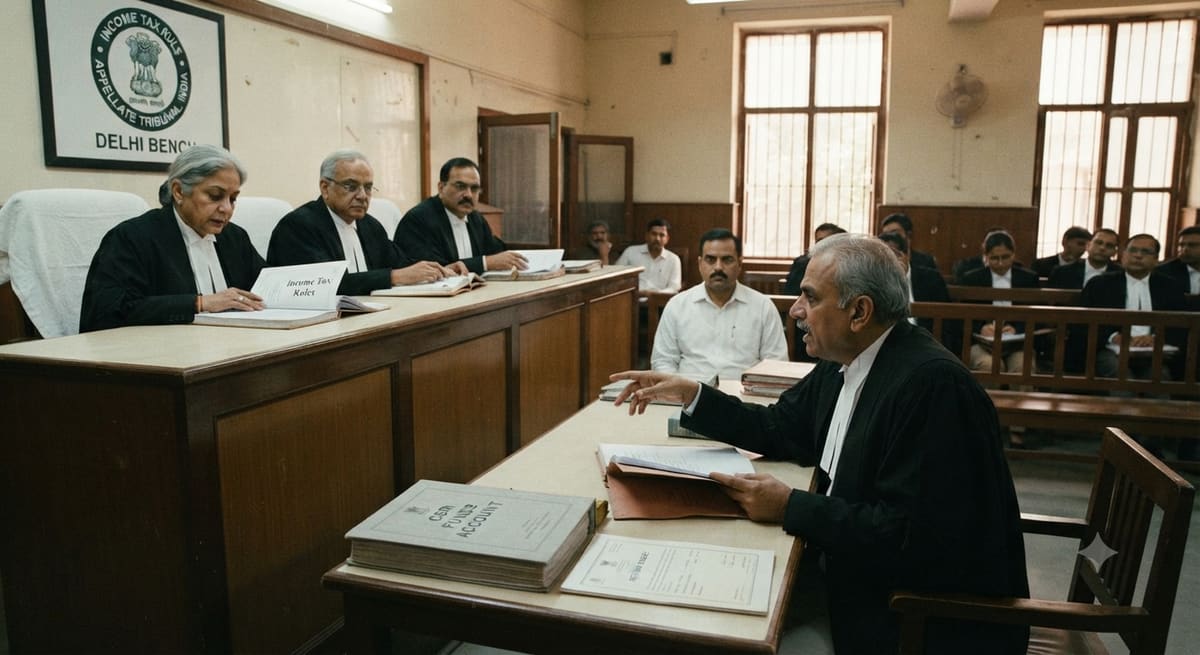
The Income Tax Appellate Tribunal, Delhi, has clarified that the mere refund of excess corporate social responsibility (CSR) funds to a donor does not automatically trigger disallowance of charitable trust exemptions under Section 13(1)(c)(ii) of the Income Tax Act, 1961, if no benefit accrues to the donor. This ruling reinforces the principle that substance must prevail over form in charitable transactions.
Background & Facts
The Dispute
The Rishab Kumar Lohia Memorial Trust (assessee), a registered charitable trust, received Rs.2.28 crores from M/s Lohia Corp. Limited during the financial year 2022-23 as CSR funding for charitable activities. Subsequently, the assessee returned Rs.33 lakhs to M/s Lohia Corp. Limited, explaining that the amount was erroneously transferred due to an administrative oversight. The funds were immediately redirected to another registered charitable organization engaged in rural education, as originally intended by M/s Lohia Corp. The Assessing Officer (AO) treated this refund as a violation of Section 13(1)(c)(ii) and disallowed the entire Rs.2.28 crores as taxable income, instead of only the Rs.33 lakhs.
Key Facts
The assessee received Rs.2.28 crores from M/s Lohia Corp. Limited on 15.01.2023 as CSR donation
M/s Lohia Corp. Limited is a company with a PAN and is a "specified person" under Section 13(3)(b) as the donation exceeded Rs.50,000
The assessee identified a second charitable organization for rural education on 20.01.2023
On 28.02.2023, the assessee initiated a refund of Rs.33 lakhs to M/s Lohia Corp. via bank transfer (NEFT)
On 01.03.2023, M/s Lohia Corp. transferred the Rs.33 lakhs to the second charitable organization
The assessee filed its return for AY 2023-24 on 30.11.2023, claiming exemption under Section 11
The AO issued notice under Section 143(2) on 10.12.2023
The AO passed order under Section 143(3) on 17.06.2025, making an addition of Rs.176.85 crores (entire receipt)
The assessee filed appeal before CIT(A) on 25.07.2025
CIT(A) passed order on 17.12.2025, deleting the addition on grounds that no benefit accrued to the donor
Procedural History
15.01.2023: Rs.2.28 crores received from M/s Lohia Corp. Limited
20.01.2023: Identification of alternate charitable entity for rural education
28.02.2023: Refund of Rs.33 lakhs initiated via bank transfer
01.03.2023: Rs.33 lakhs transferred by M/s Lohia Corp. to second charitable organization
30.11.2023: Income tax return filed for AY 2023-24
10.12.2023: Notice under Section 143(2) issued by AO
17.06.2025: AO’s assessment order making addition of Rs.176.85 crores
25.07.2025: Appeal filed before CIT(A)
17.12.2025: CIT(A) order deleting addition
13.07.2026: Hearing before ITAT Delhi
15.07.2026: ITAT order pronounced
Relief Sought
The Revenue sought to set aside the CIT(A)’s order and uphold the AO’s addition of Rs.176.85 crores, arguing that the refund violated Section 13(1)(c)(ii) and rendered the entire donation taxable. The assessee sought confirmation of the CIT(A)’s order, arguing that only the Rs.33 lakhs, if at all, should be subject to scrutiny, and that no benefit accrued to the donor.
The Legal Issue
The central question was whether the refund of Rs.33 lakhs to M/s Lohia Corp. Limited, a specified person under Section 13(3)(b), constitutes a "direct or indirect benefit" under Section 13(1)(c)(ii) of the Income Tax Act, thereby disentitling the assessee to exemption under Section 11, and whether the entire donation receipt of Rs.2.28 crores can be taxed as a consequence.
Arguments Presented
For the Appellant/Revenue
The Revenue contended that Section 13(1)(c)(ii) prohibits any return of donation to a specified person, regardless of intent or benefit. It argued that once a donation is received, its voluntary and irrevocable character is vitiated by any refund, rendering the transaction conditional. The Revenue relied on the literal reading of Section 13(1)(c)(ii), asserting that the provision does not require proof of benefit - only the act of refund. It further argued that Section 13(2) is illustrative and not exhaustive, and that the AO was justified in treating the entire receipt as taxable under Section 11(1), since the trust failed to comply with Section 13(1)(c).
For the Respondent/Assessee
The assessee argued that the refund was purely administrative, with no benefit accruing to M/s Lohia Corp. The funds were immediately passed on to another charitable entity as originally intended. The assessee emphasized that the substance of the transaction - funding rural education - remained unchanged. It cited CIT v. Shri Ram Trust and CIT v. Sri Sathya Sai Central Trust to support the principle that technical violations without economic benefit should not override the charitable purpose. It also argued that the AO’s action of taxing the entire Rs.2.28 crores was disproportionate and legally unsustainable.
The Court's Analysis
The Tribunal examined the language of Section 13(1)(c)(ii), which prohibits a trust from giving "any direct or indirect benefit" to a specified person. It noted that the provision is designed to prevent misuse of charitable funds for private gain, not to penalize inadvertent administrative corrections. The Tribunal observed that the refund of Rs.33 lakhs was not retained by M/s Lohia Corp. but was immediately redirected to another charitable organization for the same purpose - rural education. There was no evidence of any financial gain, preferential treatment, or quid pro quo.
"It is seen that the facts themselves render the balance of convenience in favour of the assessee since there is no evidence whatsoever that there was any benefit accruing to the donor merely because an amount of Rs.33 lakhs was returned to him."
The Tribunal rejected the Revenue’s argument that the refund alone, irrespective of context, triggers disallowance. It held that Section 13(1)(c)(ii) requires a nexus between the refund and a benefit to the specified person, which was absent here. The Tribunal also distinguished this case from those involving circular transactions or sham donations, noting that the entire transaction was transparent, documented, and routed through banking channels with clear audit trails.
Regarding the AO’s addition of the entire Rs.2.28 crores, the Tribunal found no legal basis for such an extreme measure. It held that even if a violation were established, the disallowance should be limited to the amount involved - the Rs.33 lakhs - not the entire corpus. The Tribunal emphasized that the trust had otherwise complied with all conditions for exemption under Section 11, including application of income for charitable purposes.
The Verdict
The appeal of the Revenue was dismissed. The ITAT upheld the CIT(A)’s order dated 17.12.2025, confirming that the refund of Rs.33 lakhs to M/s Lohia Corp. Limited did not violate Section 13(1)(c)(ii) as no benefit accrued to the donor. The addition of Rs.176.85 crores was set aside. The assessee’s claim for exemption under Section 11 for the entire Rs.2.28 crores was upheld. The Tribunal directed that no further proceedings be initiated on this issue, and compliance with the order was to be completed within 30 days of the judgment date.
What This Means For Similar Cases
Refund Does Not Automatically Equal Benefit
Practitioners may now argue that inadvertent refunds to donors, especially when funds are immediately redirected to another charitable entity, do not trigger Section 13(1)(c)(ii) disallowance
The burden shifts to the Revenue to prove actual benefit, not merely the act of refund
Documentation proving intent and subsequent use of funds is critical
Proportionality in Disallowance
Tax authorities cannot disallow entire donations due to minor administrative errors
Disallowance must be limited to the specific amount involved, unless there is evidence of systemic abuse
The ITAT’s rejection of the Rs.176.85 crore addition sets a precedent against disproportionate assessments
Substance Over Form in CSR Transactions
Charitable trusts may rely on this judgment to defend CSR-related fund reallocations
Banking channel compliance and contemporaneous documentation strengthen the argument for legitimate intent
This ruling supports the spirit of Section 11 - promoting charitable activity - over rigid technical compliance