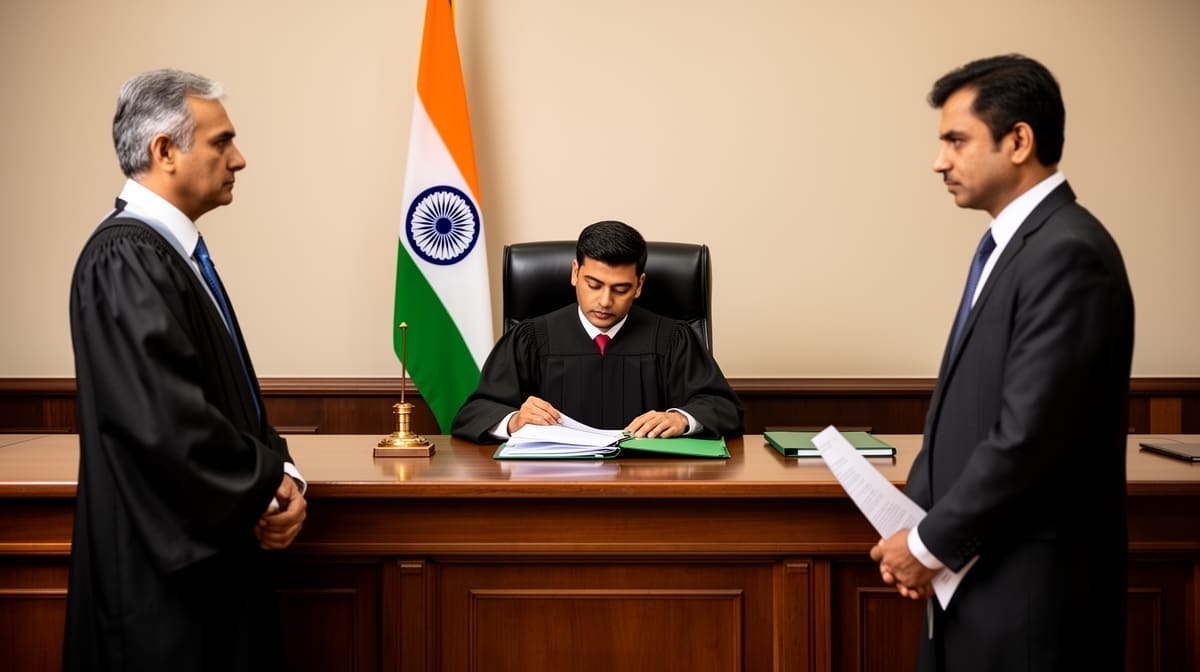
The Madras High Court has clarified that allegations arising from intercaste matrimonial disputes cannot be automatically elevated to criminal conspiracies under the SC/ST (PoA) Act, 1989. This ruling reinforces that the Act’s stringent provisions must not be invoked as a tool to resolve private family conflicts, and that bail must be evaluated on individual merit, not communal presumption.
Background & Facts
The Dispute
The petitioners, members of the family of Ajithkumar, are accused in Crime No.53 of 2026 for allegedly subjecting the defacto complainant - Ajithkumar’s wife - to communal abuse and harassment following an intercaste marriage. The complainant, who belongs to the Scheduled Caste community, alleged that after being left at her parental home during a marriage visit, Ajithkumar repeatedly abused her on caste grounds. The petitioners, including her in-laws, were subsequently arrested under the SC/ST (PoA) Act.
Procedural History
- 06.06.2025: Alleged incident occurred during a family visit
- Early 2026: FIR registered under SC/ST (PoA) Act, 1989
- Before petition: Petitioners arrested and denied bail by trial court
- March 2026: Criminal Original Petition filed under Section 528 of BNSS seeking direction to the Special Judge to consider bail
Relief Sought
The petitioners sought a direction to the Special Judge for exclusive Trial of SC/ST Cases to consider their bail application promptly upon surrender, arguing that the case arose from a private matrimonial dispute and not from any act of untouchability or caste-based atrocity as contemplated by the Act.
The Legal Issue
The central question was whether a matrimonial dispute between spouses of different castes, without evidence of caste-based humiliation in public or institutional context, can trigger the presumptive criminality under the SC/ST (PoA) Act, 1989, thereby justifying denial of bail without individualized scrutiny.
Arguments Presented
For the Petitioner
The petitioner’s counsel argued that the allegations stemmed solely from a breakdown in an intercaste marriage, with no evidence of public humiliation, denial of access to public spaces, or economic boycott - hallmarks of atrocities under the Act. Reliance was placed on P. Sivakumar v. State and K. Srinivas v. State of Telangana, where courts held that personal grievances cannot be recast as atrocities under the Act. The petitioners emphasized that their arrest was disproportionate and violated Article 21 rights.
For the Respondent
The Additional Public Prosecutor contended that any verbal abuse based on caste identity, even within a domestic setting, falls within the purview of Section 3(1)(x) of the SC/ST (PoA) Act. Citing State of Maharashtra v. Suresh, the State argued that the Act’s protective intent overrides procedural safeguards, and that bail should be denied to deter caste-based violence.
The Court's Analysis
The Court rejected the State’s broad interpretation, emphasizing that the SC/ST (PoA) Act was designed to combat systemic caste-based oppression, not to adjudicate private marital discord. The Court noted that the complainant’s allegations, while serious, were confined to private exchanges between spouses and their families, with no indication of public degradation or institutional exclusion.
"The Act was never intended to be a matrimonial dispute resolution mechanism. To treat every caste-based remark in a marital context as an atrocity is to dilute its purpose and invite misuse."
The Court further held that Section 15-A of the Act, which mandates victim consultation before bail decisions, requires more than a perfunctory hearing - it demands genuine consideration of the victim’s perspective, not merely procedural compliance. The Court directed the Special Judge to conduct a meaningful hearing with the complainant before deciding bail, ensuring her voice is heard without prejudging the petitioners’ guilt.
The Verdict
The petitioners won. The Madras High Court held that matrimonial discord, even with caste-based language, does not automatically constitute an atrocity under the SC/ST (PoA) Act, and directed the Special Judge to consider bail on surrender, after affording the victim a meaningful opportunity under Section 15-A.
What This Means For Similar Cases
Matrimonial Disputes Are Not Presumptive Atrocities
- Practitioners must challenge bail denials where allegations arise from private marital conflict, even if caste terms are used
- The burden shifts to the prosecution to prove the act was committed in a manner that degraded the victim’s dignity in a public or institutional context
- Merely invoking caste identity in a domestic argument does not satisfy the actus reus required under Section 3(1) of the Act
Section 15-A Requires Substantive Engagement, Not Formality
- Courts must record the victim’s statement or provide a written opportunity to submit views before bail orders
- A one-line note that "victim was heard" is insufficient; the court must demonstrate actual consideration
- Failure to comply may render bail orders liable to quash under Article 226
Arrests Under SC/ST Act Must Be Justified by Context, Not Caste Alone
- Police must distinguish between caste-based abuse in public life versus private spousal conflict
- Arrests without prima facie evidence of atrocity elements risk violating Arnesh Kumar v. State of Bihar principles
- Defense counsel should file applications under Section 438 CrPC early, citing this judgment to pre-empt arbitrary arrest