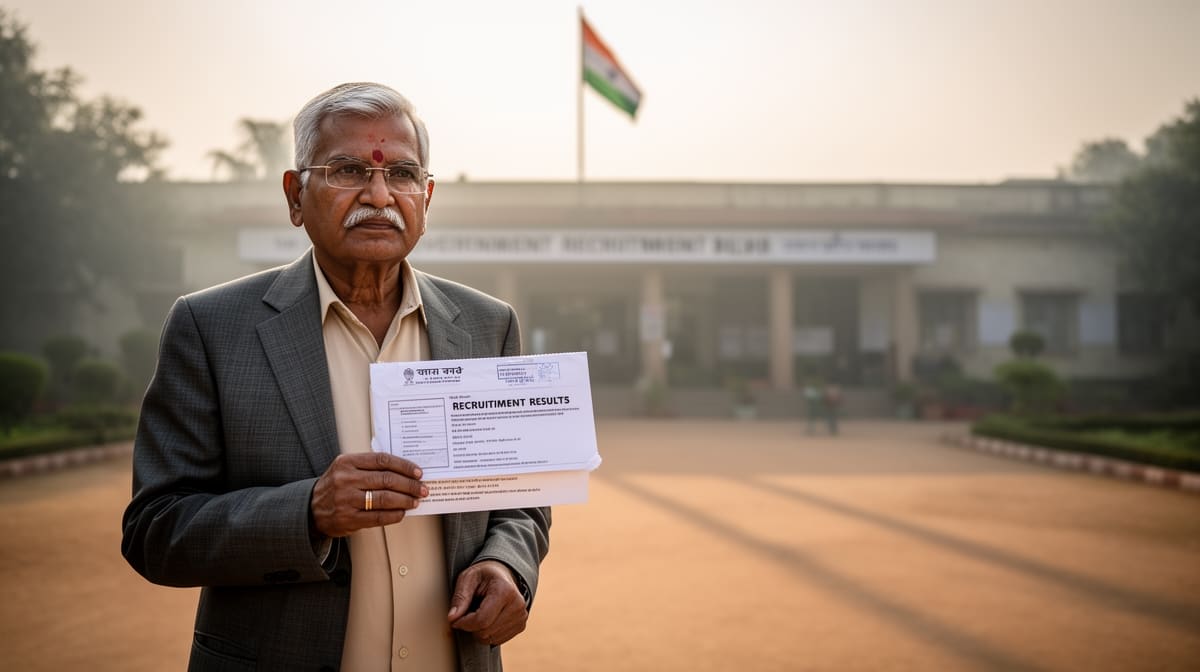
A landmark ruling by the Delhi High Court has redefined the eligibility timeline for ex-servicemen seeking recruitment into Central Armed Police Forces through competitive examinations. The judgment clarifies a long-standing ambiguity in the interpretation of Rule 5(c) of the Ex-Servicemen (Re-employment in Central Civil Services and Posts) Rules, 1979, ensuring that procedural fairness and substantive justice prevail over rigid administrative timelines.
Background & Facts
The Dispute
Ghunna Ram, a Havildar Major in the Indian Army, applied for the post of Assistant Commandant (AC) in the Central Reserve Police Force (CRPF) under the Ex-Serviceman (ESM) quota in the CAPFs (ACs) Examination 2019. He had executed a five-year bond upon promotion in 2015, which was due to expire on 31 December 2020. On 15 April 2019, his Commanding Officer issued a Serving Personnel Certificate confirming his assignment would end by that date. He submitted an undertaking acknowledging that his appointment would be contingent upon his formal discharge from the Army.
Procedural History
- April 2019: Petitioner applied for the CAPF (ACs) Examination 2019 as an ESM, submitting the Serving Personnel Certificate and undertaking.
- November 2019: Petitioner’s bag containing all documents was stolen. He filed an FIR, mistakenly stating his ESM ID was lost, not the Serving Personnel Certificate.
- February 2021: Petitioner cleared the written test and applied for discharge from the Army.
- March 2021: Army recommended his discharge, but implementation was delayed due to the COVID-19 pandemic.
- March 2022: Petitioner was officially discharged.
- August 2021: UPSC issued a show-cause notice alleging disqualification under Rule 5(c) of the 1979 Rules, citing failure to be discharged by 19 May 2020 (one year after application deadline).
- January 2023: Revised results excluded the petitioner; a Scheduled Tribe candidate was selected in his place.
Relief Sought
The petitioner sought quashing of the cancellation of his candidature and direct appointment as AC in BSF under the ESM quota, arguing that the one-year window under Rule 5(c) should be calculated from the date of result declaration, not the application deadline.
The Legal Issue
The central question was whether the one-year eligibility window under Rule 5(c) of the Ex-Servicemen (Re-employment in Central Civil Services and Posts) Rules, 1979, as amended in 2012, must be reckoned from the last date of application submission or from the date of declaration of examination results.
Arguments Presented
For the Petitioner
The petitioner contended that Rule 5(c) begins with the phrase "For appointment to any vacancy... on the results of an All India Competitive Examination," indicating that eligibility must be assessed at the point of appointment, not application. He argued that interpreting the one-year window from the application deadline would create an absurd outcome: a candidate discharged after the result declaration but before appointment would be penalized despite fulfilling the spirit of the rule. He relied on the use of the phrase "due to be completed" in Rule 5(c)(i), suggesting prospective eligibility. He further challenged the relevance of the DOPT OM dated 3 April 1991, which was issued before the 2012 amendment and based on a now-removed explanation to Rule 2(c).
For the Respondent
The UPSC and DOPT argued that the one-year period must be calculated from the last date of application submission (20 May 2019), as per the longstanding interpretation in the DOPT OM dated 3 April 1991 and affirmed in Mukesh Kumar v. UOI. They contended that the undertaking signed by the petitioner bound him to produce discharge documents by that cutoff. They also alleged suppression of facts due to the petitioner’s misstatement in the FIR and contradictory entries in the Detailed Application Form.
The Court's Analysis
The Court began by distinguishing Mukesh Kumar v. UOI, noting that the earlier decision was based on an unchallenged concession by the petitioner and thus lacked precedential value. It further held that the DOPT OM dated 3 April 1991 was rendered obsolete by the 2012 amendment to Rule 5(c), which replaced the earlier framework under Rule 2(c). The Court emphasized that the 1991 OM was tied to an explanation that was expressly removed in 2012, rendering any reliance on it legally untenable.
The Court undertook a purposive interpretation of Rule 5(c), focusing on its opening words: "For appointment to any vacancy... on the results of an All India Competitive Examination." It reasoned that the phrase "on the results" anchors the eligibility criterion to the moment of selection, not application. The parenthetical clause - "including those whose assignment is due to be completed within one year" - was interpreted as a qualifying condition for appointment, not application. To interpret it otherwise would render the phrase otiose, as candidates would be assessed for eligibility before any result existed.
"One who succeeds, is to be appointed; one who does not, is not."
The Court rejected the UPSC’s reliance on Note II of the 2019 notification, clarifying that it merely incorporated the definition of "ex-serviceman" and did not alter the substantive timing requirement under Rule 5(c). It further held that the principle of benefit of doubt in favor of the candidate, as established in Parvaiz Ahmad Parry v. State of J&K, applied here.
Regarding the allegations of suppression, the Court found them unsubstantiated. The petitioner’s error in the FIR - confusing the Serving Personnel Certificate with his ESM ID - was excusable given the trauma of losing all documents. The alleged contradiction in the DAF - stating he was an ESM but had never been employed - was reasonably explained as referring to prior employment in CAPFs, not the Army.
The Verdict
The petitioner won. The Delhi High Court held that the one-year eligibility window under Rule 5(c) of the 1979 Rules must be reckoned from the date of declaration of examination results, not the application deadline. The cancellation of the petitioner’s candidature was quashed, and he was directed to be considered for appointment if an ESM vacancy remains available.
What This Means For Similar Cases
Eligibility Window Begins at Result Declaration
- Practitioners must now argue that Rule 5(c) applies prospectively from the date results are declared, not the application cutoff.
- Candidates discharged after the application deadline but before result declaration remain eligible if their service was "due to be completed" within one year of that deadline.
- Administrative bodies cannot rely on pre-2012 DOPT OMs to enforce outdated timelines.
Misstatements Require Contextual Evaluation
- Minor errors in documentation, especially under duress (e.g., lost documents, trauma), cannot justify automatic disqualification.
- The burden shifts to the authority to prove intentional suppression, not mere clerical or emotional misstatements.
- DAF responses must be interpreted in context; contradictions are not fatal if a reasonable explanation exists.
Precedents Based on Concessions Are Non-Binding
- Courts will not treat judgments as binding if they rest on unchallenged concessions by a party.
- Practitioners must actively contest interpretations in new cases, even if similar ones have been decided previously.
- Mukesh Kumar is now limited to its factual and procedural posture and cannot be cited as authoritative on Rule 5(c) interpretation.