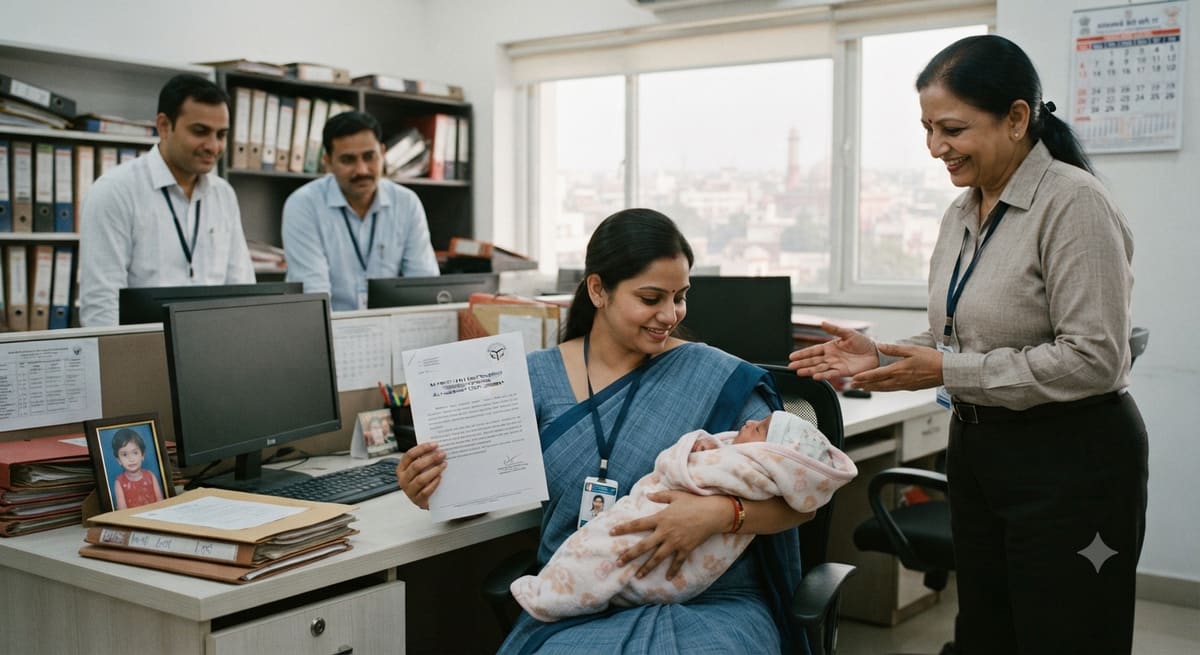
The Central Administrative Tribunal, Jammu Bench, has reaffirmed that statutory limits on Child Care Leave are binding and cannot be expanded by judicial sympathy, even when the third child has exceptional needs. The ruling clarifies that the phrase 'two eldest surviving children' in Rule 41-A admits no exception, reinforcing the principle that beneficial welfare provisions must be interpreted within their express textual boundaries.
Background & Facts
The Dispute
Dr. Puja Nanda, an Associate Professor in the Higher Education Department, Jammu and Kashmir, applied for Child Care Leave (CCL) on 19.03.2025 to care for her 16-year-old son, who was studying in Class XII and participating in national-level fencing tournaments. Her request was rejected by the Principal of Government Degree College, Udhampur, on 20.03.2025, on the ground that she already had two eldest surviving children - her twin daughters born on 12.04.2006 - and her son, born in January 2009, was the third child. The rule, under which she sought leave, explicitly restricts CCL to the two eldest surviving children.
Key Facts
- Dr. Puja Nanda was appointed as Lecturer in December 2007 and promoted to Associate Professor in December 2019
- She married in November 2004 and gave birth to twin daughters on 12.04.2006 and a son in January 2009
- She had availed CCL on multiple occasions, utilizing 263 days out of the maximum permissible 730 days under Rule 41-A
- Her son is currently in Class XII and actively participates in national-level sports
- She had previously availed maternity leave for the birth of her twins, but no record exists of maternity leave for her son
- The rejection order cited Rule 41-A of the Jammu and Kashmir Civil Services (Leave) Rules, 1979, as the sole basis for denial
Procedural History
- 19.03.2025: Applicant submits request for Child Care Leave
- 20.03.2025: Principal, Government Degree College, Udhampur, rejects request citing Rule 41-A
- 12.04.2025: Original Application No. 1321/2025 filed before Central Administrative Tribunal, Jammu Bench
- 29.10.2025: Case reserved for order after hearing
- 08.04.2026: Judgment pronounced by the Tribunal
The Parties' Positions
Applicant’s Position:
- Argued that CCL is a beneficial social legislation meant to support working mothers and children
- Contended that the birth of twins should be counted as one child for the purpose of Rule 41-A
- Relied on Shalini Dharmani v. State of Himachal Pradesh and Deepika Singh v. CAT & Ors. to argue for liberal interpretation under Articles 14, 15, and 21 of the Constitution
- Asserted that her son’s academic and sporting commitments justify compassionate exception
- Claimed that prior grant of maternity leave for the twins implied recognition of her parental responsibilities
Respondents’ Position:
- Maintained that Rule 41-A is unambiguous and permits CCL only for the two eldest surviving children
- Stated that twins are two distinct children under the rule, regardless of simultaneous birth
- Argued that Shalini Dharmani involved a child with special needs and Deepika Singh dealt with family definition in maternity leave, neither addressing numerical limits
- Emphasized that maternity leave (Rule 41) and CCL (Rule 41-A) are distinct entitlements with separate conditions
- Asserted that no mala fides, arbitrariness, or discrimination was involved in the rejection
Relief Sought
The applicant sought:
- Quashing of the order dated 20.03.2025 rejecting CCL
- Direction to grant CCL for her son
- Costs of the petition
- Any other relief deemed fit by the Tribunal
The Legal Issue
The central question was whether Rule 41-A of the Jammu and Kashmir Civil Services (Leave) Rules, 1979 permits Child Care Leave for a third child when the employee has already given birth to twins, and whether judicial interpretation can override the explicit numerical limit of two children.
Arguments Presented
For the Appellant/Petitioner
The applicant relied on constitutional principles under Articles 14, 15, and 21 to argue that CCL is a welfare provision requiring liberal interpretation. She contended that treating twins as two separate children for the purpose of CCL is mechanistic and defeats the spirit of the rule, which aims to support working mothers. She cited Shalini Dharmani, where the Supreme Court allowed CCL for a child with disabilities despite a third child, and Deepika Singh, which expanded the definition of family for maternity benefits. She argued that the rule’s purpose - to enable mothers to balance work and childcare - should prevail over rigid textualism, especially given her son’s exceptional circumstances.
For the Respondent/State
The respondents countered that Rule 41-A is clear, unambiguous, and contains no provision for exceptions based on birth circumstances, child’s needs, or sporting achievements. They emphasized that the rule’s language - “two eldest surviving children” - is categorical and admits no judicial modification. They distinguished Shalini Dharmani on the ground that it involved a child with disabilities and a specific government policy allowing exceptions, and Deepika Singh as concerning maternity leave and family definition, not CCL’s numerical cap. They further noted that the applicant had already availed maternity leave for the twins and that no irregularity in past leave grants could create a vested right to CCL for a third child.
The Court's Analysis
The Tribunal began by acknowledging the beneficial nature of Child Care Leave, recognizing its role in supporting working mothers and promoting gender equity in public service. However, it emphasized that even beneficial legislation must be interpreted within the confines of its statutory text. The Tribunal held that judicial intervention cannot rewrite rules or create exceptions not contemplated by the rule-making authority.
"Courts and Tribunals cannot rewrite the rule or create exceptions which the rule-making authority has consciously not provided."
The Tribunal rejected the applicant’s argument that twins should be counted as one child, noting that the rule refers to "two eldest children," not "two births" or "two pregnancy events." The birth of twins results in two distinct legal persons, each entitled to be counted separately under the rule. Any interpretation to the contrary would amount to judicial legislation, which is impermissible under the separation of powers.
The Tribunal further examined the precedents cited by the applicant. It held that Shalini Dharmani involved a child with severe disabilities and a specific government circular permitting exceptions, which was absent in the present case. Similarly, Deepika Singh dealt with the inclusive definition of "family" for maternity benefits under the CCS (Leave) Rules, not the numerical restriction on CCL. Neither judgment invalidated or diluted the two-child ceiling under Rule 41-A.
The Tribunal also dismissed the argument that prior grant of maternity leave for the twins created an expectation or vested right to CCL for the third child. It clarified that maternity leave and CCL are governed by separate rules with distinct eligibility criteria. The grant of one does not imply entitlement to the other.
Finally, the Tribunal noted that there was no allegation of mala fides, arbitrariness, or discrimination in the rejection. Personal hardship, however genuine, cannot override a clear statutory provision. The Tribunal concluded that the decision of the Principal was lawful, procedurally correct, and consistent with the rule.
The Verdict
The applicant’s Original Application was dismissed. The Tribunal held that the rejection of Child Care Leave for the third child was in strict conformity with Rule 41-A of the Jammu and Kashmir Civil Services (Leave) Rules, 1979, which permits CCL only for the two eldest surviving children. No relief was granted. No costs were awarded.
What This Means For Similar Cases
Statutory Limits Are Absolute in Leave Rules
- Practitioners must advise clients that numerical caps in leave rules (e.g., two children for CCL, two children for maternity benefits) are not subject to judicial expansion based on compassion or exceptional circumstances
- Arguments invoking constitutional rights under Articles 14, 15, or 21 will fail if the rule’s language is clear and unambiguous
- Any request for relaxation must be directed to the rule-making authority, not the courts or tribunals
Birth of Twins Counts as Two Children
- In all service leave rules referencing "number of children," twins are counted as two separate children unless the rule explicitly states otherwise
- This applies uniformly across central and state service rules, including those in Jammu and Kashmir, Delhi, and other Union Territories
- Legal challenges based on "equal treatment of twins as one" will be dismissed as contrary to statutory language
Welfare Provisions Cannot Override Textual Clarity
- Beneficial social legislation does not permit courts to rewrite statutory ceilings
- The principle of liberal interpretation applies to the scope of the benefit, not its quantitative limits
- Practitioners should focus on advocating for policy amendments through administrative channels rather than litigation when rules are unambiguous