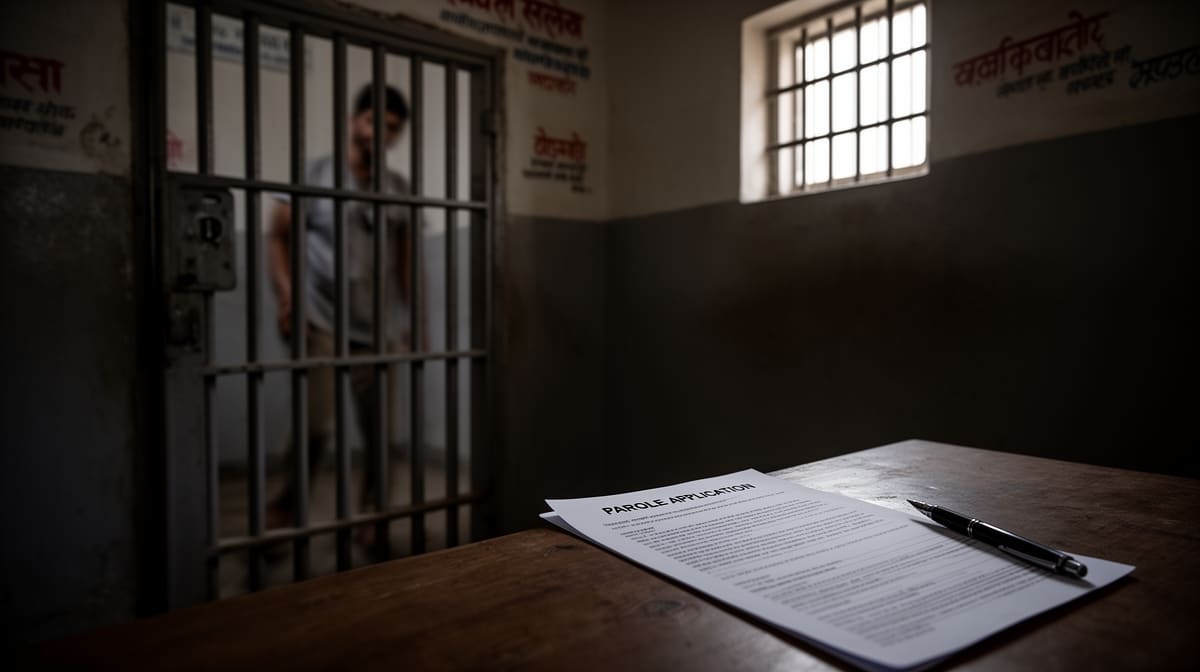
The Chhattisgarh High Court has clarified that a prisoner convicted in a single criminal case involving multiple deaths cannot be disqualified from premature release under the classification of 'guilty of murder in two or more cases.' This ruling reinforces statutory interpretation grounded in textual clarity and procedural fairness, setting a critical precedent for the application of prison release rules across India.
Background & Facts
The Dispute
The petitioner, Toran Lal S/o Shri Asharam Sahu, aged 41, is a prisoner currently lodged as Prisoner No. 9168/124 in Central Jail, Raipur. He was convicted and sentenced to death for the murder of three persons in a single incident arising out of a land dispute in Village Sonesilli, Raipur District. The conviction was confirmed by the trial court and upheld on appeal. The sentence was later commuted to life imprisonment. He applied for premature release under the Chhattisgarh Jail Rules, 1968, on the grounds that he met the eligibility criteria under Rule 358.
Key Facts
- The petitioner was convicted in a single case (Sessions Case No. 12/2015) involving the murder of three individuals on 18.07.2014
- The trial court delivered judgment on 12.03.2017; the High Court affirmed the conviction on 05.08.2019
- The petitioner has served over 11 years in custody as of the date of the impugned order
- He has maintained a clean conduct record in prison, with no disciplinary reports
- He submitted an application for premature release on 15.12.2025
- The competent authority rejected the application by order dated 02.02.2026
- The rejection cited Rule 358(6)(ix) and Rule 358(7)(viii) of the Chhattisgarh Jail Rules, 1968
- A co-accused, Rakesh Sahu, in an identical factual matrix, had his rejection order quashed by this Court on 23.02.2026
Procedural History
- 18.07.2014: Alleged incident of triple murder
- 12.03.2017: Conviction and death sentence by Sessions Court
- 05.08.2019: Conviction affirmed by Chhattisgarh High Court; death sentence commuted to life imprisonment
- 15.12.2025: Petitioner filed application for premature release under Rule 358
- 02.02.2026: Competent authority rejected application without assigning reasons
- 10.02.2026: Petitioner filed Writ Petition No. 201 of 2026 under Article 226
- 16.04.2026: Hearing before Division Bench of Chhattisgarh High Court
The Parties' Positions
Petitioner’s Position: The rejection order is non-speaking, arbitrary, and based on a misinterpretation of Rule 358(6)(ix). The phrase "two or more cases" refers to distinct prosecutions, not multiple victims in one case. The order violates the mandatory requirement of assigning "reasonable and logical reasons" under Rule 358(7)(viii). Parity with the co-accused, whose similar rejection was quashed, demands identical relief.
Respondents’ Position: The petitioner committed a heinous crime with multiple fatalities, justifying exclusion under Rule 358(6)(ix). The term "cases" must be interpreted broadly to include the multiplicity of victims. The discretionary power of the State must be respected, and the order, though brief, reflects due consideration of gravity of offence and societal impact.
Relief Sought
The petitioner seeks:
- Quashing of the impugned order dated 02.02.2026
- Declaration that he is entitled to premature release under Rule 358
- A writ of mandamus directing immediate release
- Costs of the petition
The Legal Issue
The central question was whether the phrase "guilty of murder in two or more cases" under Rule 358(6)(ix) of the Chhattisgarh Jail Rules, 1968, applies to a person convicted in a single criminal case involving multiple victims, or whether it requires separate and distinct prosecutions.
Arguments Presented
For the Petitioner
The petitioner’s counsel relied on the plain language of Rule 358(6)(ix), arguing that the word "cases" unambiguously refers to distinct legal proceedings arising from separate incidents. He cited State of Punjab v. Baldev Singh to support the principle that penal provisions must be construed strictly. He emphasized that Rule 358(7)(viii) mandates a speaking order, and the failure to assign reasons renders the decision arbitrary and violative of Article 14. He further invoked the principle of parity, pointing to the Court’s own order dated 23.02.2026 quashing a nearly identical rejection.
For the Respondent
The State counsel contended that the legislative intent behind Rule 358(6)(ix) was to exclude offenders responsible for multiple killings, regardless of whether they arose from one or multiple incidents. He argued that a narrow interpretation would defeat the purpose of the rule, which is to deny premature release to those who commit crimes of extreme brutality. He maintained that discretion in granting premature release is not justiciable unless manifestly arbitrary, and that the brevity of the order does not invalidate it if the decision is based on relevant considerations.
The Court's Analysis
The Court conducted a detailed textual and contextual analysis of Rule 358(6)(ix). It observed that the language of the provision uses the word "cases," not "victims," "incidents," or "offences." The Court held that in legal parlance, a "case" refers to a distinct prosecution initiated under a specific FIR and charge sheet. A single FIR leading to a single trial and conviction constitutes one case, irrespective of the number of victims.
"The expression 'guilty of murder in two or more cases' clearly contemplates separate and distinct criminal proceedings, not multiple deaths arising from a single transaction. To interpret 'cases' as synonymous with 'victims' would be to rewrite the Rule and impose a standard not enacted by the legislature."
The Court further emphasized that Rule 358(7)(viii) imposes a mandatory obligation to record "reasonable and logical reasons" for rejection. The impugned order contained no reference to the petitioner’s conduct in prison, no evaluation of welfare officer’s report, no consideration of rehabilitation potential, and no analysis of the statutory parameters. The Court held that such a non-speaking order is legally unsustainable and violates the principle that "reasons are the soul of justice."
The Court also rejected the State’s argument that discretion is unfettered. It cited State of Haryana v. Bhajan Lal to affirm that even discretionary powers must be exercised on relevant considerations and not arbitrarily. The Court noted that the co-accused, under identical circumstances, had already been granted relief, making the differential treatment of the petitioner violative of Article 14.
The Verdict
The writ petition was allowed. The Court quashed the impugned order dated 02.02.2026 and remanded the matter to the competent authority to reconsider the petitioner’s application for premature release afresh. The authority must pass a speaking order within four weeks of receipt of a certified copy of this judgment, taking into account all relevant factors under Rule 358, including conduct in prison, likelihood of reformation, and welfare officer’s report. No costs were awarded.
What This Means For Similar Cases
"Cases" Means Separate Prosecutions, Not Multiple Victims
- Practitioners must now argue that Rule 358(6)(ix) applies only when a prisoner has been convicted in two or more distinct criminal cases, each arising from separate FIRs and trials
- A single case with multiple victims - even if the victims are unrelated - does not trigger the disqualification
- This interpretation aligns with the principle of strict construction of penal and disqualifying provisions
Non-Speaking Orders Are Per Se Invalid
- Any rejection of premature release without assigning reasons under Rule 358(7)(viii) is liable to be quashed
- Authorities must document evaluation of: conduct in jail, welfare officer’s report, rehabilitation potential, and societal impact
- Mechanical or boilerplate orders will not survive judicial scrutiny
Parity Must Be Respected in Prison Release Decisions
- Where two prisoners are similarly situated and convicted under identical circumstances, differential treatment without rational basis violates Article 14
- Courts will intervene where parity is ignored, even in discretionary matters
- Practitioners should cite parallel orders as persuasive authority in pending applications