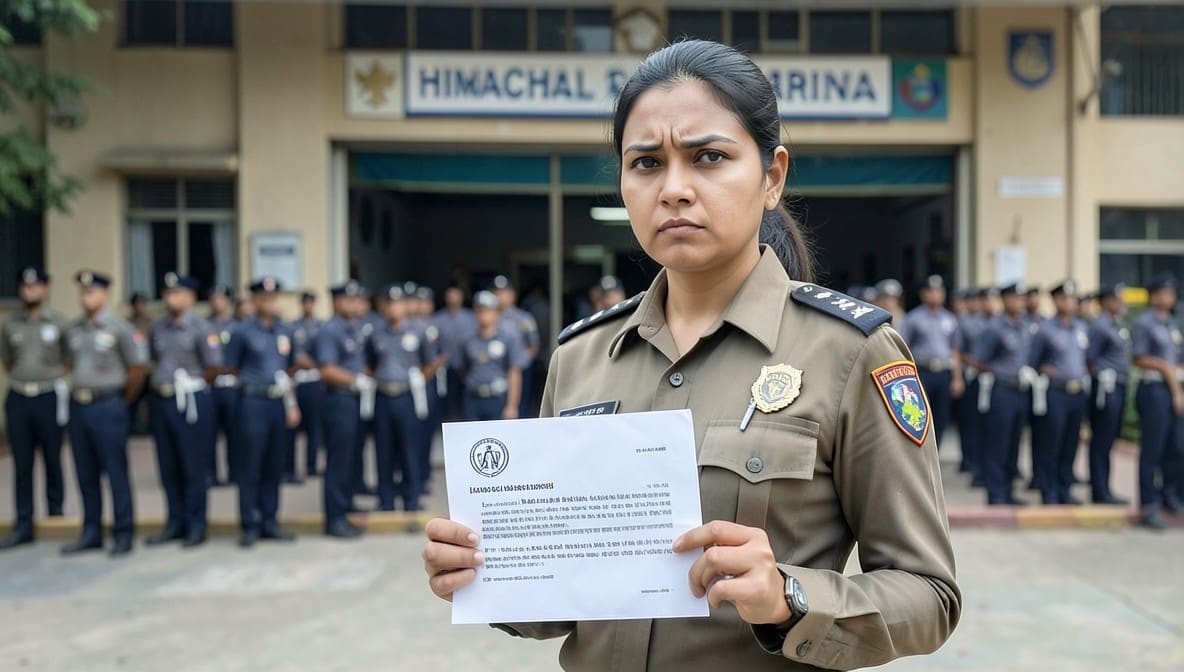
The Himachal Pradesh High Court has reaffirmed that probationary employees in disciplined forces can be discharged for willful absence without leave, even without a formal departmental enquiry. In Sapna Devi v. State of H.P., the Court upheld the discharge of a Lady Constable under Rule 12.21 of the Punjab Police Rules, distinguishing precedents on disproportionate penalty and emphasizing the gravity of unauthorized absence in police service.
Background & Facts
The Dispute
The appellant, Sapna Devi, was appointed as a Lady Constable on 01.01.2010 and sent to the Training Center, Sakoh. During her training period, she proceeded on medical leave on 14.02.2010 but failed to resume training, resulting in her being marked absent from 19.02.2010 onwards. Despite a wireless message dated 22.02.2010 directing her to resume training, she sought an extension of leave via telegram on the same day. She eventually rejoined training on 07.04.2010, after a 47-day absence.
Key Facts
- Medical Certificates: The appellant produced three medical certificates:
- 18.02.2010 to 02.03.2010: Issued by MO PHC, Bhadsali, District Una
- 03.03.2010 to 09.03.2010: Issued by MO, Kumar Nursing Home, Una
- 10.03.2010 to 06.04.2010: Issued by MO, New Saini Hospital, Hoshiarpur
- These certificates were ignored in the enquiry report as they were issued by private hospitals not approved by the government.
- Repatriation and Further Absence: The appellant was repatriated to her parent unit (5th India Reserve Battalion) on 07.04.2010 and reported for training on 08.04.2010. She proceeded on four days' casual leave and one day's station leave on 16.04.2010 but failed to report back on 22.04.2010. Wireless messages dated 24.04.2010 and 06.05.2010 directed her to resume duty, but she did not comply.
- Departmental Enquiry: A departmental enquiry was ordered on 28.05.2010 under Rule 16.24 of the Punjab Police Rules. The appellant claimed she was under "acute medical depression" and being treated by a Tantrik but failed to produce any defense witnesses or substantive evidence.
- Discharge Order: The appellant was discharged on 25.08.2010 under Rule 12.21 of the Punjab Police Rules, which permits discharge of a constable unlikely to prove efficient within three years of enrolment.
Procedural History
- 25.08.2010: Order of discharge passed under Rule 12.21.
- 01.07.2010: Appellant found absent from Battalion Headquarters, Bilaspur, for seven days.
- 09.07.2010: Suspension revoked; appellant left for Una without permission.
- 15.07.2010 & 27.07.2010: Reminders to join duty ignored.
- 29.11.2014: Representation filed against discharge order after four years.
- 07.01.2015: Coordinate Bench directed competent authority to decide the representation.
- 22.04.2015: Speaking order upholding discharge passed.
- 2015: CWP No. 320 of 2015 filed; dismissed on 07.01.2015.
- 2019: CWPOA No. 5173 of 2019 filed; dismissed on 18.11.2025.
- 2026: Present Letters Patent Appeal (LPA No. 72 of 2026) filed.
Relief Sought
The appellant sought:
- Setting aside of the discharge order dated 25.08.2010 and the impugned judgment dated 18.11.2025.
- Reinstatement with full back wages and consequential benefits.
The Legal Issue
The central question was whether the discharge of a probationary constable under Rule 12.21 of the Punjab Police Rules for willful absence from training and duty requires a formal departmental enquiry, and whether the penalty imposed was disproportionate given the appellant’s medical claims.
Arguments Presented
For the Appellant
- Relied on Bhagwan Lal Arya v. Commissioner of Police, Delhi & others ((2004) 4 SCC 560) to argue that the penalty of discharge was disproportionate as the appellant’s absence was due to medical reasons.
- Contended that the appellant’s medical condition (acute depression) justified her absence, and the discharge order was punitive without a proper enquiry.
For the Respondent (State)
- Argued that Rule 12.21 permits discharge of a probationary constable without a formal enquiry if they are found unlikely to prove efficient.
- Cited State of Punjab & others v. Sukhwinder Singh ((2005) 5 SCC 569) and State of Punjab & others v. Constable Avtar Singh ((2008) 7 SCC 405) to support that no preliminary enquiry is required for discharge under Rule 12.21.
- Emphasized that the appellant’s willful absence (47 days during training and subsequent unauthorized leaves) constituted grave misconduct, justifying discharge under Rule 16.24.
- Highlighted that the appellant failed to produce credible medical evidence or defense witnesses during the enquiry.
The Court's Analysis
The Court conducted a detailed analysis of the legal principles governing probationary discharge and the scope of Rule 12.21 and Rule 16.24 of the Punjab Police Rules:
-
Distinguishing Bhagwan Lal Arya:
"The contention raised on the basis of the aforesaid judgment is that the penalty imposed on the appellant, in the case at hand, is highly disproportionate and therefore, the same is required to be set aside. The aforesaid judgment is clearly distinguishable, as in the said case, there was only one instance of absence and that too because of bad health. Therefore, therein the Apex Court was of the view that there was valid and justifiable ground for the absence from duty. Hence, awarding of punishment of removal from service was held to be excessive and disproportionate."
The Court held that Bhagwan Lal Arya was inapplicable because:
- The appellant had multiple instances of willful absence (47 days during training, subsequent unauthorized leaves).
- The appellant’s medical claims were not substantiated by government-approved medical certificates.
- The appellant’s defense (treatment by a Tantrik) was not credible and lacked evidence.
-
Scope of Rule 12.21: The Court relied on State of Punjab & others v. Sukhwinder Singh ((2005) 5 SCC 569) to hold that Rule 12.21 permits discharge of a probationary constable without a formal enquiry if they are found unlikely to prove efficient. The relevant extract from the judgment:
"When an employee is on probation, an opportunity is afforded to the employee to watch the work, ability, efficiency, sincerity and competence of the employee and if the employee is not found suitable for the post, the employer has a right to dispense his service without anything more during the period of probation."
The Court further noted that even a preliminary enquiry is not mandatory under Rule 12.21, distinguishing it from Rule 16.24, which requires a formal departmental enquiry for punitive action.
-
Grave Misconduct in Disciplined Forces: The Court cited State of Punjab & others v. Mohinder Singh ((2005) 12 SCC 182) to emphasize that willful absence without leave in a disciplined force amounts to grave misconduct, justifying dismissal or discharge. The relevant extract:
"The conduct of the respondent who is a member of a disciplined force in remaining absent from duty for five-and-a-half months without sanctioned leave or prior intimation is reprehensible... In our view, the respondent being member of a disciplined force could not be permitted to remain absent without taking leave and that too for such a long period. He cannot be retained in service."
The Court held that the appellant’s continued misconduct (absences during training and post-repatriation) demonstrated incorrigibility and unfitness for police service, justifying discharge under Rule 16.24 even if Rule 12.21 was the initial basis.
-
Natural Justice Compliance: The Court observed that the departmental enquiry under Rule 16.24 was conducted in accordance with principles of natural justice. The appellant was afforded opportunities to present her defense, including:
- Submission of a response to the summary of allegations.
- Request to treat her response as a reply to the charge-sheet.
- Opportunity to produce defense witnesses (which she failed to utilize).
- Show-cause notice before the discharge order.
The Court held that the findings of the enquiry officer and disciplinary authority were sustainable based on the evidence adduced.
The Verdict
The Division Bench dismissed the Letters Patent Appeal (LPA No. 72 of 2026), upholding:
- The discharge order dated 25.08.2010 passed under Rule 12.21 of the Punjab Police Rules.
- The order dated 22.04.2015 rejecting the appellant’s representation.
- The impugned judgment dated 18.11.2025 of the learned Single Judge.
The Court held that the appellant’s willful absence and failure to substantiate her medical claims justified her discharge, and no infirmity was found in the departmental enquiry or the orders passed.
What This Means For Similar Cases
Discharge Under Rule 12.21 Does Not Require Formal Enquiry
- Probationary employees in disciplined forces can be discharged under Rule 12.21 without a formal departmental enquiry if they are found unlikely to prove efficient.
- Preliminary enquiries (e.g., calling for explanations) do not convert an otherwise innocuous discharge order into a punitive one.
- Practitioners must distinguish between Rule 12.21 (discharge during probation) and Rule 16.24 (punitive action), as the former does not mandate an enquiry.
Willful Absence in Disciplined Forces is Grave Misconduct
- Unauthorized absence from training or duty, even for a single prolonged period, can justify discharge or dismissal in disciplined forces.
- Medical claims must be substantiated by government-approved certificates; private hospital certificates may be ignored if not recognized by the employer.
- Habitual absenteeism or failure to comply with duty resumption directives strengthens the case for discharge under Rule 16.24.
Representations Must Be Filed Timely
- Delayed representations (e.g., after four years, as in this case) weaken the employee’s case, especially if no statutory appeal/revision was filed.
- Courts are unlikely to interfere with findings of fact in departmental enquiries if principles of natural justice were followed and evidence supports the conclusions.
Key Takeaways for Practitioners
-
For Employees:
- Ensure medical certificates are from government-approved hospitals if claiming illness as a defense.
- File statutory appeals/revisions against adverse orders within the prescribed timeline.
- Comply with duty resumption directives to avoid charges of willful absence.
-
For Employers:
- Rule 12.21 provides a quick mechanism to discharge probationary employees without a formal enquiry.
- Rule 16.24 should be invoked for punitive action where misconduct is grave or repeated.
- Document all communications (e.g., wireless messages, reminders) to establish willful absence.
-
For Courts:
- Distinguish between Bhagwan Lal Arya (single absence due to illness) and cases involving repeated or prolonged willful absence.
- Uphold discharge orders under Rule 12.21 if the employee’s conduct demonstrates unfitness for service, even if a formal enquiry was conducted under Rule 16.24.