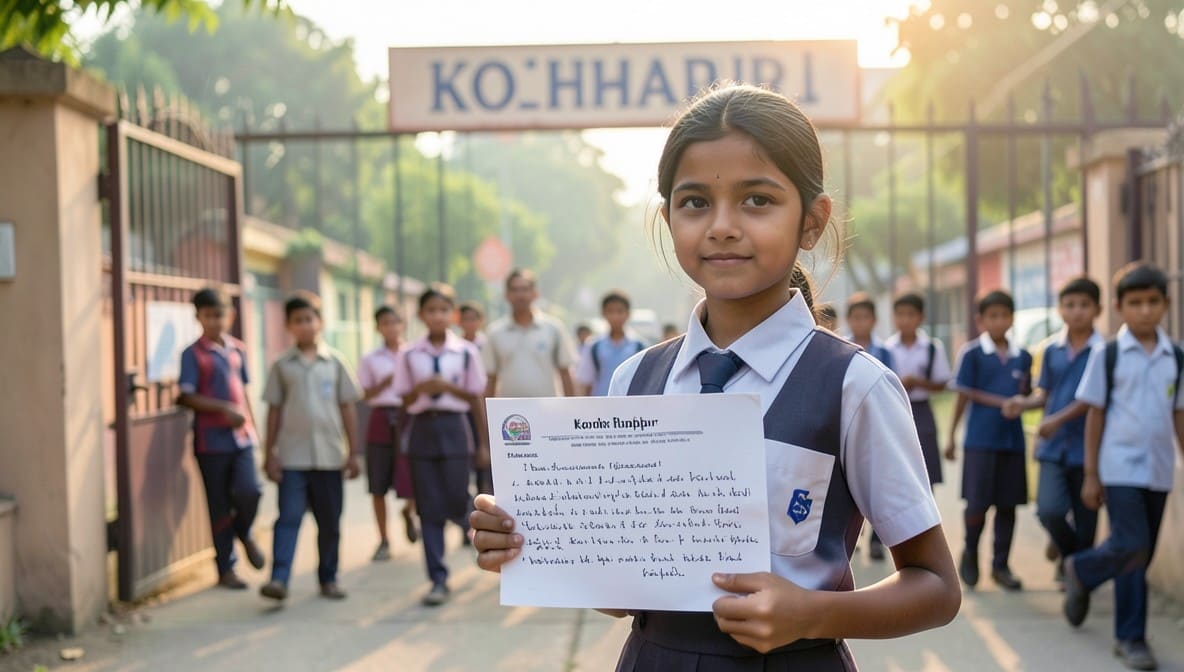
The Bombay High Court has issued an interim order safeguarding a Scheduled Caste child’s right to elementary education under Article 21A, holding that rigid adherence to a registered leave and license agreement as the sole proof of residence cannot override established factual evidence of long-term habitation. The judgment underscores the State’s constitutional obligation to ensure access to education, even where procedural documentation is imperfect.
Background & Facts
The Dispute
The petitioner, Advik Narendra Masure, a six-year-old minor belonging to the Scheduled Caste category, sought admission into the 1st standard at a government-aided school in Navi Mumbai for the academic year 2026 - 2027 under the 25% reservation mandated by the Right of Children to Free and Compulsory Education Act, 2009 (RTE Act). The application was initially accepted but later rejected on the ground that the submitted proof of residence - a leave and license agreement dated 3rd July 2025 - was not registered.
Key Facts
- The petitioner’s father has resided at H-67, Ground Floor, Sector-3, Airoli, Navi Mumbai - 400708 since at least 2021.
- Documents supporting this residence include: a gas connection bill (dated 2021), a passport with the same address, and savings bank account statements reflecting the Airoli address.
- The initial application (No. 26TH002701) was provisionally approved on 15th May 2026 by Respondent No. 4 (School Admission Authority).
- On 28th May 2026, the same authority rejected the application solely due to the unregistered nature of the leave and license agreement dated 3rd July 2025.
- On 5th June 2026, the father submitted a representation along with a newly executed, duly registered leave and license agreement dated 20th May 2026, covering the same premises from 1st June 2026 to 31st December 2026.
- The registered agreement was submitted alongside the earlier documents to demonstrate continuous residence.
- The rejection was reaffirmed on 10th June 2026, prompting the filing of the writ petition on 11th June 2026, with the admission deadline set for 12th June 2026.
Procedural History
- 15th May 2026: Provisional admission certificate issued by Respondent No. 4.
- 28th May 2026: Rejection letter issued citing unregistered leave and license agreement.
- 5th June 2026: Representation filed by father with registered agreement and supporting documents.
- 10th June 2026: Rejection reaffirmed.
- 11th June 2026: Writ Petition (No. 15956 of 2026) filed before the Bombay High Court seeking urgent interim relief.
The Parties' Positions
The petitioner, through counsel, argued that the family has resided at the same address for over five years, as corroborated by multiple independent documents. The unregistered agreement was an honest oversight, remedied promptly with a registered one. The rejection, they contended, was hyper-technical and violated the spirit of the RTE Act.
The State, represented by the Additional Government Pleader, did not appear for Respondents 4 and 5, despite service. No written submission was filed opposing the petitioner’s claims.
Relief Sought
The petitioner sought:
- Immediate stay of the rejection orders dated 28th May 2026 and 10th June 2026.
- Direction to process the admission application (No. 26TH002701) without delay.
- Protection of the child’s right to education pending final adjudication.
The Legal Issue
The central question was whether the rejection of a child’s admission application under the RTE Act, solely on the ground of submitting an unregistered leave and license agreement, is lawful when other credible and consistent documentary evidence establishes long-term residence at the claimed address.
Arguments Presented
For the Petitioner
Counsel relied on the principle of substantive compliance over technical formalities, citing the constitutional mandate under Article 21A and the purposive interpretation of the RTE Act. He highlighted that the registered agreement dated 20th May 2026 confirmed the same residence, and that the earlier unregistered agreement was merely an initial oversight. He also drew parallels to a prior order dated 21st May 2026 by the Kolhapur Bench of the same Court, which granted interim relief in an identical factual matrix.
For the Respondent
No arguments were presented by Respondents 4 and 5, despite service. The State’s representative appeared only for Respondents 1 to 3 and did not contest the merits of the admission denial.
The Court's Analysis
The Court observed that the child’s right to education is not contingent on perfect documentation but on the reality of residence and the State’s duty to ensure access. It noted that the father’s residence at the Airoli address was corroborated by multiple independent documents dating back to 2021, including bank records, passport, and utility bills - all consistent and unchallenged.
"Prima facie, it appears that the Petitioner and his family have been residing at the said address, namely, H-67, ground floor, Sector-3, Airoli, Navi Mumbai - 400708."
The Court emphasized that the RTE Act is a rights-based statute designed to eliminate barriers to education, particularly for marginalized communities. A rigid insistence on a single document type, especially when the underlying fact of residence is otherwise proven, defeats the statute’s purpose.
The Court further held that the earlier provisional approval on 15th May 2026 indicated that the application met the threshold for consideration. The subsequent rejection on a technicality, without any inquiry into the veracity of the residence claim, was arbitrary and violative of natural justice.
The Court also relied on its own prior decision in Charumitra Rajwardhan Kamble v. State of Maharashtra, which held that procedural lapses must yield to the child’s fundamental right.
The Verdict
The petitioner succeeded on interim relief. The Court stayed the rejection orders dated 28th May 2026 and 10th June 2026. Respondents 4 and 5 were directed to immediately process the petitioner’s application (No. 26TH002701) for admission into the 1st standard. The petitioner was barred from claiming any pre-admission entitlements based on this order. The State was directed to file a reply within four weeks, with the rejoinder due within two weeks thereafter. The matter was listed for admission hearing on 30th July 2026.
What This Means For Similar Cases
Substantive Proof Overrides Technical Formalities
- Practitioners must argue that multiple consistent documents (bank statements, utility bills, passports) can establish residence even if the primary document (e.g., leave and license) is initially unregistered.
- Rejection solely on the absence of a registered agreement, without verifying the underlying fact of residence, is legally unsustainable under the RTE Act.
Procedural Lapses Must Not Deny Fundamental Rights
- Courts will intervene where technicalities obstruct access to education, especially for children from Scheduled Castes and other marginalized groups.
- Provisional approvals, once granted, cannot be arbitrarily revoked without a substantive review of the evidence.
Urgency in RTE Matters Demands Judicial Intervention
- Writ petitions under Article 226 are maintainable even at the eleventh hour if admission deadlines are imminent.
- Courts are empowered to grant interim relief to preserve the status quo and prevent irreparable harm to a child’s right to education.