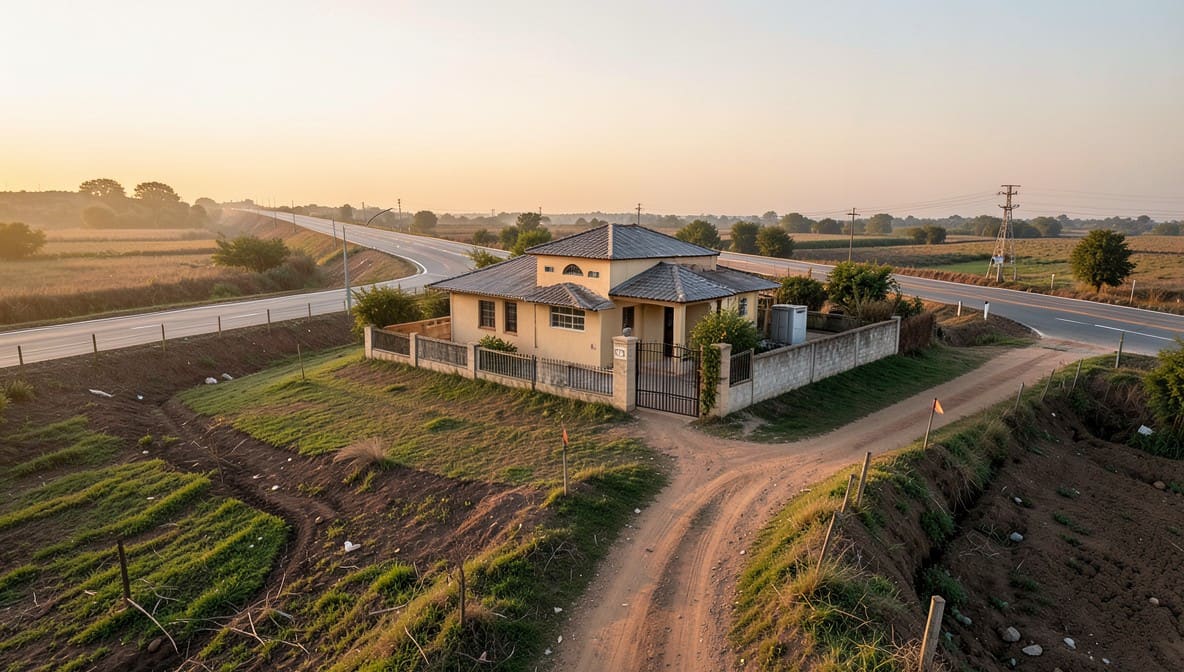
The High Court of Telangana has affirmed that the denial of established road access to a residential colony by a state-owned transport corporation, without due process or alternative provision, constitutes arbitrary state action violative of fundamental rights. This order reinforces the principle that public infrastructure decisions must respect longstanding community access and procedural fairness.
Background & Facts
The Dispute
The petitioners, residents of NTR Colony in Armoor Municipality, Nizamabad District, have historically used a road passing through TGSRTC’s depot land as their primary access route to public thoroughfares. The respondents, including the State of Telangana, District Collector, Armoor Municipality, and TGSRTC officials, commenced construction of a compound wall around the TGSRTC depot, effectively blocking this access without prior notice, consultation, or provision of an alternative route.
Procedural History
The petitioners filed a representation on 22.12.2025 seeking restoration of access and a hearing. No response was rendered. Subsequently, they filed:
- Writ Petition No. 3473 of 2026 under Article 226 of the Constitution, seeking a writ of mandamus to declare the blocking illegal and to direct restoration or provision of alternative access
- IA No. 107 of 2026 under Section 151 CPC, seeking interim stay of construction
Relief Sought
The petitioners sought: (1) a declaration that the blocking of the access road is illegal, arbitrary, and unconstitutional; (2) a direction to restore the existing access; or (3) in the alternative, to provide a viable alternative road before constructing the compound wall.
The Legal Issue
The central question was whether a state entity, such as TGSRTC, can unilaterally block a long-standing public access route to a residential colony without affording the residents an opportunity to be heard or providing a reasonable alternative, and whether such action violates the principles of natural justice and Article 21 of the Constitution.
Arguments Presented
For the Petitioner
Sri Nayakawadi Ramesh, Advocate, argued that the access road had been in continuous, peaceful, and public use for decades, constituting an implied easement and a de facto public pathway. He relied on State of Haryana v. Bhagwan Das and M.C. Mehta v. Union of India to contend that denial of access to basic infrastructure infringes the right to life and personal liberty under Article 21. He further emphasized that the failure to respond to the 22.12.2025 representation violated the mandate of audi alteram partem.
For the Respondent
The Standing Counsel for TGSRTC and the Assistant Government Pleader for Revenue contended that the land on which the compound wall was being constructed was government property vested in TGSRTC, and that the petitioners had no legal title or easementary right over it. They argued that the construction was necessary for security and operational purposes and that no statutory obligation existed to provide alternative access.
The Court's Analysis
The Court rejected the respondents’ contention that the petitioners had no legal right to the access route. It held that even in the absence of a formal easement, prolonged, uninterrupted, and public use of a route by a residential colony creates a legitimate expectation protected under Article 21. The Court emphasized that the State, as a welfare actor, cannot act in a manner that deprives citizens of essential infrastructure without procedural safeguards.
"The right to access one’s residence via a public pathway is not a privilege granted by the State, but a necessary incident of the right to life and dignity. Denial of such access without notice or hearing is arbitrary and unconstitutional."
The Court further noted that the respondents had ignored the petitioners’ formal representation dated 22.12.2025, thereby violating the principle of fair hearing. It observed that the State’s interest in securing its property must be balanced against the fundamental rights of citizens, and that such balancing requires a transparent, participatory process.
The Court declined to adjudicate the final merits at the interim stage but found sufficient grounds to intervene to prevent irreparable harm. It directed the District Collector to conduct a hearing within three weeks, giving all parties an opportunity to present evidence and proposals regarding access.
The Verdict
The petitioners succeeded on the interim relief. The Court directed the District Collector to consider the petitioners’ representation within three weeks, afford them a hearing, and maintain the status quo until then. The construction of the compound wall was stayed pending this process.
What This Means For Similar Cases
Access Cannot Be Terminated Without Hearing
- Practitioners must now argue that any state action blocking established community access routes triggers natural justice obligations, regardless of land ownership
- Failure to respond to representations or conduct hearings renders such actions liable to be set aside under Article 14 and Article 21
Status Quo Is a Protective Measure, Not a Final Ruling
- Courts will intervene to preserve existing access even before determining legal title, recognizing the immediate impact on livelihood and dignity
- Interim orders under Article 226 may be framed to compel administrative action, not merely restrain it
Public Use Creates Legitimate Expectation
- Long-standing public use of a route - even on government land - can establish a legitimate expectation enforceable under constitutional law
- Practitioners should document historical usage through photographs, affidavits, and municipal records to substantiate claims