The Bombay High Court has reaffirmed the primacy of procedural integrity in municipal redevelopment, holding that a first-in-time proposal supported by verified 51% tenant consent cannot be displaced by a competing application, even if the latter claims broader support. This decision reinforces the statutory framework designed to prevent developer-driven chaos and protect vulnerable tenants from protracted uncertainty.
Background & Facts
The Dispute
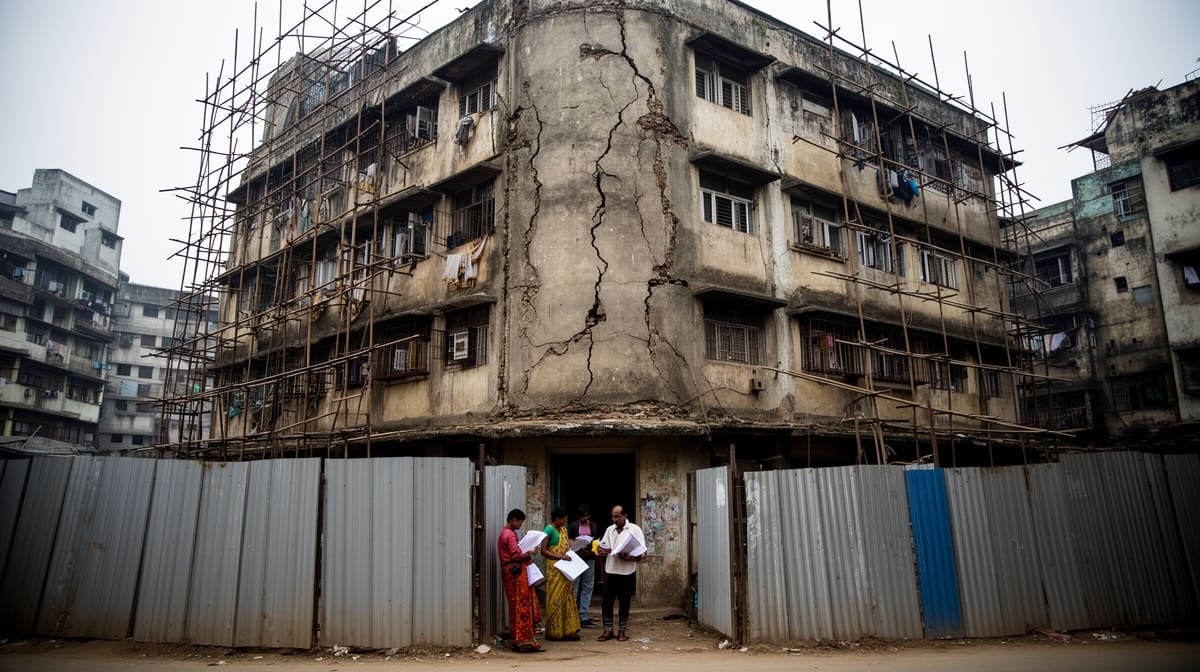
The dispute concerns the redevelopment of seven municipal chawls - Ahmed Manzil Chawl and six others - situated on City Survey Nos. 597, 597A, and 597B in Prabhadevi, Mumbai. The property is governed by the Maharashtra Housing and Area Development Act, 1976, and redevelopment is regulated under Regulation 33(7) of the Development Control and Promotion Regulations, 2034 (DCPR-2034). Two competing redevelopment proposals emerged: one by Sant Rohidas Co-op Housing Society Ltd. (Respondent No. 6) with Atmiya Future Venture Pvt. Ltd. (Respondent No. 5) as developer, and another by Crestline Developer LLP (Petitioner) for five of the seven chawls.
Key Facts
- The seven chawls house 154 municipal tenants: 117 residential and 37 commercial.
- Respondent No. 6/Society was originally registered on 26.08.2009 under the Maharashtra Cooperative Societies Act, 1960.
- An interim liquidation order was passed on 27.11.2017, followed by a final order on 30.07.2018.
- The liquidation order was quashed by the Divisional Registrar, Cooperative Societies, on 15.05.2025, restoring the Society’s legal status.
- On 04.08.2024, the Society held a General Body Meeting and appointed Respondent No. 5/Developer as its redevelopment partner.
- Respondent No. 5 submitted a consolidated proposal for all seven chawls on 13.11.2024, later revised on 24.04.2025.
- Respondent No. 5 submitted 113 consents from tenants: 82 from Principal Tenants and 31 from sub-tenants, amounting to 53.25% of Principal Tenants.
- All consents were duly registered with the Joint Sub-Registrar, Mumbai City/Suburban, as required under the amended Circular No. AC/ESTATES/538455/AE(IMP)/AO(SOC) dated 17.02.2025.
- The Petitioner/Developer filed an online proposal on 03.05.2025 for five chawls only, submitting 45 consents (45.88% of tenants in those five chawls).
- The Municipal Corporation of Greater Mumbai (MCGM) granted preliminary approval to Respondent No. 5 on 26.05.2025 and issued a detailed 22-page order on 17.10.2025 rejecting the Petitioner’s objections.
Procedural History
- 19.10.2016: MCGM issued Letter of Intent (LOI) to Sant Rohidas Society and Hi-Rock Vora & Vishal Joint Ventures for redevelopment.
- 24.06.2024: Administrator (IMP.COM) issued ICR No. 07 terminating the 2016 LOI.
- 02.07.2024: Administrator (Corporation) issued ICR No. 226 confirming termination.
- 03.08.2024: MCGM informed Society and prior developer of termination.
- 04.08.2024: Sant Rohidas Society passed resolution appointing Atmiya Future Venture as developer.
- 13.11.2024: Architect uploaded initial redevelopment proposal online.
- 12.03.2025: MCGM directed submission of consolidated proposal for all seven chawls.
- 03.05.2025: Crestline Developer filed proposal for five chawls.
- 16.05.2025: Crestline submitted additional 17 consents.
- 19.09.2025: Bombay HC disposed of Writ Petition No. 3503 of 2025, directing MCGM to conduct hearings and issue reasoned order by 18.10.2025.
- 01.10.2025 to 08.10.2025: MCGM conducted five hearings with all stakeholders.
- 17.10.2025: MCGM issued detailed order approving Respondent No. 5’s proposal.
- 25.05.2025: Crestline filed Writ Petition No. 4795 of 2025.
- 27.05.2025: Legal notice sent by Crestline to MCGM.
- 13.11.2025: Deepika Jitendra Bhaskar, a tenant, filed WP(L) No. 38451 of 2025.
- 23.01.2026: Arguments concluded.
- 13.03.2026: Judgment pronounced.
The Parties' Positions
Petitioner/Developer (Crestline): Alleged that Respondent No. 6/Society was under liquidation until 15.05.2025, rendering its GBM resolution void. Claimed the meeting was attended by only 17 members, violating the 2/3rd quorum requirement under DCPR-2034. Argued that MCGM failed to verify consents, ignored its own order dated 19.09.2025, and acted arbitrarily by favoring Respondent No. 5 despite its lower consent percentage (45.88% vs. 53.25%). Alleged violation of natural justice, Article 14, and Article 226.
Respondent No. 5/Developer & MCGM: Contended that liquidation was quashed on 15.05.2025, restoring the Society’s authority. Highlighted that 53.25% of Principal Tenants’ consents were duly registered with the Sub-Registrar, satisfying statutory requirements. Emphasized that the proposal was for all seven chawls, while Petitioner’s was limited to five. Cited Awdesh Vasistha Tiwari to assert that only the first valid proposal may be processed. Stated that MCGM conducted five hearings and issued a 22-page reasoned order.
Relief Sought
The Petitioner sought quashing of MCGM’s order dated 17.10.2025, declaration that Respondent No. 5’s proposal is invalid, and direction to consider its own proposal. The Petitioner in WP(L) No. 38451 of 2025 sought similar relief, alleging lack of consultation and procedural unfairness.
The Legal Issue
The central question was whether Regulation 33(7) of DCPR-2034 permits the Municipal Corporation to entertain a second redevelopment proposal while a first valid proposal with statutorily verified 51% tenant consent remains pending, and whether the quashing of a prior liquidation order validates the subsequent consent process.
Arguments Presented
For the Appellant/Petitioner
The Petitioner relied on Awdesh Vasistha Tiwari to argue that simultaneous consideration of proposals is prohibited, but contended that Respondent No. 5’s proposal was invalid because it was initiated by a Society under liquidation. It claimed that the General Body Meeting on 04.08.2024 was procedurally defective due to inadequate quorum and lack of cluster-wide representation. It further argued that MCGM violated its own order dated 19.09.2025 by failing to conduct a fresh verification of consents and by acting without application of mind. The Petitioner invoked principles of natural justice, Article 14, and Article 226 to challenge the arbitrariness of the approval.
For the Respondent/State
The Respondents relied on Awdesh Vasistha Tiwari to assert that only the first valid proposal with 51% registered consents may be processed. They emphasized that the liquidation order was quashed on 15.05.2025, restoring the Society’s legal capacity. They submitted that the consents were registered with the Sub-Registrar, satisfying the amended Circular dated 17.02.2025, which exempted further verification. They argued that the Petitioner’s proposal was incomplete (only five chawls) and filed after the first proposal was already under consideration. The MCGM contended that its 22-page order demonstrated due diligence and compliance with all statutory and judicial mandates.
The Court's Analysis
The Court undertook a meticulous review of the statutory framework under DCPR-2034 and the precedent in Awdesh Vasistha Tiwari v. Chief Executive Officers, Slum Rehabilitation Authority. It held that the scheme of Regulation 33(7) is designed to prevent “unhealthy competition” among developers, which has historically led to tenant displacement, prolonged litigation, and stalled projects across Mumbai.
"The scheme does not contemplate simultaneous consideration of such an application made by a proposed society with an Application subsequently made by another proposed society relating to same land. The Applicant-society has to have 70% support which obviously two societies cannot have. The Application received first is to be processed first independently."
The Court found that Respondent No. 5’s proposal was the first to be submitted for all seven chawls and was supported by 53.25% registered consents - exceeding the statutory threshold. The fact that these consents were registered with the Sub-Registrar, as mandated by the 2025 amendment to the MCGM Circular, rendered further biometric or video verification redundant. The Court rejected the Petitioner’s argument that the Society’s prior liquidation invalidated the consent process, noting that the liquidation order had been quashed on 15.05.2025, thereby validating all subsequent actions taken by the Society.
The Court also dismissed the Petitioner’s claim that the GBM was procedurally defective, observing that the number of attendees was not the sole determinant of validity; the registered consents, not the meeting attendance, were the statutory basis for approval. The Court noted that the Petitioner’s proposal was limited to five chawls and could not be considered while a comprehensive proposal for all seven was pending, as fragmentation would render redevelopment of the remaining two chawls unviable.
Regarding allegations of violation of natural justice, the Court found that MCGM conducted five hearings over eight days, heard all parties, and issued a detailed 22-page order addressing each objection. The Court held that the mere fact that the same officer issued both the preliminary approval (26.05.2025) and the final order (17.10.2025) did not constitute bias, as the latter was a reasoned reconsideration after full hearing.
The Verdict
The Petitioners’ writ petitions were dismissed. The Court upheld MCGM’s order dated 17.10.2025 approving the redevelopment proposal of Respondent No. 5/Developer, based on 53.25% registered consents from Principal Tenants for all seven chawls. The Court confirmed that the quashing of the liquidation order on 15.05.2025 validated the Society’s authority to appoint the developer and secure consents. The Petitioner’s proposal, submitted later and covering only five chawls with 45.88% consent, was deemed ineligible for consideration while the first proposal remained pending. No monetary relief or further directions were issued, as the relief sought was purely declaratory and injunctive.
What This Means For Similar Cases
First Proposal with Verified Consent Is Paramount
- Practitioners must prioritize verifying the chronological sequence of proposals in redevelopment disputes.
- A proposal with 51% registered consents filed first cannot be displaced by a later proposal, even if the latter claims higher support.
- Developers must ensure consents are registered with the Sub-Registrar to comply with the 2025 MCGM Circular and avoid verification delays.
Liquidation Does Not Invalidate Post-Quashing Actions
- A cooperative society’s actions taken after the quashing of a liquidation order are legally valid.
- Consent obtained post-quashing, even if initiated during liquidation, is enforceable if the Society’s status is restored.
- Legal notices challenging redevelopment based on prior liquidation are likely to fail if the order has been set aside.
Fragmented Proposals Are Not Permissible
- Proposals covering only part of a cluster are invalid if a comprehensive proposal for the entire property is pending.
- Municipal authorities may reject partial proposals on grounds of planning feasibility, as fragmentation undermines redevelopment viability.
- Developers must submit consolidated proposals covering all affected units to be eligible for consideration.