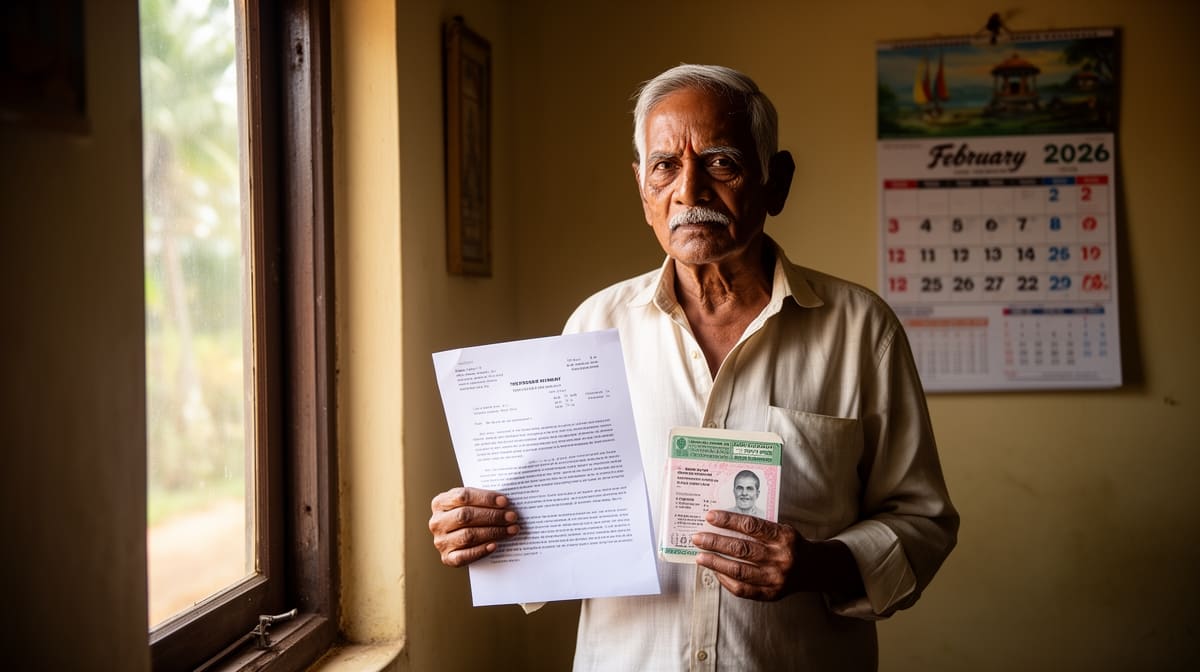
A landmark ruling by the Punjab and Haryana High Court has established that the state cannot recover excess pension payments made over a nine-year period when the pensioner bears no fault, fraud, or concealment. The judgment reinforces the principle that administrative convenience cannot override equity and natural justice, especially when dealing with retired public servants dependent on pension for survival.
Background & Facts
The Dispute
The petitioner, Ruli Singh, served in the Punjab Police from 1966 until his retirement in 2000. He was promoted to Head Constable in 2000 and began receiving pension w.e.f. 01.01.2006. In 2015, the Punjab government, acting through the bank responsible for pension disbursement, discovered an error in the calculation of his pension. It concluded that he had received an excess amount of Rs.4,32,179/- over nine years. The government recovered Rs.90,300/- and issued an order to recover the remaining Rs.3,41,879/- in monthly installments of Rs.4,300/-. The petitioner challenged this recovery as arbitrary and unjust.
Procedural History
- 2006: Pension payments commenced based on government bank’s calculation
- 2015: Government identified alleged overpayment and initiated recovery
- May 14, 2015: Order passed to recover Rs.3,41,879/- in monthly installments
- July 6, 2015: High Court stayed further recovery pending hearing
- March 5, 2026: High Court delivered final judgment
Relief Sought
The petitioner sought quashing of the recovery order, arguing that no fault lay with him. He did not seek refund of the Rs.90,300/- already recovered but opposed any further deduction, citing the Supreme Court’s decision in State of Punjab & Ors. v. Rafiq Masih.
The Legal Issue
The central question was whether the state can recover excess pension payments made over a period of nine years, where the pensioner had no role in the error, did not conceal facts, and relied in good faith on the regular disbursements.
Arguments Presented
For the Petitioner
Counsel argued that the petitioner had no knowledge of the miscalculation and had no opportunity to challenge the pension amount during the nine-year period. He relied on State of Punjab & Ors. v. Rafiq Masih (2015) 4 SCC 334, where the Supreme Court held that recovery of excess pension is impermissible where there is no fraud, misrepresentation, or deliberate concealment by the pensioner. The petitioner emphasized that the error was purely clerical and attributable to the bank and government machinery.
For the Respondent
The state contended that the petitioner had signed an undertaking to refund any excess payment, thereby creating a contractual obligation. It cited High Court of Punjab & Haryana v. Jagdev Singh to argue that a service-provider (bank) has the right to recover overpayments from beneficiaries. It further claimed that the pensioner’s acceptance of payments over nine years amounted to acquiescence.
The Court's Analysis
The Court examined the nature of the relationship between the pensioner and the state. It noted that pension is not a gratuity or bonus but a statutory right earned through service. The Court rejected the notion that a mere undertaking signed by the pensioner could override principles of equity and natural justice.
"The petitioner retired in 2000 and was regularly receiving pension as calculated by the bank. There is no allegation of fraud, misrepresentation, concealment or even negligence on his part. The mistake was entirely on the part of the bank and the administrative machinery."
The Court distinguished Jagdev Singh on the ground that it involved a short-term overpayment with clear knowledge by the recipient. Here, the error persisted for nearly a decade without any notice or opportunity to rectify. The Court held that the state cannot be permitted to benefit from its own administrative failure. The Supreme Court’s ruling in Rafiq Masih was applied squarely: recovery is barred where the pensioner acted in good faith and the error was not attributable to him.
The Court also emphasized the vulnerability of elderly pensioners, noting that the petitioner was bedridden and dependent on the pension for subsistence. The recovery of over Rs.3.4 lakh in monthly installments would cause undue hardship.
The Verdict
The petitioner succeeded. The Court held that recovery of excess pension after nine years is impermissible where the pensioner committed no fraud, concealment, or negligence. The order directing further recovery was quashed. The earlier recovery of Rs.90,300/- was allowed to stand, as the petitioner did not challenge it.
What This Means For Similar Cases
Recovery Cannot Be Based on Administrative Error Alone
- Practitioners must now argue that mere clerical mistakes by government banks or departments cannot justify recovery from pensioners who acted in good faith
- Any recovery demand must be preceded by timely notice and opportunity to respond
- Delay beyond five years, absent fraud, creates a presumption of estoppel against the state
Good Faith Reliance Is a Complete Defense
- Pensioners who receive payments regularly for years without objection from authorities are entitled to assume correctness
- Undertakings signed under administrative pressure are not enforceable if they violate principles of equity
- Courts will apply Rafiq Masih as binding precedent in all pension recovery disputes
Equitable Relief Trumps Technical Claims
- The doctrine of unjust enrichment does not apply when the state is the cause of overpayment
- Courts will prioritize human dignity and financial security of retired public servants over technical accounting corrections
- Recovery orders must be proportionate and must consider age, health, and dependency of the pensioner