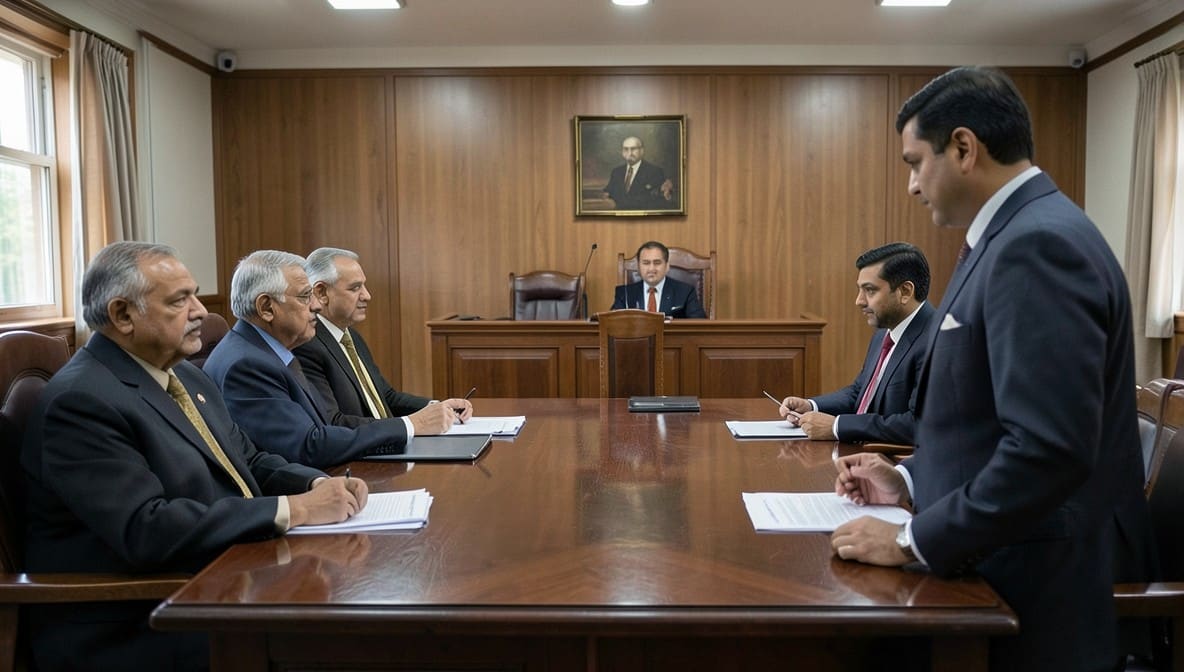
The Chhattisgarh High Court has reaffirmed a critical protection for Class-III government employees: recovery of erroneously paid salaries is legally impermissible when the employee holds a Group C or D post. This judgment, grounded in binding Supreme Court precedent, provides clear doctrinal clarity for public sector employers and employees alike, reinforcing the principle that administrative errors cannot be rectified at the cost of financial hardship to lower-tier service personnel.
Background & Facts
The Dispute
The petitioner, Darshan Singh Keshkar, a Constable (GD) in the Telecommunication Division under the Chhattisgarh Police, was subjected to a recovery order for alleged excess salary payments made over a period of 17 years, from July 2007 to August 2024. The recovery was initiated after a service book audit by the Divisional Joint Director, Treasury Account and Pension, Durg Division, which found that the petitioner’s pay had been incorrectly fixed during this period.
Key Facts
- The petitioner was appointed as a Constable (GD) in the Telecommunication Department, Jagdalpur, Bhilai Zone, on a Class-III post.
- From July 2007 to August 2024, he received salary based on an erroneous pay fixation.
- On 28.04.2025, respondent No. 3 (Superintendent of Police, Telecommunication, Bhilai Zone) issued a notice informing the petitioner of the error and proposing revised pay fixation.
- On 02.02.2026, a formal recovery order was issued directing the deduction of Rs. 2,13,259/- from the petitioner’s future salary.
- The petitioner had not been informed of the pay error at the time of its occurrence, nor had he been asked to provide any undertaking regarding refund of excess payments.
- The petitioner was still in service at the time of the recovery order and had not retired.
Procedural History
- 02.02.2026: Recovery order issued by respondent No. 3 directing deduction of Rs. 2,13,259/-.
- 15.03.2026: Writ Petition (WPS No. 4065 of 2026) filed before the Chhattisgarh High Court seeking quashing of the recovery order.
- 12.05.2026: Hearing conducted before the Hon’ble Justice Bibhu Datta Guru.
Relief Sought
The petitioner sought quashing of the recovery order dated 02.02.2026 and a direction to the respondents to return the amount already recovered, if any, and to cease further deductions.
The Legal Issue
The central question was whether recovery of excess salary payments from a Class-III government employee, made over a period exceeding five years, is permissible in law under the principles laid down in Rafiq Masih v. State of Punjab and subsequent precedents.
Arguments Presented
For the Petitioner
The petitioner’s counsel relied on the binding precedent of State of Punjab v. Rafiq Masih (White Washer) and Others (2015) 4 SCC 334, wherein the Supreme Court held that recovery of excess payments is impermissible in five specific situations, including recovery from Class-III and Class-IV employees. He further cited High Court of Punjab and Haryana v. Jagdev Singh (2016) 14 SCC 267 and two Division Bench judgments of this Court - State of Chhattisgarh v. Labha Ram Dhruv (Writ Appeal No. 264 of 2020) and State of Chhattisgarh v. Roshan Lal Baghel (Writ Appeal No. 265 of 2020) - both of which applied Rafiq Masih to bar recovery from Group C employees. He argued that the petitioner was never given notice at the time of erroneous payment, nor did he provide any undertaking to refund excess amounts, making the recovery arbitrary and violative of natural justice.
For the Respondent
The State counsel contended that the recovery was justified as the error was discovered through a routine audit and that the petitioner had benefited from the incorrect pay fixation for nearly two decades. He submitted that the State had a legitimate right to recover misapplied funds and that the petitioner’s service status did not immunize him from liability. However, no specific legal precedent or statutory provision was cited to counter the Rafiq Masih doctrine.
The Court's Analysis
The Court undertook a detailed examination of the Supreme Court’s judgment in Rafiq Masih, particularly paragraph 10, which enumerates five categories of cases where recovery of excess payments is legally impermissible. The Court noted that the first category explicitly prohibits recovery from employees belonging to Class-III and Class-IV services. The petitioner, holding a Constable (GD) position, unequivocally falls within this classification.
"Recovery from employees belonging to Class-III and Class-IV service (or Group 'C' and Group 'D' service) is impermissible in law."
The Court rejected the State’s argument that the long duration of the error justified recovery, emphasizing that the Rafiq Masih rule is categorical and not subject to balancing of equities. The Court further observed that the State had not demonstrated any fraud, misrepresentation, or intentional wrongdoing by the petitioner. The absence of an undertaking or prior notice rendered the recovery arbitrary and violative of the principle of fairness.
The Court also distinguished the Supreme Court’s observation in paragraph 11 of Rafiq Masih, which permits recovery where the employee had furnished an undertaking - a condition absent in the present case. The petitioner had not signed any document agreeing to refund excess payments upon discovery of error.
The Division Bench judgments of this Court, which had previously applied Rafiq Masih to bar similar recoveries, were affirmed as binding precedents within the jurisdiction.
The Verdict
The writ petition was allowed. The recovery order dated 02.02.2026 is quashed. The respondents are directed to return any amount already recovered from the petitioner within six months from the date of receipt of this order. No further deductions shall be made on account of the alleged excess payment.
What This Means For Similar Cases
Recovery from Class-III Employees Is Per Se Illegal
- Practitioners representing government employees in Class-III or Group C/D posts must immediately invoke Rafiq Masih to challenge any recovery order for excess pay.
- Employers cannot rely on audit findings or long-standing errors to justify deductions from lower-tier service personnel.
- Any recovery order issued against such employees must be challenged at the earliest stage, as courts will not entertain balancing of interests under this rule.
No Undertaking, No Recovery
- The absence of a written undertaking from the employee at the time of pay fixation or during the period of erroneous payment renders recovery legally invalid.
- Employers must ensure that any revised pay fixation is communicated with explicit terms of refund liability - otherwise, future recovery attempts will fail.
- This judgment reinforces that administrative convenience cannot override statutory and constitutional protections for service personnel.
Precedent Binding Across All States
- The Rafiq Masih doctrine is now firmly entrenched in Chhattisgarh’s jurisprudence and applies uniformly to all State government departments.
- Similar cases pending in other High Courts or tribunals must be cited with this judgment as reinforcing authority.
- Legal officers in State Pay Commissions and Pension Departments must review all pending recovery notices against Group C/D employees and withdraw those found non-compliant.