The Bombay High Court has reaffirmed that writ jurisdiction under Article 226 is not available when an efficacious statutory remedy exists under the Public Premises (Eviction of Unauthorised Occupants) Act, 1971. However, recognizing an emergent threat of forcible eviction, the Court granted limited interim protection to petitioners to enable them to approach the District Judge as provided by law.
Background & Facts
The Dispute
The petitioners, Eknath Laxman Shamser and others, are occupants of residential properties situated on land claimed by the Central Railway Zone as public premises under the Public Premises (Eviction of Unauthorised Occupants) Act, 1971. The Estate Officer, Respondent No.1, issued an order dated 16.02.2026 and 23.02.2026 under Section 5(1) of the Act directing eviction of the petitioners. The petitioners challenged this order by filing Writ Petition No. 3084 of 2026 before the Bombay High Court, Aurangabad Bench.
Key Facts
- The petitioners have been in continuous possession of the properties since 1985
- They constructed houses on the land under a government housing scheme
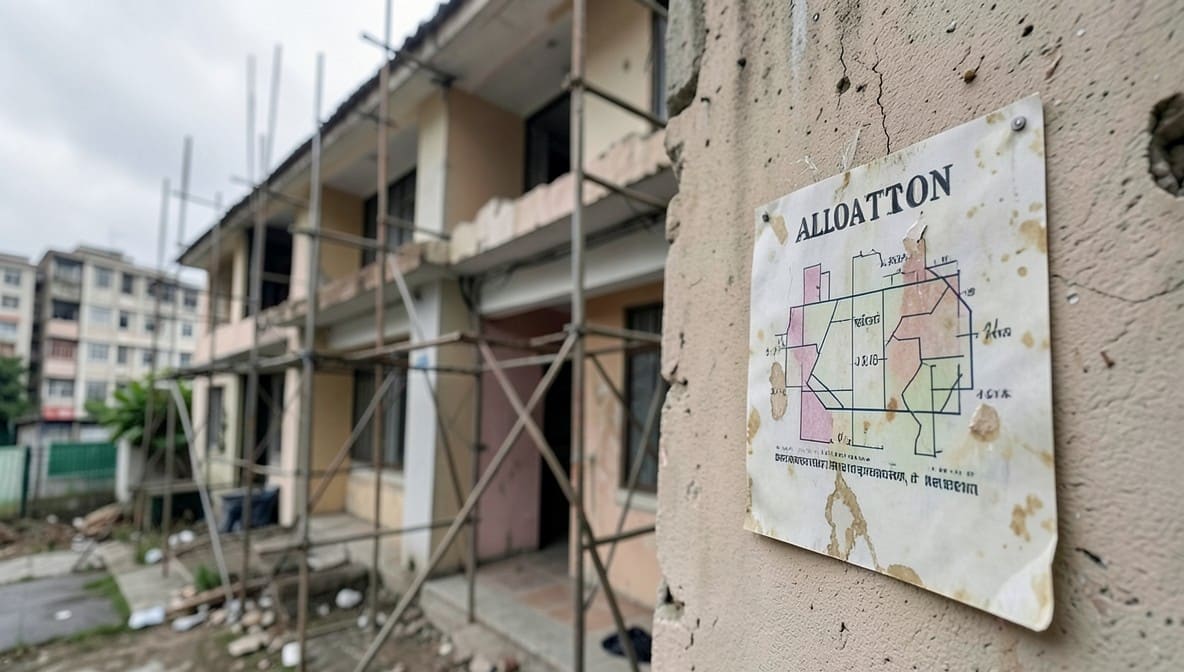
- They possess documentary evidence including allotment letters, payment receipts, and municipal records to substantiate their title and possession
- On 10.01.2026, the Estate Officer issued a notice under Section 4(1) and (2) of the Act calling upon them to show cause why they should not be evicted
- The petitioners submitted a detailed reply on 28.01.2026, accompanied by supporting documents challenging the classification of the land as public premises and asserting their lawful title
- The Estate Officer passed the impugned eviction order on 16.02.2026 and 23.02.2026 without addressing the petitioners’ reply or documents
- By 03.04.2026, the Estate Officer had deployed personnel and machinery (JCBs) at the premises, indicating imminent execution of the eviction order
- The petitioners filed the writ petition on 15.03.2026 seeking quashing of the eviction order and restraint on coercive action
Procedural History
- 10.01.2026: Notice under Section 4(1) and (2) of the Public Premises Act issued by Estate Officer
- 28.01.2026: Petitioners submitted reply with documentary evidence
- 16.02.2026: Impugned eviction order passed under Section 5(1) of the Act
- 23.02.2026: Re-issuance or clarification of the same order
- 03.04.2026: Execution machinery deployed at the premises
- 15.03.2026: Writ Petition filed before Bombay High Court, Aurangabad Bench
- 06.04.2026: Hearing before Justice S.G. Chapalgaonkar
The Parties' Positions
Petitioners: Argued that they are lawful occupants with title dating back to 1985, that the property was allotted under a government housing scheme, and that the Estate Officer failed to consider their documentary evidence. They contended that the impugned order was arbitrary and violative of natural justice. They also highlighted the emergent threat of forcible eviction.
Respondent No.1 (Estate Officer): Maintained that the land in question is public premises under the Act, that the petitioners are unauthorised occupants, and that the eviction order was passed in accordance with law. The respondent did not dispute the existence of documents but argued that the statutory appeal mechanism under Section 9 was available.
Relief Sought
The petitioners sought:
- Quashing of the eviction order dated 16.02.2026 and 23.02.2026
- Stay on all coercive steps including eviction, demolition, or use of machinery
- Direction to the Estate Officer to consider their documents and grant a hearing
The Legal Issue
The central question was whether a writ petition under Article 226 of the Constitution is maintainable to challenge an eviction order under Section 5 of the Public Premises (Eviction of Unauthorised Occupants) Act, 1971, when an efficacious statutory remedy of appeal to the District Judge under Section 9 is available.
Arguments Presented
For the Petitioner
Mr. S.S. Gangakhedkar argued that while Section 9(2)(a) provides an appeal to the District Judge, the petitioners’ situation was exceptional. The Estate Officer had ignored their documentary evidence and passed the order without any reasoning. The imminent deployment of JCBs and personnel constituted an emergent threat to possession, which could not be remedied post-facto through appeal. He relied on the principle that the existence of an alternate remedy does not bar writ jurisdiction when the statutory authority acts arbitrarily or in violation of natural justice.
For the Respondent
Mr. N.U. Yadav contended that the Act of 1971 is a complete code with its own appellate mechanism under Section 9. The legislature intended to channel all disputes arising under the Act through the District Judge. The petitioners had not exhausted this remedy. He cited precedents holding that writ jurisdiction is not a substitute for statutory appeal unless the order is mala fide or the remedy is illusory.
The Court's Analysis
The Court acknowledged the general rule that where a specific statutory remedy is provided, writ jurisdiction under Article 226 is not the appropriate forum. The Court noted that Section 9(2)(a) of the Public Premises Act explicitly provides that any person aggrieved by an order under Section 5 may file an appeal before the District Judge within 60 days.
"The Act of 1971 is a self-contained enactment with a clear appellate structure. The legislature has entrusted the District Judge with the authority to review the findings of the Estate Officer. This mechanism is neither inadequate nor illusory."
The Court further observed that the petitioners had submitted documents challenging the classification of the property as public premises and had established a prima facie case of long-standing possession since 1985. The Estate Officer’s failure to consider these documents rendered the order procedurally defective.
However, the Court emphasized that the existence of an alternate remedy does not automatically preclude judicial intervention when the situation is urgent and irreparable harm is imminent. The Court noted:
"The deployment of JCBs and personnel at the premises indicates an emergent situation where eviction may be executed before the statutory appeal can be filed and heard."
The Court held that while the petitioners must pursue the statutory remedy under Section 9, the threat of immediate eviction warranted limited interim protection to preserve the status quo.
The Verdict
The writ petition was disposed of with the following directions:
- The petitioners are granted liberty to file an appeal before the District Judge under Section 9 of the Public Premises Act within 15 days from the date of this order
- No coercive steps, including eviction, demolition, or use of machinery, shall be taken against the petitioners until the expiry of the 15-day period
- If an appeal is filed within the stipulated time, the District Judge shall consider the petitioners’ prayer for interim relief in accordance with law
- The time consumed in prosecuting this writ petition shall be excluded while computing the limitation period for filing the appeal
What This Means For Similar Cases
Alternate Remedy Is Not Absolute
- Practitioners must still exhaust statutory appeals under special enactments like the Public Premises Act
- However, if the authority acts arbitrarily, ignores evidence, or initiates imminent execution, writ jurisdiction may be invoked for limited interim relief
- The burden is on the petitioner to demonstrate emergent, irreparable harm
Documentary Evidence Triggers Judicial Scrutiny
- Long-standing possession supported by documents (allotment letters, payment records) creates a prima facie case
- Authorities under the Public Premises Act cannot ignore such evidence without reasons
- Failure to consider documents renders the order vulnerable to challenge even through statutory appeal
Procedural Compliance Is Non-Negotiable
- Eviction orders under Section 5 must be preceded by proper consideration of replies and documents under Section 4
- Mechanical orders without reasoning are liable to be set aside
- Courts will not permit execution of orders that violate natural justice, even if statutory remedies exist