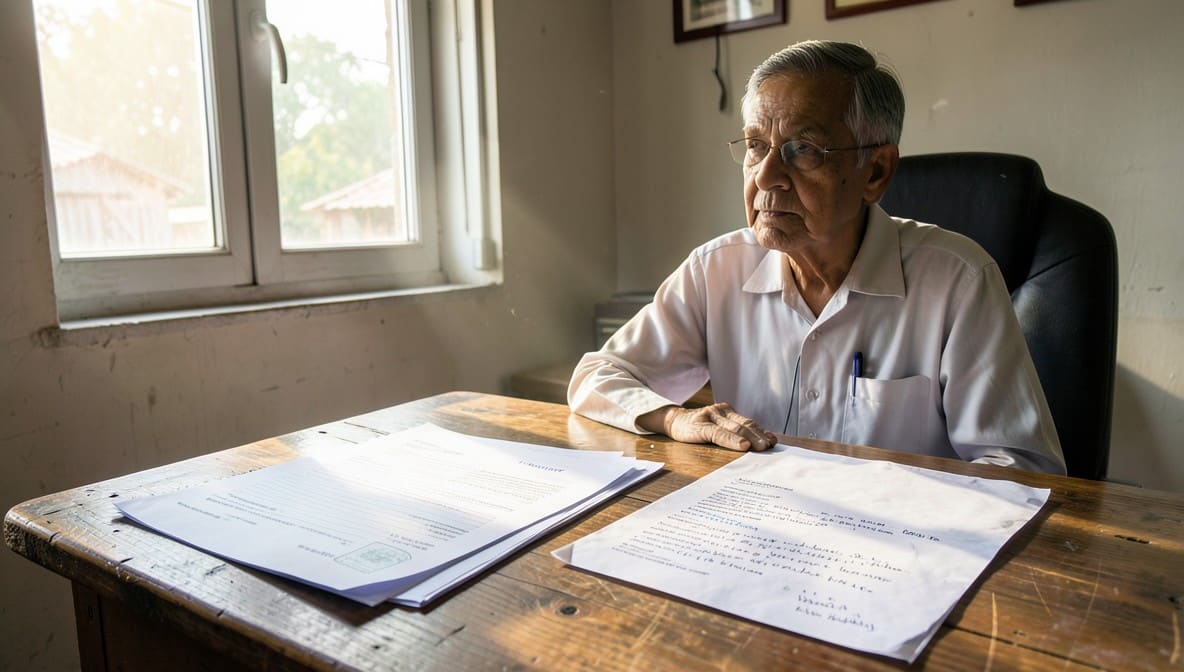
The Bombay High Court Nagpur Bench has held that persistent inaction by revenue authorities to implement a lawful order of a Tahsildar, coupled with demands for illegal gratification, constitutes a clear failure of public duty. This judgment reinforces the state’s obligation to execute statutory orders without undue delay or corruption.
Background & Facts
The Dispute
The petitioners, Rameshwar S/o Yashwanta Choudhari and others, sought enforcement of an order dated 28.03.2025 passed by respondent No.4, the Tahsildar of Sindkhed (Raja), District Buldhana. The order directed respondent No.5, a revenue official, to mutate the petitioners’ names in the revenue records following verification of their claim as legal heirs to ancestral agricultural land.
Key Facts
- The petitioners are legal heirs of a deceased landholder whose property was recorded in the revenue records under the deceased’s name.
- On 28.03.2025, the Tahsildar, after verifying title documents and family records, issued a binding order directing mutation of names in favor of the petitioners.
- Despite the order, respondent No.5 refused to act unless the petitioners obtained an heirship certificate from the Civil Court.
- The petitioners applied before the Civil Judge (Junior Division), Sindkhed (Raja), on 15.07.2025 for an heirship certificate.
- On 01.10.2025, the Civil Judge granted the heirship certificate in MJC No. 22/2020, which was formally issued and submitted to respondent No.5.
- Upon submission of the certificate, respondent No.5 demanded Rs. 1,00,000 as illegal gratification for processing the mutation.
- Respondent No.5 further threatened that, absent payment, he would not comply with the Tahsildar’s order.
- The petitioners issued a legal notice dated 03.11.2025 to respondent No.2 (District Collector) and respondent No.3 (Sub-Divisional Officer), detailing the demand for bribe and inaction.
- No action was taken by the higher authorities in response to the notice.
Procedural History
- 28.03.2025: Tahsildar issues order directing mutation of revenue records.
- 15.07.2025: Petitioners file application for heirship certificate before Civil Judge (Junior Division).
- 01.10.2025: Civil Judge grants heirship certificate (Annexure-P-3).
- 03.11.2025: Petitioners issue legal notice to District Collector and Sub-Divisional Officer.
- 01.04.2026: Writ petition filed before Bombay High Court, Nagpur Bench.
The Parties' Positions
Petitioners: Argued that the Tahsildar’s order was final and binding under revenue law; the demand for bribe and refusal to act violated Article 14 and Article 21 of the Constitution. They contended that requiring an heirship certificate after a Tahsildar’s verification was an illegal procedural hurdle.
Respondents: Did not file a written reply. The Additional Government Pleader appeared and conceded the delay but offered no justification for the inaction or the alleged demand for gratification.
Relief Sought
The petitioners sought a writ of mandamus directing immediate mutation of names in revenue records, initiation of disciplinary proceedings against respondent No.5, and directions to prevent future extortion by revenue officials.
The Legal Issue
Whether the persistent refusal of a revenue official to implement a lawful order of a Tahsildar, coupled with a demand for illegal gratification, amounts to a violation of constitutional rights and warrants judicial intervention under Article 226 of the Constitution.
Arguments Presented
For the Petitioner
Mr. A.J. Thakkar, Advocate, submitted that the Tahsildar’s order dated 28.03.2025 was a statutory duty under Section 88 of the Maharashtra Land Revenue Code, 1966, and could not be obstructed by subordinate officials. He cited State of U.P. v. Raj Kumar to argue that administrative delay in executing lawful orders is a form of arbitrariness. He emphasized that demanding money for performing a statutory duty constitutes corruption under the Prevention of Corruption Act, 1988.
For the Respondent
The Additional Government Pleader did not dispute the facts but argued that the matter was under internal review. No legal submissions were made to justify the delay or the alleged demand for bribe.
The Court's Analysis
The Court observed that the Tahsildar’s order dated 28.03.2025 was not merely advisory but a final determination based on verification of title and heirship. The subsequent demand for an heirship certificate from the Civil Court was redundant, as the Tahsildar had already performed the requisite inquiry under revenue law.
"The duty to implement a lawful order of a competent authority cannot be made contingent upon the payment of illegal gratification or the production of redundant documents."
The Court noted that the petitioners had fully complied with all lawful requirements, including obtaining the heirship certificate, yet the official continued to stall. The Court held that such conduct, if proven, amounts to a criminal offense under the Prevention of Corruption Act and a breach of public trust.
The Court further held that the failure of higher authorities - the District Collector and Sub-Divisional Officer - to act upon the legal notice dated 03.11.2025 constituted a dereliction of supervisory duty under Article 226.
The Verdict
The writ petition is disposed of with the following directions: The Sub-Divisional Officer, Tahsil Sindkhed (Raja), shall implement the Tahsildar’s order dated 28.03.2025 within four weeks. He shall also conduct a due inquiry into the allegations of illegal gratification against respondent No.5 and initiate disciplinary proceedings if the allegations are substantiated. The decision shall be communicated to the petitioners within two weeks of its issuance. An action taken report shall be submitted to the Registry of this Court within six weeks. No costs are awarded.
What This Means For Similar Cases
Administrative Orders Must Be Implemented Without Delay
- Revenue officials cannot impose additional conditions beyond those specified in a Tahsildar’s order.
- Any demand for money or documents not mandated by law is illegal and actionable under Article 226.
- Petitioners in similar cases may now cite this judgment to compel immediate compliance with statutory orders.
Corruption in Revenue Administration Is Judicially Actionable
- Allegations of bribery by revenue staff must trigger mandatory inquiry by supervisory officers.
- Failure to act on complaints against corrupt officials exposes higher authorities to writ jurisdiction.
- This judgment establishes that delay + demand for bribe = prima facie violation of public duty.
Heirship Verification by Tahsildar Is Sufficient
- A Tahsildar’s verification under the Maharashtra Land Revenue Code supersedes the need for a civil court heirship certificate in revenue mutation matters.
- Practitioners should challenge any demand for civil court certificates in revenue mutation proceedings unless explicitly required by statute.