The Rajasthan High Court has reaffirmed that provisional attachment of property under the Prevention of Money Laundering Act cannot be sustained indefinitely when the foundational grounds for such attachment are no longer valid. This ruling underscores the constitutional imperative of proportionality and the right to property under Article 300A, even in cases involving serious economic offences.
Background & Facts
The Dispute
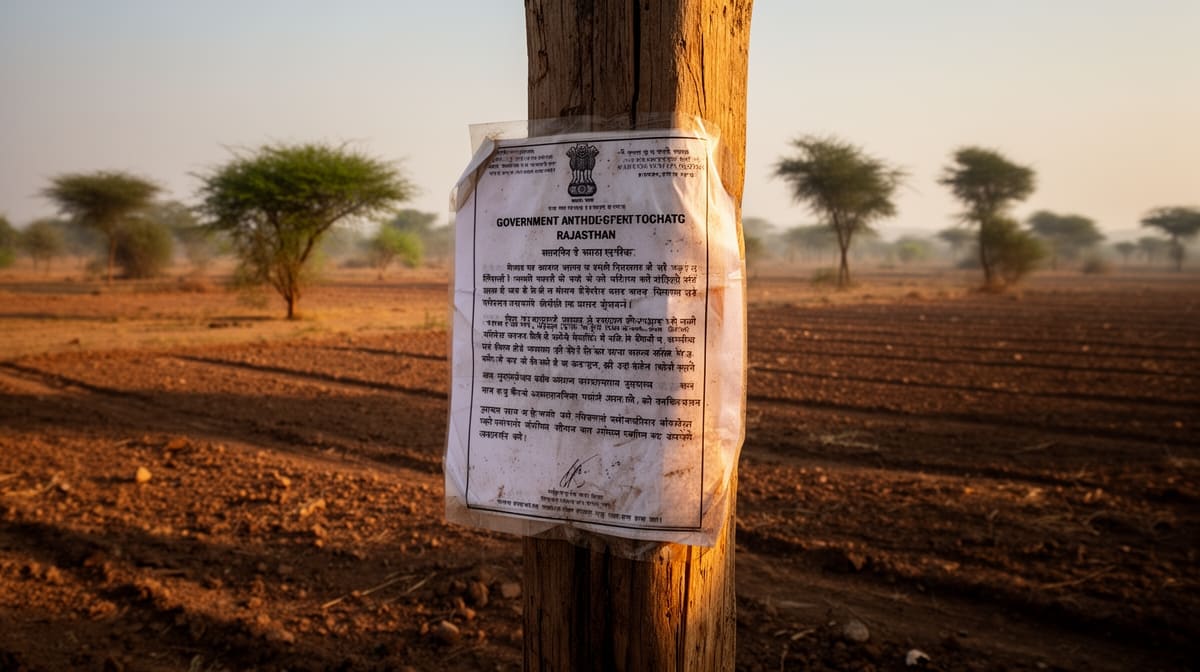
The petitioner, Mohan Lal Dangi, challenged the provisional attachment of Khasra No. 562 in Udaipur, which was ordered under the Prevention of Money Laundering Act, 2002 (PMLA), on the basis of alleged proceeds of crime linked to a separate CBI case. The attachment was issued on 12 September 2020 and remained in force despite the withdrawal of similar prohibitory orders against adjacent Khasra No. 561, which was identically situated and similarly alleged.
Procedural History
- 12 September 2020: Provisional Attachment Order (PAO No. 05/2020) issued under Section 5 of PMLA against Khasra No. 562.
- 26 March 2021: Confiscation order issued under Section 8(4) of PMLA, seeking permanent forfeiture.
- 2024: Petitioner filed Writ Petition No. 18357/2024 before the Rajasthan High Court, seeking quashing of both orders.
- 24 February 2026: Respondent Directorate of Enforcement admitted in court that proceedings to release the property had been initiated.
Relief Sought
The petitioner sought quashing of the Provisional Attachment Order dated 12.09.2020 and the Confiscation Order dated 26.03.2021, arguing that the continued attachment was arbitrary and violative of Article 14 and Article 300A of the Constitution, especially since the basis for attachment against the adjacent plot had been withdrawn.
The Legal Issue
The central question was whether provisional attachment under Section 5 of the PMLA can be maintained when the factual and legal basis for such attachment - particularly in relation to identically situated properties - has been formally withdrawn by the same enforcement agency.
Arguments Presented
For the Petitioner
The petitioner’s counsel argued that continued attachment of Khasra No. 562 violated the principle of equality under Article 14, as the Enforcement Directorate had already withdrawn prohibitory orders against Khasra No. 561, which was identical in nature, location, and alleged connection to the offence. Reliance was placed on P. Chidambaram v. Directorate of Enforcement to assert that attachment must be based on concrete, specific evidence and cannot be sustained by mere suspicion or procedural inertia.
For the Respondent
The Directorate of Enforcement conceded that the process for release of the property had been initiated, acknowledging that the continued attachment lacked justification in light of the withdrawal of similar orders. The counsel did not contest the petitioner’s core argument regarding arbitrariness but sought time to complete internal review procedures.
The Court's Analysis
The Court examined the nature of provisional attachment under Section 5 of the PMLA, noting that it is an extraordinary measure intended to preserve assets pending adjudication, not to punish or prejudice the owner. The Court emphasized that provisional attachment is not a final confiscation and must be reviewed periodically to ensure its continued necessity.
"The Enforcement Directorate cannot retain property under the shadow of an attachment order when the very rationale for such attachment, as applied to identical properties, has been abandoned. This amounts to arbitrary state action, contrary to the rule of law."
The Court held that the withdrawal of prohibitory orders against Khasra No. 561 rendered the continued attachment of Khasra No. 562 legally indefensible. The doctrine of equal treatment under similar circumstances was invoked to strike down the discriminatory application of enforcement action. The Court further noted that the right to property, though not a fundamental right, remains a constitutional right under Article 300A, and cannot be extinguished without due process.
The Verdict
The petitioner succeeded. The Court held that provisional attachment under PMLA cannot persist when its foundational basis is withdrawn, and directed all concerned authorities, including the Special Court under PMLA, to release Khasra No. 562 from attachment within one month, in accordance with law.
What This Means For Similar Cases
Attachment Cannot Outlive Its Justification
- Practitioners must now challenge prolonged attachments under PMLA where the Enforcement Directorate has withdrawn similar orders against comparable properties.
- The burden shifts to the state to demonstrate a continuing nexus between the property and proceeds of crime; mere procedural delay is insufficient.
- Courts will scrutinize selective enforcement as a potential violation of Article 14.
Procedural Fairness Trumps Investigative Convenience
- The judgment reinforces that provisional attachment is a temporary safeguard, not a tool for indefinite pressure.
- Authorities must initiate review mechanisms within reasonable timeframes, especially when external circumstances (like withdrawal of orders on adjacent properties) undermine the original basis.
- Delay in releasing property, even if not malicious, constitutes a violation of constitutional rights if no new evidence emerges.
Judicial Oversight Is Non-Negotiable
- The Court’s directive to the Special Court under PMLA to act expeditiously signals that judicial oversight cannot be bypassed even in high-stakes economic investigations.
- Practitioners should now routinely seek interim directions for release where attachment orders appear stale or inconsistent.
- This precedent may be invoked in other jurisdictions to challenge prolonged PMLA attachments lacking updated evidentiary support.