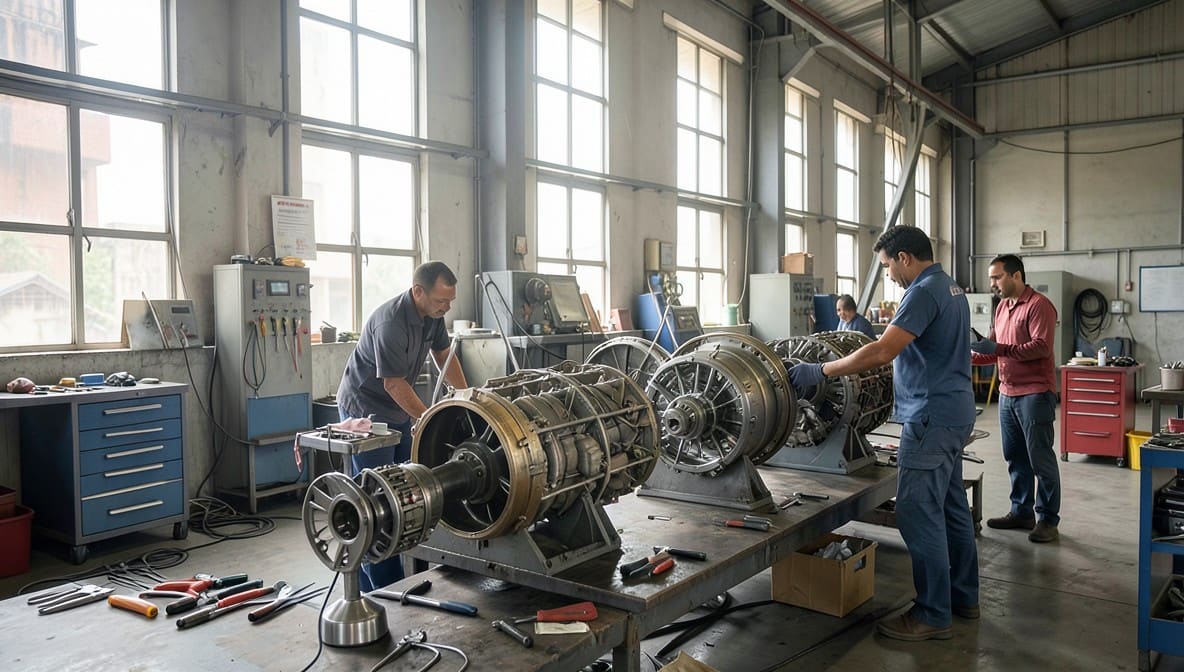
The Income Tax Appellate Tribunal, Delhi, has clarified that a provision for repair of unserviceable aircraft spares, though contingent in nature, may be allowable as a business expense if grounded in reasonable estimation based on inventory data and industry practice. This ruling overturns a rigid application of the 'actual expenditure' principle in the airline sector, where maintenance cycles are inherent and predictable.
Background & Facts
The Dispute
The appellant, M/s Jet Lite (India) Limited, an airline operator, made a provision of Rs. 14,97,52,191/- during the assessment year 2007-08 for the anticipated repair of unserviceable aircraft spare parts. The Assessing Officer disallowed this provision, characterizing it as an unascertained and contingent liability with no actual expenditure incurred. The Commissioner of Income Tax (Appeals)-23 upheld this disallowance, holding that no expenditure had been actually incurred and that the provision was merely an estimate without supporting documentation.
Key Facts
- The appellant acquired aircraft inventory and spare parts as part of its core business operations in the airline industry
- Upon change in management, a material audit was conducted, resulting in an inventory of spare parts across five categories: rotatable, repairable, expendable, consumable, and expendable-repairable
- The audit identified unserviceable spares held both by the company and its vendors
- Based on this inventory, the company estimated the cost required to repair and restore these spares to serviceable condition
- The provision was not for replacement but for repair - a common practice in aviation maintenance
- The revenue authorities rejected the provision on grounds of contingency and lack of actual expenditure
Procedural History
- 25.05.2010: Assessment order passed by Assessing Officer disallowing provision of Rs. 14,97,52,191/-
- 28.01.2015: CIT(A) order confirmed the disallowance
- 16.03.2026: Hearing before ITAT Delhi - appellant failed to appear
- 03.06.2026: ITAT pronounced order ex-parte
The Parties' Positions
Appellant’s Position: The provision was based on a systematic inventory audit and industry-specific maintenance practices. In aviation, repair of unserviceable spares is a recurring, predictable cost. The estimate was not speculative but derived from actual physical data. Precedents support allowance of such provisions if based on reasonable probability.
Revenue’s Position: No actual expenditure was incurred during the year. The provision was an estimated liability, not an ascertained one. Under Section 37 of the Income Tax Act, only actual expenses are deductible. Contingent liabilities cannot be claimed as deductions.
Relief Sought
The appellant sought deletion of the disallowance of Rs. 14,97,52,191/- and allowance of the provision as a legitimate business expense under Section 37.
The Legal Issue
Whether a provision for repair of unserviceable aircraft spares, based on a documented inventory and industry practice, constitutes an allowable business expense under Section 37 of the Income Tax Act, 1961, despite being contingent and not yet actually incurred.
Arguments Presented
For the Appellant
The appellant relied on two landmark Supreme Court decisions: Bharat Earth Movers v. Commissioner of Income Tax ([2000] 245 ITR 428) and Chainrup Sampatram v. CIT (1953) 24 ITR 481. In Bharat Earth Movers, the Court held that a provision for future liabilities, if based on reasonable estimation and arising from business necessity, is allowable. In Chainrup Sampatram, the Court affirmed that a provision for anticipated business loss or expenditure is deductible if there is a reasonable probability of its incurrence. The appellant argued that in the airline industry, repair of unserviceable spares is not an occasional cost but a continuous operational requirement. The provision was not arbitrary but derived from physical inventory data.
For the Respondent
The Revenue contended that Section 37 permits only actual, not estimated, expenditures. The provision was not supported by invoices, contracts, or payment records. The liability was contingent and uncertain - the spares might be scrapped, not repaired. The Revenue cited the CIT(A)'s reasoning that the correct accounting treatment was to write off unserviceable spares and claim repair costs only upon actual incurrence.
The Court's Analysis
The Tribunal acknowledged the Revenue’s reliance on the principle that only actual expenditures are deductible. However, it emphasized that the nature of the airline industry necessitates a pragmatic approach. The Court noted that the appellant’s provision was not speculative but rooted in a detailed inventory audit and industry-specific classification of spares.
"In the airline industry, spares play a key role in maintaining airworthiness of aircraft... Replacement or repair of unserviceable spares is an ongoing exercise."
The Tribunal rejected the Revenue’s rigid interpretation, distinguishing between mere contingency and reasonable estimation based on business reality. It held that the CIT(A) erred in treating all provisions as non-deductible merely because they were not yet paid.
The Court explicitly invoked Bharat Earth Movers, observing that the Supreme Court had permitted provisions for future liabilities where the business context made their incurrence inevitable. Similarly, Chainrup Sampatram established that a provision for anticipated loss is allowable if based on reasonable probability.
The Tribunal further noted that the Revenue’s own position - that repair costs should be claimed only upon actual expenditure - was inconsistent with the operational reality of aviation maintenance, where spares are routinely repaired and reused over multiple cycles. The provision was not an attempt to inflate expenses but to match costs with the period in which the risk of failure arose.
The Tribunal concluded that the disallowance was legally unsustainable in light of the nature of the business and binding precedents.
The Verdict
The appellant succeeded on the first substantive ground. The ITAT allowed the provision of Rs. 14,97,52,191/- for repair of unserviceable spares as a deductible business expense under Section 37. The order of the CIT(A) dated 28.01.2015 was set aside in respect of this amount. Necessary computation of the revised taxable income shall be done in accordance with law. The appeal was otherwise dismissed for failure to press other grounds.
What This Means For Similar Cases
Provisions Based on Industry Practice Are Allowable
- Practitioners may now argue that provisions for recurring operational costs in regulated industries (aviation, shipping, power generation) are deductible if based on documented inventory and industry norms
- Blanket disallowance of provisions solely on the ground of contingency is legally untenable
- Documentation of inventory, audit reports, and technical manuals supporting the estimate strengthens the claim
Estimation ≠ Speculation
- A provision is not disallowable merely because the exact amount is not known at year-end
- Reasonable estimation derived from historical data, physical counts, or technical assessments satisfies the requirement of "business necessity"
- The burden shifts to the Revenue to prove the estimate is arbitrary or inflated
Section 37 Must Be Interpreted Contextually
- Section 37 does not require actual payment; it requires the expense to be laid out "wholly and exclusively" for business purposes
- The timing of expenditure recognition may differ from the timing of payment - accrual basis accounting is recognized under tax law
- This judgment reinforces that tax law must accommodate commercial realities, not impose mechanical accounting standards