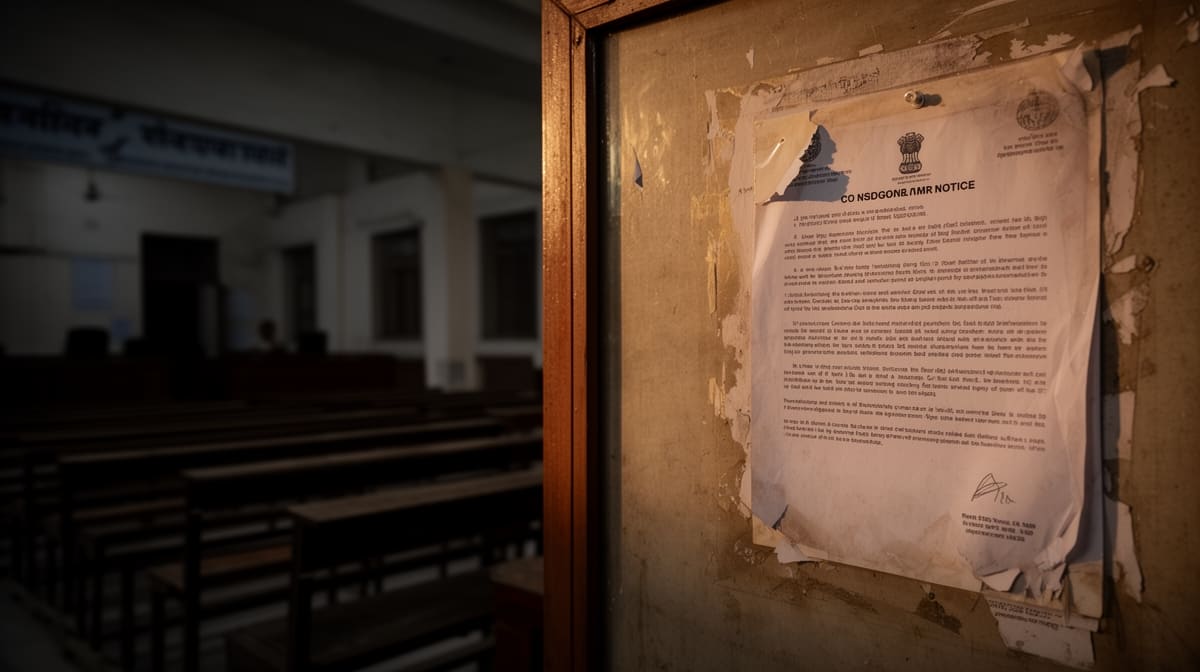
The Punjab and Haryana High Court has reaffirmed that the declaration of a person as proclaimed offender cannot proceed without strict adherence to the mandatory procedural safeguards under Section 82 of the Code of Criminal Procedure. This judgment underscores that procedural irregularities in proclamation proceedings vitiate the entire legal process, regardless of the nature of the underlying offence.
Background & Facts
The Dispute
The petitioner, Arshdeep Singh Gill, was named as an accused in FIR No. 170 dated 02.10.2018 registered at Police Station Machhiwara under Sections 295, 160, 323, 506 and 34 of the Indian Penal Code. He was granted bail by the Trial Court. During the pendency of trial, the parties reached a mutual compromise, and a petition for quashing the FIR was filed before this Court but later withdrawn on 20.02.2024. The petitioner, believing the matter was resolved, travelled abroad for higher studies.
Procedural History
- 12.04.2024: Petitioner failed to appear before the Trial Court due to notice being received by his father; bail and surety bonds were forfeited and warrants of arrest issued.
- 07.10.2024: Warrants remained unexecuted; proclamation issued under Section 82 CrPC.
- 11.11.2024: Serving constable submitted report stating petitioner was not found at residence; one copy of proclamation affixed to gate, one to bus stand, one to court notice board.
- 09.12.2024: Trial Court declared petitioner a proclaimed person without recording judicial satisfaction or verifying compliance with Section 82(2).
Relief Sought
The petitioner sought quashing of the impugned order dated 09.12.2024 declaring him a proclaimed person, arguing non-compliance with mandatory procedural requirements under Section 82 CrPC and absence of wilful absconding.
The Legal Issue
The central question was whether a person can be declared a proclaimed offender under Section 82 of the Code of Criminal Procedure, 1973 when the statutory requirements for publication of the proclamation - particularly public reading, affixation at residence, and court notice board - are not fulfilled, and when the Court is aware the accused is abroad.
Arguments Presented
For the Petitioner
Counsel argued that the Trial Court failed to comply with the conjunctive requirements of Section 82(2)(i), which mandates three modes of publication: public reading, affixation at the accused’s residence, and affixation at the court-house. The constable’s report showed only two affixations and no public reading. Counsel cited Sonu v. State of Haryana to emphasize that non-compliance renders the proclamation a nullity. It was further submitted that the petitioner was not absconding but had gone abroad under a bona fide belief that the case was compromised.
For the Respondent
The State contended that the Trial Court had recorded satisfaction regarding due service and passage of the 30-day period. It argued that the petitioner’s absence despite bail forfeiture indicated deliberate evasion. The State relied on the constable’s report and claimed technical compliance, asserting that the petitioner’s conduct disentitled him to relief.
The Court's Analysis
The Court held that Section 82 CrPC is mandatory and not directory. Any deviation from its procedural mandates vitiates the entire proceeding. The Court emphasized that the three modes of publication under Section 82(2)(i) are conjunctive, not disjunctive, as established in Pawan Kumar Gupta v. State of W.B. and reaffirmed in Sonu v. State of Haryana. The absence of public reading in a conspicuous place rendered the proclamation legally invalid.
"The three sub-clauses (a)-(c) in section 82(2)(i) of the Cr.P.C., 1973 are conjunctive and not disjunctive, which means that there would be no valid publication of the proclamation unless all the three modes of publication are proved."
The Court further noted that the Trial Court was aware from the zimni order dated 21.07.2023 that the petitioner had gone abroad for studies. Despite this, the Court proceeded to declare him a proclaimed person, thereby ignoring the foundational requirement under Section 82(1) that the accused must be absconding or concealing himself to evade arrest. The mechanical reliance on the constable’s report, without independent judicial satisfaction, amounted to a failure of due process.
The Court also rejected the State’s argument that the petitioner’s conduct justified the proclamation. It held that even if the petitioner erred in believing the case was compromised, this did not equate to wilful evasion of process. The Court invoked its inherent powers under Section 528 of the Bharatiya Nagarik Suraksha Sanhita, 2023 (equivalent to Section 482 CrPC) to prevent abuse of process and secure justice.
The Verdict
The petitioner succeeded. The Court quashed the impugned order dated 09.12.2024 declaring him a proclaimed person and all consequential proceedings. The Court held that proclamation proceedings under Section 82 CrPC are null and void if mandatory publication requirements are not strictly complied with, regardless of the accused’s conduct or the gravity of the offence.
What This Means For Similar Cases
Proclamation Requires Triple Compliance
- Practitioners must verify that all three modes of publication under Section 82(2)(i) - public reading, affixation at residence, and affixation at court-house - are documented in writing.
- A single affixation or oral report by a constable is insufficient; the Court must record a written statement of compliance.
- Failure to conduct public reading invalidates the proclamation even if other steps are completed.
Awareness of Accused’s Absence Outside Jurisdiction Is Fatal
- If the Court has evidence that the accused is abroad or outside the jurisdiction, it cannot presume absconding under Section 82(1).
- Proclamation cannot be issued as a punitive measure for non-appearance if the accused is not evading process but is genuinely unreachable due to legitimate reasons.
- Courts must distinguish between inadvertent non-appearance and intentional evasion.
Judicial Satisfaction Must Be Recorded, Not Assumed
- The Court’s written statement under Section 82(3) is conclusive evidence - but only if the underlying facts support it.
- Mechanical issuance of proclamation based on police reports without independent judicial scrutiny violates Article 21.
- Practitioners should challenge proclamation orders on grounds of non-recorded satisfaction, even if the order purports to comply with Section 82(3).