The Allahabad High Court has affirmed that administrative decisions in public recruitment cannot rest on erroneous physical measurements, especially when verified medical evidence confirms eligibility. The judgment underscores the duty of state authorities to ensure procedural fairness and accurate assessment in selection processes.
Background & Facts
The Dispute
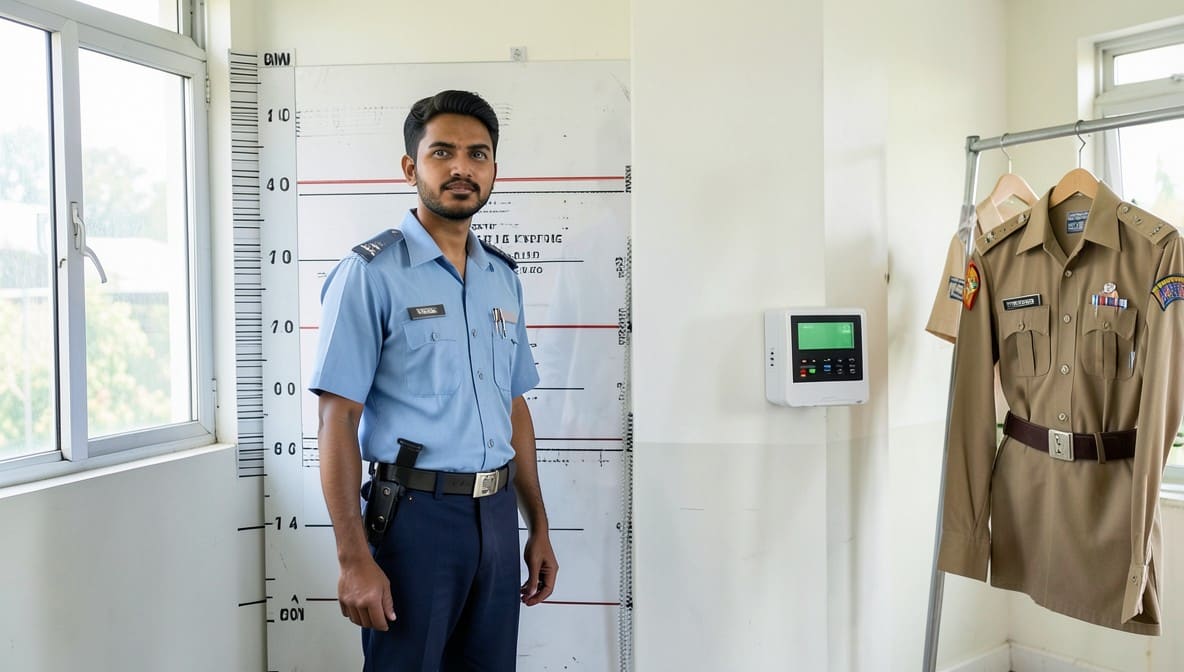
The appellant, Danish Fareed, applied for recruitment to the Uttar Pradesh Police under Advertisement No.????????-??-2(3 ???)/2020 dated February 2021. The post required a minimum height of 167.5 cm. The appellant claimed to meet this criterion with a height of 168 cm, as certified by two medical institutions. However, during the Physical Efficiency Test (PET) conducted on 10.06.2022, his height was recorded as 167.2 cm, leading to his disqualification.
Key Facts
- The appellant submitted medical certificates from the In-charge Medical Officer, PAC 32 Battalion, Lucknow, and Balrampur Medical Hospital, Lucknow, both certifying his height as 168 cm
- These certificates were annexed to the writ petition filed on 25.05.2022
- The PET result dated 10.06.2022 recorded his height as 167.2 cm, resulting in rejection
- The writ petition was filed on 25.05.2022 challenging the disqualification
- The single judge dismissed the writ petition on 12.07.2022, relying solely on the PET measurement
- The appellant filed Special Appeal No. 537 of 2022 on 15.08.2022
- On 26.03.2026, the Division Bench ordered a fresh medical examination by a Special Medical Board
- The Special Medical Board, comprising five experts including two Orthopaedic Surgeons, a Deputy Director, the CMO, and a Head of Department, conducted the measurement on 06.04.2026
- The Board’s report, received in sealed cover on 04.05.2026, recorded the appellant’s height as 168.0 cm
Procedural History
- February 2021: Advertisement No.????????-??-2(3 ???)/2020 issued for police recruitment
- 10.06.2022: Physical Efficiency Test conducted; appellant’s height recorded as 167.2 cm
- 12.07.2022: Single Judge dismissed Writ Petition No. 9257 of 2022
- 15.08.2022: Special Appeal No. 537 of 2022 filed before Division Bench
- 26.03.2026: Division Bench ordered constitution of Special Medical Board
- 06.04.2026: Special Medical Board measured appellant’s height
- 07.04.2026: Appellant informed of examination venue
- 04.05.2026: Sealed report of Special Medical Board submitted to court
Relief Sought
The appellant sought quashing of the dismissal order dated 12.07.2022, declaration of his eligibility, and direction to issue an appointment letter based on his successful clearance of all selection stages.
The Legal Issue
The central question was whether an administrative decision disqualifying a candidate on the basis of a single physical measurement, contradicted by prior certified medical evidence and later confirmed by a multidisciplinary medical board, can stand without violating principles of natural justice and substantive fairness.
Arguments Presented
For the Appellant
Learned counsel argued that the initial measurement of 167.2 cm was erroneous and inconsistent with two prior certified medical reports. He relied on the doctrine of audi alteram partem and the principle that administrative action must be based on accurate and verified facts. He emphasized that the appellant had already cleared all other selection stages and that the disqualification was based on a flawed process, not on any genuine deficiency.
For the Respondent
The State did not contest the findings of the Special Medical Board. The Additional Chief Standing Counsel conceded that the Board’s report was conclusive and that the earlier measurement was likely an error. No counter-argument was advanced against the appellant’s eligibility.
The Court's Analysis
The Court examined the discrepancy between the PET measurement and the certified medical reports. It noted that the initial disqualification was based on a single measurement conducted under potentially unstandardized conditions, while the subsequent assessment was carried out by a five-member medical board including specialists in orthopaedics, ophthalmology, and public health administration.
"The height of a person such as the petitioner, at his age, may not vary or improve as may allow for any further objection to be raised that the petitioner has met the eligibility after the examination process was over."
The Court held that the petitioner’s eligibility was not a matter of subsequent compliance but of correct assessment from the outset. The State’s failure to verify the measurement before disqualification amounted to a procedural lapse that prejudiced the appellant’s right to fair opportunity. The Court emphasized that once a candidate clears all other selection criteria, a minor discrepancy in physical measurement - especially when later corrected by authoritative medical evidence - cannot justify permanent exclusion.
The Court further observed that the report of the Special Medical Board, prepared under judicial supervision and submitted in sealed cover, was beyond challenge and constituted conclusive evidence of the appellant’s qualification.
The Verdict
The Special Appeal and the writ petition were allowed. The order dated 12.07.2022 dismissing the writ petition was set aside. The State was directed to issue an appointment letter to the appellant consequent to his successful clearance of the selection process under Advertisement No.????????-??-2(3 ???)/2020 dated February 2021. No costs were awarded. The report of the Special Medical Board, confirming the appellant’s height as 168.0 cm, was sealed and retained on record.
What This Means For Similar Cases
Accurate Measurement Is Mandatory in Physical Tests
- Practitioners must challenge disqualifications based on single-point physical measurements where multiple certified reports exist
- Administrative bodies must adopt standardized, calibrated equipment and trained personnel for height, weight, or endurance tests
- A candidate’s prior medical certification cannot be disregarded without independent verification
Post-Selection Eligibility Cannot Be Denied on Flawed Preliminary Data
- Once a candidate clears written, interview, and other stages, a disputed physical measurement must be re-verified before final rejection
- Courts will intervene where the state relies on unverified or inconsistent data to deny appointment
- The burden shifts to the state to prove the accuracy of its measurement when contradicted by credible medical evidence
Judicial Oversight Ensures Procedural Fairness
- Courts will not uphold administrative decisions that lack transparency or scientific rigor
- The constitution of a Special Medical Board under judicial direction establishes a new benchmark for resolving contested physical eligibility
- This precedent applies to all state recruitment involving physical standards, including police, paramilitary, and forest services