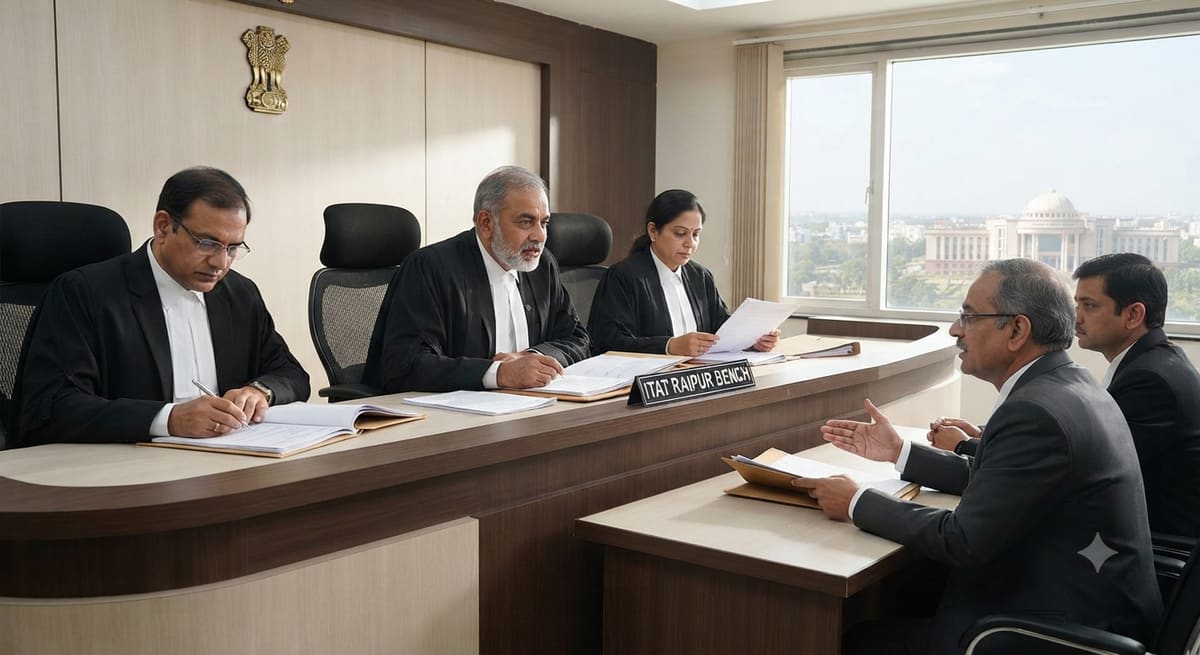
The Income Tax Appellate Tribunal has delivered a significant ruling affirming that procedural lapses, however substantial, cannot override the principle of substantial justice when a taxpayer asserts a legitimate claim of statutory exemption. In a case involving a government-funded medical trust, the Tribunal restored multiple assessments and penalties to the Assessing Officer for de-novo adjudication, emphasizing that technicalities must not defeat the core objective of tax law: fair adjudication on merits.
Background & Facts
The Dispute
The appellant, Gujarat Medical Education and Research Society (GMERS), is a trust established by the Government of Gujarat to operate eight medical colleges and nine hospitals, with over 90% of its funding derived from state grants. For Assessment Years 2015-16 and 2018-19, GMERS did not file income tax returns, relying on its belief that its income was fully exempt under Section 10(23C)(iiiab) and Section 10(23C)(iiiac) of the Income-tax Act, 1961. Despite this, the Assessing Officer initiated reassessment proceedings under Section 147 after detecting large cash deposits, time deposits, rental income, and interest receipts through the Non-filers Monitoring System.
Procedural History
- 2022: Notice under Section 148 issued; multiple notices under Sections 148A(b), 142(1), and 144 ignored by GMERS.
- 2023: Assessment completed ex parte under Sections 147, 144, and 144B, adding Rs. 4,898.5 crore for A.Y. 2015-16 and Rs. 478.2 crore for A.Y. 2018-19 under Sections 69 to 69C and 115BBE.
- 2024: GMERS filed appeals before the CIT(A) after delays of 257 days (A.Y. 2015-16) and 258 days (A.Y. 2018-19), accompanied by affidavits citing bona fide belief in exemption and absence of tax consultants.
- CIT(A): Rejected condonation of delay, dismissed quantum appeals in limine, and upheld penalties under Sections 271(1)(c), 270A, and 271AAC(1) on the basis of finality of the assessment.
Relief Sought
GMERS sought: (1) condonation of delay in filing appeals; (2) deletion of additions on grounds of exemption under Section 10(23C); (3) quashing of penalties as they were contingent on unlawful additions; and (4) restoration of appeals for adjudication on merits.
The Legal Issue
The central question was whether procedural non-compliance, including delay in filing appeals and failure to respond to notices, can justify dismissal of appeals in limine without adjudicating a claim of statutory exemption under Section 10(23C), particularly when the taxpayer is a large public-interest entity and the additions are based on ex parte proceedings.
Arguments Presented
For the Appellant
The appellant argued that: (1) its non-filing of returns was based on a genuine, albeit mistaken, belief in exemption under Section 10(23C), which qualifies as reasonable cause under Section 273B; (2) the Assessing Officer’s ex parte assessment lacked evidentiary foundation and violated natural justice; (3) the CIT(A) erred in treating penalty appeals as automatically consequential to quantum appeals, ignoring settled law that penalty requires independent scrutiny; and (4) the Supreme Court in Collector, Land Acquisition v. Mst. Katiji mandates a liberal approach to procedural delays in the interest of substantial justice.
For the Respondent
The Revenue contended that: (1) Section 139(1) imposes a mandatory obligation to file returns if income exceeds the exemption limit, regardless of claimed exemptions; (2) failure to respond to statutory notices constitutes negligence, not reasonable cause; (3) the CIT(A) correctly applied the principle that once an appeal is time-barred, the assessment attains finality and penalties based on it cannot be disturbed; and (4) GMERS, as a large institution, was expected to maintain professional compliance.
The Court's Analysis
The Tribunal acknowledged the appellant’s procedural failures but emphasized that the nature of the entity and the magnitude of the additions demanded a merits-based adjudication. It observed that the Assessing Officer had made massive additions - over Rs. 4,800 crore for A.Y. 2015-16 - based entirely on ex parte proceedings, without examining any documentary evidence submitted by the assessee.
"The issues involved require proper verification of facts, examination of documentary evidence and adjudication on merits, which has not taken place either at the assessment stage or at the first appellate stage."
The Tribunal relied on the Supreme Court’s ruling in Tin Box Company v. CIT, which holds that when an assessee has not been afforded a proper opportunity to be heard, the matter must be restored for fresh adjudication. It further cited Collector, Land Acquisition v. Mst. Katiji and CIT v. Gujarat Oil and Allied Industries to reinforce that procedural rules are handmaidens of justice, not its masters.
Crucially, the Tribunal noted that Section 10(23C) exemptions are not self-executing; they require substantiation. However, the burden of proof lies on the Revenue to establish that the exemption does not apply, and this cannot be done in ex parte proceedings. The CIT(A)’s refusal to examine the claim of exemption - despite the affidavit and the nature of the trust - was deemed legally unsustainable.
The Tribunal also rejected the Revenue’s argument that penalties automatically follow from quantum additions. It affirmed that Section 271(1)(c), Section 270A, and Section 271AAC(1) require independent satisfaction of conditions, including mens rea or underreporting, which cannot be presumed merely because an appeal is dismissed on procedural grounds.
The Verdict
The appellant won. The Tribunal set aside the assessment orders and penalty orders for both A.Y. 2015-16 and 2018-19, restoring the matters to the Assessing Officer for de-novo adjudication. It held that claims of exemption under Section 10(23C) must be adjudicated on merits, even if appeals are delayed, and that penalties cannot be sustained on the basis of a set-aside assessment.
What This Means For Similar Cases
Substantial Justice Overrides Procedural Technicalities
- Practitioners must argue that delays in filing appeals by public-interest entities (e.g., hospitals, educational trusts) should be excused if grounded in bona fide belief in exemption.
- Tribunals and CIT(A)s are now bound to examine the substance of exemption claims before dismissing appeals on technical grounds.
- Mere assertion of exemption is insufficient, but refusal to hear evidence supporting it violates natural justice.
Penalty Proceedings Require Independent Scrutiny
- Penalties under Sections 271(1)(c), 270A, and 271AAC(1) cannot be upheld merely because the quantum appeal was dismissed.
- Each penalty must be independently evaluated for: (a) concealment or underreporting, (b) intent, and (c) compliance with procedural safeguards.
- Practitioners should file separate grounds challenging penalty imposition even if quantum appeal is time-barred.
De-novo Assessment Is Mandatory When Ex Parte Orders Are Set Aside
- When assessments are completed ex parte and later set aside, the Assessing Officer must afford a fresh opportunity to produce evidence.
- The Revenue cannot rely on prior non-cooperation to justify adverse inferences in the new proceeding.
- Practitioners should prepare comprehensive documentation (funding records, bank statements, trust deeds) in advance for de-novo hearings.