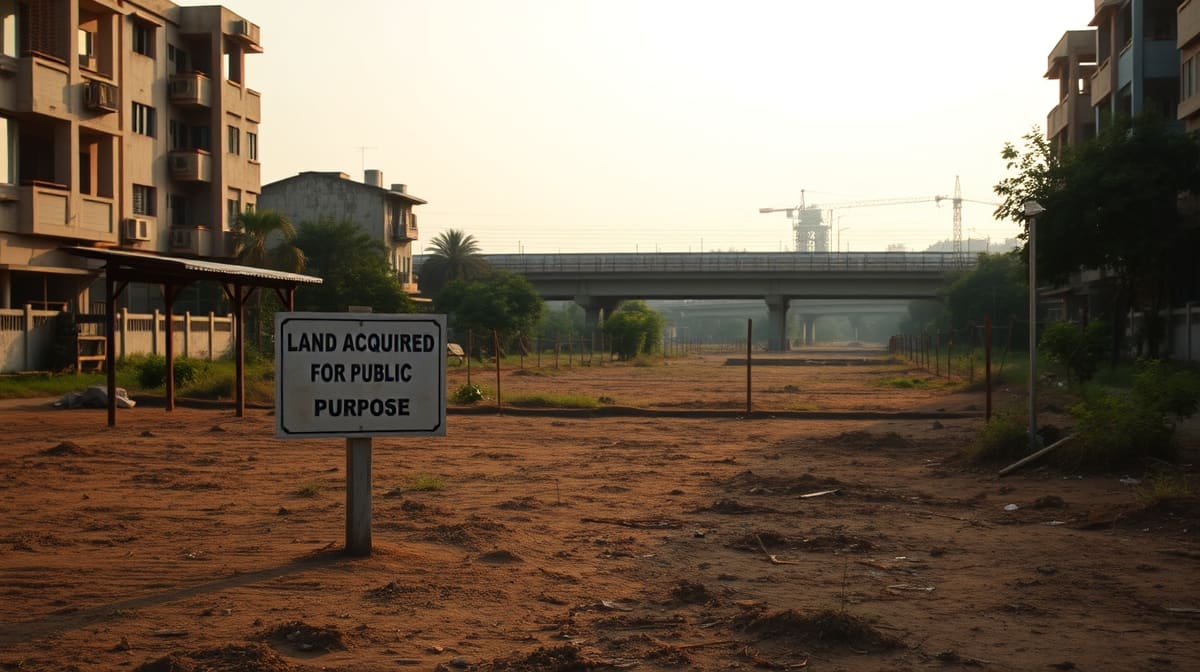
The Himachal Pradesh High Court has affirmed that compensation for residential structures constructed prior to a land acquisition notification cannot be denied merely on the absence of formal title, provided the claimant establishes factual possession and construction before the notification date. This ruling reinforces the principle that acquisition authorities bear the burden of disproving pre-notification existence of structures, and that market value must be determined with parity across similar acquisitions under the same notification.
Background & Facts
The Dispute
The dispute arose from the acquisition of land in Phati Manyashi, Sub-Tehsil Sainj, District Kullu, Himachal Pradesh, for the construction of the Sainj Bye-Pass Road under the Parbati Hydro Electric Project (PHEP), Stage-III. The land of respondent No.1, Beli Ram, was acquired under a notification issued under Section 4 of the Land Acquisition Act, 1894, published in the Rajpatra on 05.09.2007 and in newspapers on 26.09.2007 and 06.11.2007. A subsequent notification under Sections 6 and 7 was published in Danik Jagran and Hindustan Times on 14.02.2008 and 11.02.2008 respectively.
Key Facts
- The Land Acquisition Collector issued Award No. 42 dated 25.09.2008, fixing total compensation at Rs. 1,13,79,966 for the land and Rs. 7,63,554 for trees, but made no provision for the respondent’s house.
- The respondent’s house was constructed in 2006 and completed in 2007, prior to the Section 4 notification of 05.09.2007.
- The respondent claimed the house’s value at Rs. 40 lakhs and submitted supporting evidence: a map (Ext. PW1/A), valuation report (Ext. PW1/B), abstract of costs (Ext. PW1/C), house tax receipt (Ext. PW2/A), and a certificate from the Pradhan of Gram Panchayat Dushad (Ext. PW3/A).
- The acquiring authority did not produce any photographs, satellite imagery, or other evidence to rebut the claim that the house existed before the notification.
- The Reference Court relied on the previous award Ext. PW1/A dated 30.04.2012, which had been upheld by this Court on 07.01.2026 in RFA No. 825 of 2012, to determine market value at Rs. 31,800 per biswa.
Procedural History
- 25.08.2007: Notification under Section 4 issued.
- 05.09.2007: Notification published in Rajpatra.
- 11.02.2008 & 14.02.2008: Notifications under Sections 6 and 7 published.
- 25.09.2008: Collector’s Award No. 42 issued, excluding compensation for house.
- 2008: Respondent filed reference petition under Section 18 of the Act.
- 20.03.2017: Reference Court awarded enhanced compensation: Rs. 31,800 per biswa for land and Rs. 9,60,000 for house.
- 07.01.2026: HP High Court dismissed appellants’ appeals against Ext. PW1/A, affirming its validity.
- 07.03.2026: RFA No. 149 of 2017 reserved for judgment.
- 01.04.2026: Judgment delivered.
The Parties' Positions
For the Appellants (NHPC/PHEP)
- Argued that the Reference Court erred in relying on Ext. PW1/A, which they claimed was not binding.
- Contended that since the house was not formally acquired, no compensation was payable under Section 18.
- Asserted that the house was constructed after the notification and thus ineligible for compensation.
- Claimed the award imposed an undue burden on the public exchequer.
For the Respondents (Beli Ram & State)
- Established through documentary and testimonial evidence that the house was constructed and occupied before 05.09.2007.
- Relied on Sunder v. Union of India (2001 SC 3516) to assert entitlement to statutory benefits.
- Highlighted the absence of any rebuttal evidence from the acquiring authority.
- Emphasized the principle of equity and parity in determining market value across similar acquisitions under the same notification.
Relief Sought
The appellants sought to set aside the Reference Court’s award dated 20.03.2017 and restore the Collector’s award dated 25.09.2008. The respondents sought confirmation of the enhanced compensation, including Rs. 9,60,000 for the house and Rs. 31,800 per biswa for land, along with all statutory benefits.
The Legal Issue
The central question was whether compensation under Section 18 of the Land Acquisition Act, 1894 is available for a residential structure built prior to the Section 4 notification, when the claimant provides credible evidence of pre-notification construction and the acquiring authority fails to rebut it.
Arguments Presented
For the Appellant
The appellant’s counsel contended that Section 18 permits enhancement only for the land acquired, not for structures not formally notified for acquisition. She argued that the Reference Court’s reliance on Ext. PW1/A was legally flawed, as it was not a binding precedent and had been challenged in other appeals. She further submitted that the absence of a formal title or municipal approval rendered the house ineligible for compensation, and that the valuation of Rs. 9,60,000 was arbitrary and unsupported by evidence.
For the Respondent
The respondents’ counsel, led by Senior Advocate Sunil Mohan Goel, argued that the Act does not require formal title for compensation of structures. He cited Sunder v. Union of India to establish that any structure existing on the date of notification, regardless of title, is compensable if proven to have been constructed prior to notification. He emphasized that the burden of disproving pre-notification existence lies with the acquiring authority, which failed to produce any photographic, aerial, or survey evidence to contradict the petitioner’s affidavits and documents.
The Court's Analysis
The Court examined the evidentiary record and found that the respondent had discharged his burden of proving that the house was constructed and occupied before the Section 4 notification of 05.09.2007. The evidence included a valuation report, house tax receipt, and a certificate from the Gram Panchayat Pradhan - all of which were unchallenged by the appellant.
"The respondents did not adduce any evidence, either in the shape of photographs or video-graphy, which could have shown/established that when the notification was published in the official gazette, the house of the petitioner did not exist on the spot."
The Court held that the absence of rebuttal evidence from the acquiring authority is fatal to its case. It reiterated that the principle of audi alteram partem requires the state to actively disprove claims of pre-notification construction; mere denial without evidence is insufficient.
Regarding market value, the Court noted that Ext. PW1/A, which fixed the rate at Rs. 31,800 per biswa, had already been upheld by this Court on 07.01.2026 in RFA No. 825 of 2012. The Court emphasized that applying the same rate to identical land under the same notification is not only legally sound but also essential to ensure equity and prevent arbitrary disparities among similarly situated landowners.
The Court rejected the appellant’s argument that Section 18 only applies to land, holding that the term "land" in the Act includes all appurtenances and structures permanently attached to it, as interpreted in multiple precedents including Sunder v. Union of India. The Reference Court’s award was thus found to be legally correct, factually supported, and procedurally fair.
The Verdict
The appeal was dismissed. The High Court upheld the Reference Court’s award dated 20.03.2017, confirming compensation at Rs. 31,800 per biswa for the acquired land and Rs. 9,60,000 for the residential structure. All statutory benefits, including solatium and additional charges, were affirmed. The Court directed that the compensation be paid within 8 weeks from the date of judgment, with interest at 9% per annum from the date of possession until actual payment.
What This Means For Similar Cases
Pre-Notification Structures Are Compensable Without Formal Title
- Practitioners must now argue that possession and construction evidence, not title deeds, are the primary basis for claiming compensation under Section 18.
- A house tax receipt, Gram Panchayat certificate, and affidavit of construction date are sufficient if unchallenged by the acquiring authority.
Burden of Disproof Rests on the Acquiring Authority
- If a claimant establishes pre-notification construction, the state must produce affirmative rebuttal evidence - photographs, satellite imagery, or survey records.
- Failure to do so renders the denial of compensation legally unsustainable.
Market Value Must Be Parity-Based Across Similar Acquisitions
- When multiple claims arise under the same notification and for the same project, courts must apply uniform market rates.
- Previous awards upheld by higher courts become binding benchmarks for subsequent claims in the same locality.