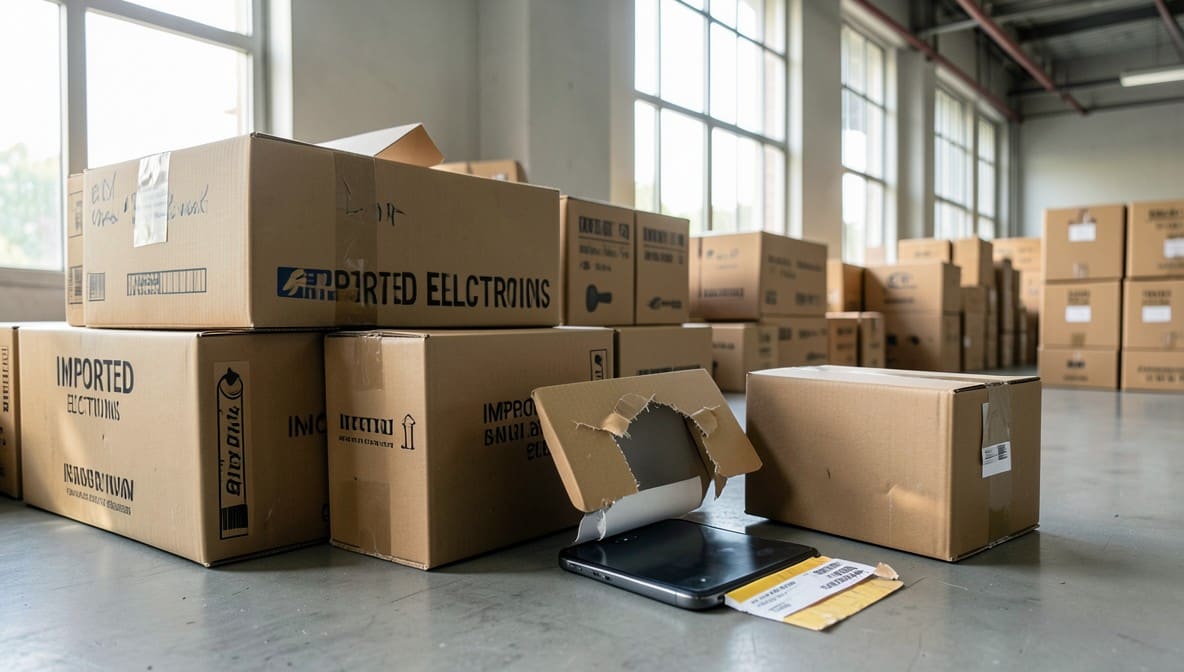
The Customs, Excise and Service Tax Appellate Tribunal (CESTAT) Hyderabad has delivered a pivotal ruling clarifying the limits of customs authorities’ power to demand additional duty based on post-importation alterations to retail sale prices by independent distributors. The judgment reinforces the principle that importers cannot be held liable for acts of third-party distributors unless direct involvement or control is proven.
Background & Facts
The Dispute
The appellants, M/s Celkon Impex Pvt Ltd and its directors (Y. Guruswamy Naidu, M. Balachandrudu, K. Krishnapavan), along with M/s Big C Mobiles Pvt Ltd and its director (K. Krishnapavan), were adjudicated upon by the Commissioner of Customs, Hyderabad, under Order-in-Original dated 12.11.2015. The department alleged that the appellants deliberately declared Retail Sale Price (RSP) below Rs. 2,000/- at the time of import to evade Countervailing Duty (CVD), and subsequently altered the MRP printed on the packaging of imported cellular phones after customs clearance to reflect higher prices, thereby evading differential CVD liability.
Key Facts
- The appellants imported cellular phones under the brand 'Celkon' and distributed them through authorized dealers, including M/s Big C Mobiles Pvt Ltd.
- M/s Big C Mobiles Pvt Ltd is an independent legal entity and one among multiple distributors of Celkon Impex.
- A market survey conducted by the department on 28.01.2014 allegedly revealed that certain models (ARR35, C66+, C208, C42, AR45, C720, C820) carried MRP above Rs. 2,000/- on packaging at distributor premises.
- Photographs of packaging labels with higher MRP were seized from M/s Big C’s premises, not from the importer’s premises or during import.
- The department claimed that the declared RSP at import (below Rs. 2,000/-) was intentionally understated to pay lower CVD, which is levied at 6% on phones with RSP above Rs. 2,000/- w.e.f. 01.03.2013.
- The department relied on the 5th Annual Report of Celkon Impex to allege common directors and thus, a 'related entity' relationship.
- Shri K. Krishnapavan, Director of M/s Big C, admitted in his statement that MRP stickers were replaced on a limited number of models during festival season for promotional discounts under a '1+1 Jodi' offer.
- No evidence was produced to show that Celkon Impex directed, authorized, or participated in the relabeling.
- The model C5050, cited in the survey, was not identical to C5050 Star, which was included in the duty demand.
- The department did not initiate proceedings under Central Excise Act against M/s Big C for alleged manufacture through relabeling.
Procedural History
- 12.11.2015: Order-in-Original passed by Commissioner of Customs, Hyderabad, demanding differential CVD, confiscating goods, and imposing penalties on all appellants.
- 05.02.2026: Hearing before CESTAT Hyderabad, Division Bench.
- 08.04.2026: Final Order passed by CESTAT Hyderabad.
The Parties' Positions
For the Appellants
- M/s Celkon Impex and its directors contended they had no role in altering MRP labels, which occurred solely at the premises of M/s Big C, an independent distributor.
- The relationship between Celkon Impex and M/s Big C was purely commercial, governed by a distributor agreement.
- The 5th Annual Report was not disclosed in the Show Cause Notice (SCN) and could not be used to establish corporate veil piercing.
- No flow-back of funds or common ownership was established to justify treating the entities as one.
- Relied on precedents: ITC Ltd v. CCE, New Delhi, Hindustan Coca Cola Beverages v. CCE, Allahabad, Motorola Speciality Oils v. CCCE, Vadodara, and Metero Satellite v. Collector.
- Argued that Rule 5 of Central Excise (Determination of Retail Sale Price) Rules, 2008, applies only to manufacturers, not importers or distributors.
- Contended that section 28 of the Customs Act, 1962, cannot be invoked to reassess CVD post-clearance as there is no machinery provision for redetermination of RSP under the Customs Tariff Act.
For the Respondent
- The Commissioner of Customs argued that common directors and the Annual Report established a nexus between the entities.
- Asserted that the alteration of MRP was a coordinated effort to evade CVD.
- Relied on market survey photographs and statements of M/s Big C’s personnel to infer joint liability.
- Invoked section 3(2) of the Customs Tariff Act, 1975, and section 4A of the Central Excise Act, 1944, to justify CVD demand.
- Claimed that the appellants were aware of and benefited from the higher MRP, thus making them liable.
Relief Sought
The appellants sought:
- Setting aside of the impugned order dated 12.11.2015.
- Cancellation of the demand for differential CVD.
- Quashing of the confiscation order.
- Cancellation of penalties imposed on both companies and individuals.
- Declaration that post-importation relabeling by distributors cannot attract CVD liability against importers.
The Legal Issue
The central question was whether an importer can be held liable for differential Countervailing Duty (CVD) under the Customs Tariff Act, 1975, based on the alteration of Retail Sale Price (RSP) by an independent distributor after customs clearance, in the absence of evidence of the importer’s direct involvement, control, or flow-back of benefits.
Arguments Presented
For the Appellant
The appellants relied on the principle that CVD is determined at the time of import based on the declared RSP, and no statutory mechanism exists under the Customs Act to reassess it post-clearance. They cited ITC Ltd v. CCE, New Delhi (2004) and Reach Infocom Tech v. CC, Kolkata (2025), where CESTAT held that section 28 of the Customs Act cannot be used to recover differential CVD where the goods have been cleared under self-assessment. They emphasized that Rule 5 of the Central Excise Rules, 2008, applies only to manufacturers, not importers or distributors. The mere presence of common directors, without evidence of operational control or financial flow-back, was insufficient to pierce the corporate veil. The department’s reliance on photographs from a distributor’s premises, without proving the importer’s participation, was legally untenable.
For the Respondent
The Commissioner contended that the shared directors and the Annual Report indicated a unified business structure. The alteration of MRP, even if done by the distributor, was done to maximize profits from the same imported goods, and the importer benefited from the higher sale price. The department argued that the appellants had constructive knowledge of the relabeling and thus shared liability under the doctrine of joint liability. They maintained that section 3(2) of the Customs Tariff Act read with section 4A of the Central Excise Act empowered them to reassess CVD based on actual RSP, regardless of who altered the label.
The Court's Analysis
The Tribunal conducted a meticulous review of statutory provisions and precedents. It observed that the Customs Act does not contain any machinery provision for redetermining the RSP of imported goods after clearance for the purpose of reassessing CVD. The Court emphasized that section 3(2) of the Customs Tariff Act, 1975, which makes CVD applicable on the basis of RSP, is linked to section 4A of the Central Excise Act, 1944, which governs valuation for excise duty on domestically manufactured goods. However, the Tribunal noted that once goods are imported and cleared, any subsequent alteration of packaging or labeling constitutes manufacture under Rule 2(f) of the Central Excise Act, making the distributor liable for excise duty - not the importer for CVD.
"The alteration, if any, to some extent, in respect of some models have taken place in the premises of M/s Big C, which is an independent legal entity and is also a distributor amongst many distributors of the appellant. Therefore, if at all any alteration or relabeling etc., has taken place, it has been done by M/s Big C."
The Court rejected the department’s reliance on the 5th Annual Report, noting it was not disclosed in the Show Cause Notice and thus violated principles of natural justice. The presence of common directors alone, without evidence of common ownership, financial interdependence, or operational control, could not justify lifting the corporate veil. The Tribunal cited Reach Infocom Tech v. CC, Kolkata to affirm that CVD cannot be recovered post-clearance unless the importer themselves altered the RSP.
"There is no machinery provision for redetermination of RSP for the purpose of reassessment of additional duties of customs (CVD) and that the authority to reassess the value under Customs Act is limited to Customs duty in terms of Customs Valuation (Determination of Value of Imported Goods) Rules, 1962."
The Court also noted that the department failed to initiate proceedings against M/s Big C under the Central Excise Act for alleged manufacture through relabeling, indicating a selective and legally flawed approach. The photographs and statements were deemed insufficient to establish willful suppression or intent to evade on the part of the importer.
The Verdict
The appellants succeeded. The CESTAT Hyderabad set aside the impugned Order-in-Original dated 12.11.2015 in its entirety. The differential demand for CVD was cancelled. The confiscation of goods was quashed. Penalties imposed on M/s Celkon Impex Pvt Ltd, M/s Big C Mobiles Pvt Ltd, and the individual directors were cancelled. The Tribunal held that no liability for CVD arises from post-importation relabeling by independent distributors in the absence of direct involvement by the importer. The order was set aside on merits, and the issue of limitation was not examined.
What This Means For Similar Cases
Importers Are Not Liable for Distributor Actions
- Practitioners must argue that CVD liability is strictly tied to the importer’s declaration at the time of clearance.
- Post-importation alterations by distributors cannot be imputed to importers absent proof of direction, authorization, or financial benefit flow-back.
- Revenue authorities cannot use market survey photographs from distributor premises to establish importer liability.
Corporate Veil Cannot Be Pierced on Common Directors Alone
- Common directors or shared office space do not establish a single economic entity.
- To pierce the corporate veil, evidence of common ownership, financial intermingling, or operational control is mandatory.
- Annual reports cannot be used retroactively to establish liability if not disclosed in the SCN.
CVD Reassessment Requires Statutory Authority
-
Section 28 of the Customs Act, 1962, cannot be invoked to reassess CVD where no machinery provision exists for redetermination of RSP.
-
If relabeling occurs post-import, the correct remedy is excise duty on the distributor as manufacturer - not CVD on the importer.
-
Self-assessed clearances without bond cannot be reopened for CVD reassessment unless fraud or suppression is proven under section 28(4).
-
Practitioners should challenge CVD demands based on post-clearance MRP changes by citing Reach Infocom Tech v. CC, Kolkata and ITC Ltd v. CCE, New Delhi.
-
Always verify whether the SCN disclosed all documents relied upon - failure to do so invalidates the adjudication.