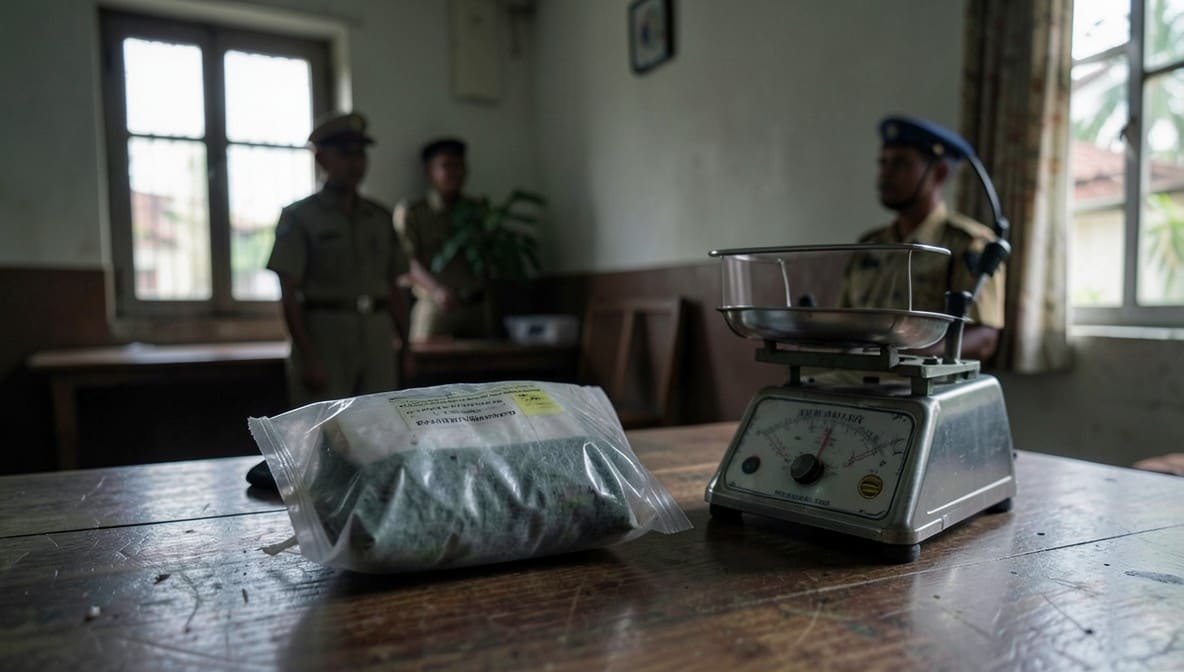
The Gauhati High Court has set aside a conviction under the NDPS Act, emphasizing that mere assertion of possession without specifying the exact source of contraband renders the prosecution’s case unsustainable. This ruling reinforces the necessity of precise evidentiary foundations in drug trafficking cases, particularly where the accused is not the vehicle owner or driver.
Background & Facts
The Dispute
The appellant, Jalal Hussain Barbhuiya, was convicted under Section 21(c) of the NDPS Act, 1985 for possessing 512 grams of heroin recovered from a white Bolero vehicle (AS-11-E-6535) during a roadside check at Saiphai Police Outpost. The contraband was found inside 42 soap cases, allegedly in the appellant’s belongings. However, the prosecution failed to establish which specific belongings - such as a suitcase, bag, or luggage - contained the drugs.
Procedural History
- 19.09.2023: Contraband recovered during search of vehicle; appellant arrested at scene
- 20.09.2023: FIR registered at Vairengte Police Station; charge-sheet filed under Section 21(c) NDPS Act
- 13.03.2024: Charge framed by Fast Track Court, Kolasib
- 10.06.2025: Trial court convicted appellant and sentenced him to 10 years’ rigorous imprisonment and ₹1 lakh fine
- 09.02.2026: Gauhati High Court allowed appeal and acquitted appellant
Relief Sought
The appellant sought acquittal on grounds of procedural violations, failure to establish possession, non-compliance with Section 50 NDPS Act, and defective examination under Section 313 CrPC.
The Legal Issue
The central question was whether the prosecution established possession under Section 21(c) of the NDPS Act when it failed to specify from which belongings of the accused the contraband was recovered, especially where the accused was neither the owner nor the driver of the vehicle.
Arguments Presented
For the Appellant
The appellant’s counsel argued that the prosecution failed to discharge the initial burden of proving possession by not identifying the specific container or item from which the contraband was seized. Reliance was placed on Arif Khan @ Agha Khan v. State of Uttarakhand to contend that Section 50 NDPS Act mandates informing the accused of rights before search, and since no personal search occurred, the failure to clarify the source of belongings vitiated the case. Further, the counsel cited Raj Kumar @ Suman v. NCT of Delhi to argue that the Section 313 CrPC examination was perfunctory and failed to apprise the accused of specific incriminating evidence.
For the Respondent
The State contended that Section 50 was inapplicable as no personal search was conducted, and recovery from belongings inside the vehicle sufficed. It relied on Kashmiri Lal v. State of Haryana to assert that police testimony, if credible, can sustain conviction even without independent witnesses. The prosecution argued that the trial court’s question under Section 313 CrPC adequately covered the entire allegation, and the burden under Section 54 NDPS Act had shifted to the accused, who offered no defence.
The Court's Analysis
The Court examined the testimonies of all four prosecution witnesses and found critical inconsistencies. While PW-1 (Investigating Officer) and PW-2 (First Informant) claimed the contraband was recovered from the appellant’s "belongings," neither specified whether it was a trunk, backpack, or other item. Crucially, both admitted a driver was present in the vehicle, yet no inquiry was made into his role or testimony.
"By merely stating that the contraband was recovered from the possession of the accused, without clarifying as to from where it was recovered is not sufficient to arrive at the conclusion that same was recovered from the possession of the appellant."
The Court noted that independent witnesses PW-3 and PW-4, though present, could not confirm whether the drugs were from the appellant’s belongings at all. Their testimony was rightly discarded by the trial court, but the Court held that the police testimony, too, became unreliable due to this omission. The absence of any explanation for why the driver was not examined or charged further undermined the prosecution’s narrative.
The Court also found the Section 313 CrPC examination defective. The trial court posed a single, sweeping question summarizing the entire prosecution case, rather than separately interrogating the accused on each incriminating circumstance, as mandated by Raj Kumar @ Suman. This failure deprived the accused of a meaningful opportunity to explain, violating his right to fair trial.
The Court concluded that without establishing the precise source of possession, the foundational requirement for invoking Section 54 NDPS Act - which shifts the burden to the accused - was not met. The prosecution’s failure to prove possession beyond reasonable doubt entitled the appellant to the benefit of doubt.
The Verdict
The appellant won. The Gauhati High Court held that possession under Section 21(c) NDPS Act cannot be established merely by alleging contraband was found in the accused’s "belongings" without specifying the exact source. The conviction was set aside, and the appellant was acquitted on benefit of doubt.
What This Means For Similar Cases
Possession Must Be Precisely Proven
- Practitioners must now ensure that charge-sheets and witness statements explicitly identify the container or item from which contraband was recovered (e.g., suitcase, pocket, luggage)
- Vague references like "belongings of the accused" or "in his possession" are legally insufficient
- Prosecution must link the contraband to the accused through tangible, identifiable property
Driver’s Absence Raises Doubt
- When a third party (e.g., driver) is present at the scene of recovery, their non-examination or non-arrest must be justified in the charge-sheet
- Failure to investigate or account for such persons creates reasonable doubt
- Courts will view such omissions as procedural negligence undermining the entire case
Section 313 CrPC Examination Must Be Specific
-
Trial courts must ask separate, distinct questions for each incriminating piece of evidence
-
A single, broad question summarizing the entire case violates the spirit of Section 313 CrPC
-
Defence counsel must object immediately if the accused is not given individual notice of each allegation
-
If the prosecution fails to specify the source of possession, the burden under Section 54 NDPS Act does not shift
-
Defence should move for acquittal at the close of prosecution case if possession is not clearly established
-
Appellate courts will set aside convictions where procedural lapses in Section 313 CrPC or Section 50 NDPS Act are coupled with evidentiary gaps