The Punjab and Haryana High Court has delivered a significant ruling affirming that victims of online fraud cannot be penalized through bank account freezing merely because illicit funds passed through their accounts. This judgment reinforces the principle that due process and presumption of innocence must prevail over administrative convenience, especially when no criminal proceedings exist against the affected individuals.
Background & Facts
The Dispute
The petitioners, doctors and staff of Dev Hospital in Amritsar, were lured by a fraudulent Telegram-based investment platform called 'Cute Doll Site'. They were promised high returns on small investments. Petitioner No. 2, Dr. Rajiv Kumar Dev, initially invested ₹7,500 from the account of Petitioner No. 3, Dr. Aanchal Sharma. The platform falsely showed the investment growing to ₹25,868, prompting other staff members to invest collectively ₹10,80,385. The fraudsters then deposited ₹25,062 into the joint account of Petitioners No. 1 and 2 at Axis Bank, Batala Road, Amritsar, to create an illusion of legitimacy. When asked to pay ₹14,00,000 as commission to unlock purported gains of ₹48,00,000, the petitioners suspected fraud and refused further payment.
Procedural History
- 2025: Petitioners’ bank accounts were frozen by Enforcement Agencies based on receipt of ₹25,062 from the fraudulent platform.
- No FIR or criminal case was registered against any petitioner.
- No inquiry or investigation was initiated to establish involvement, knowledge, or mala fide intent.
- Petitioners filed a writ under Articles 226 and 227 seeking de-freezing of accounts.
Relief Sought
The petitioners sought immediate de-freezing of their bank accounts, arguing that they were innocent victims of a cyber fraud scheme and that freezing their accounts violated their fundamental right to access financial services under Article 21.
The Legal Issue
The central question was whether the mere receipt of funds from a fraudulent scheme, without any evidence of criminal intent, knowledge, or participation, justifies the freezing of a person’s bank account by Enforcement Agencies under PMLA or other regulatory frameworks.
Arguments Presented
For the Petitioner
Counsel relied on Arnesh Kumar v. State of Bihar and Siddharth v. State of U.P. to argue that presumption of innocence and proportionality must guide state action. They emphasized that no criminal case had been registered, no charge sheet filed, and no prima facie evidence linked petitioners to money laundering. The receipt of ₹25,062 was a result of deception, not complicity. The freezing of accounts caused severe hardship to medical professionals reliant on daily transactions.
For the Respondent
The Union of India conceded that no criminal proceedings were pending against the petitioners. The Enforcement Agencies admitted that the freezing was based solely on the receipt of funds from a flagged account, without any independent investigation into the petitioners’ role. Counsel acknowledged the precedent set in Labpreet Kaur v. Union of India, which had ordered de-freezing in identical circumstances.
The Court's Analysis
The Court examined the nature of the transaction and the absence of any mens rea on the part of the petitioners. It held that financial institutions and enforcement bodies cannot treat victims as suspects merely because illicit funds passed through their accounts. The Court distinguished between active participation in fraud and passive receipt of proceeds through deception.
"Neither there appears fraud or misfeasance on the part of petitioners nor lapse or mala fide intention on the part of respondents."
The Court emphasized that Article 21 protects the right to livelihood and access to banking services, and that freezing accounts without due process violates this right. It noted that the Enforcement Agencies had failed to apply the triple test of necessity, proportionality, and least restrictive means before imposing such a severe measure. The Court also referenced its own prior order in Labpreet Kaur, reinforcing consistency in judicial approach.
The Court rejected the notion that administrative convenience or automated flagging systems could override individual rights. It held that mere receipt of funds, without corroborative evidence of intent or involvement, cannot form the basis for asset freezing.
The Verdict
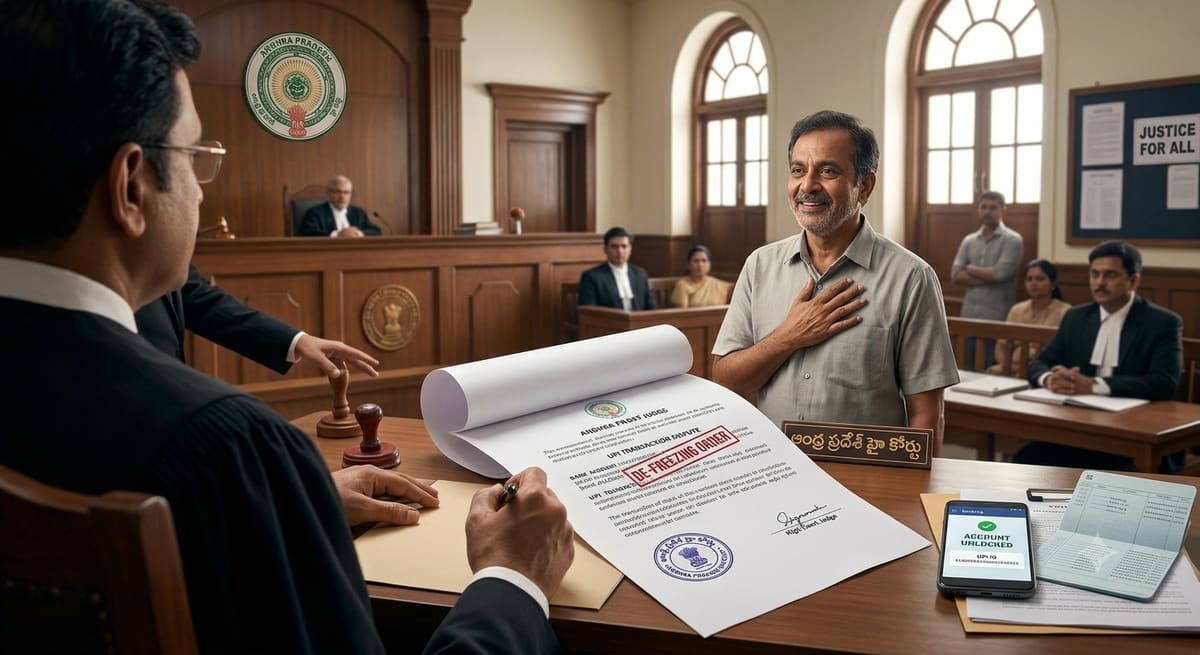
The petitioners succeeded. The Court held that the freezing of bank accounts of fraud victims, in the absence of any criminal proceedings or evidence of intent, is unlawful. The Court directed all respondent banks to de-freeze the petitioners’ accounts within three days and clarified that this order does not confer immunity for any future discovery of unlawful conduct.
What This Means For Similar Cases
Freezing Requires More Than Suspicious Transactions
- Practitioners must challenge account freezes where no FIR, charge sheet, or investigation exists
- Banks and Enforcement Agencies must demonstrate active participation or knowledge before imposing financial restrictions
- Automated systems flagging transactions based on source alone are legally insufficient
Victims Are Not Suspects by Default
- Individuals who fall prey to investment scams cannot be treated as co-conspirators
- The burden shifts to the state to prove mens rea before invoking PMLA or other asset forfeiture provisions
- Legal aid clinics should proactively file writs for victims of cyber fraud whose accounts are frozen
Procedural Compliance Is Non-Negotiable
- Any freezing order must be preceded by a reasoned order citing specific evidence
- Blanket freezes based on third-party transaction patterns violate natural justice
- Petitioners can now cite this judgment to seek interim relief in pending freezing matters across India