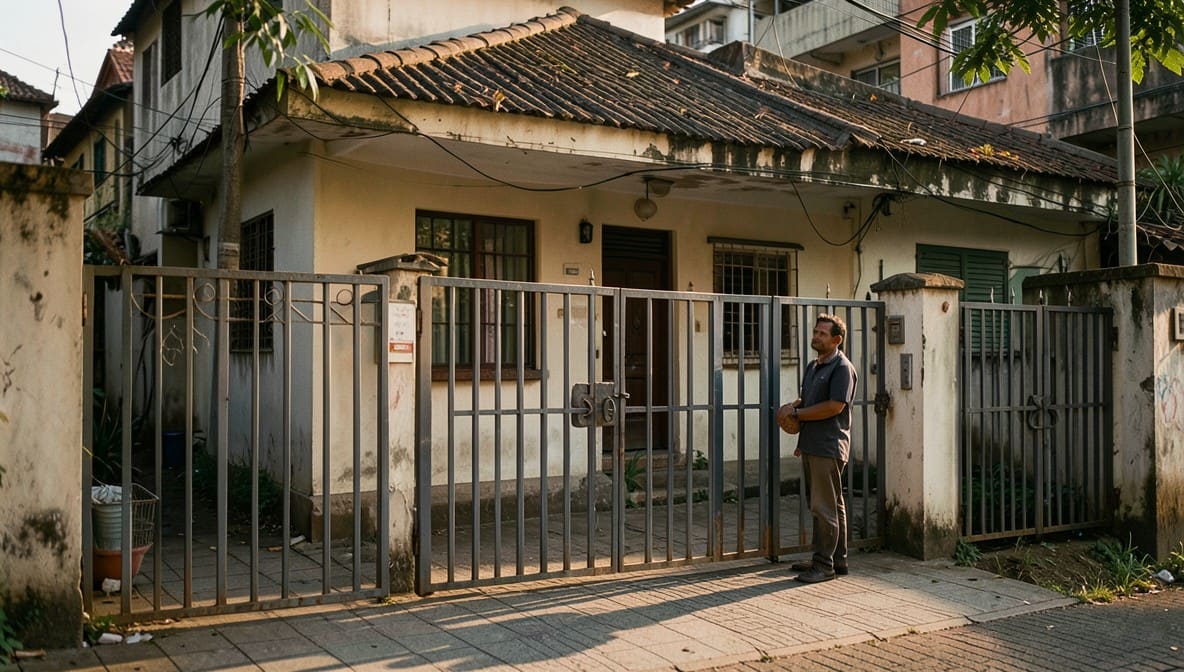
The Punjab & Haryana High Court has clarified that mere long-term occupation of property without any legal title or tenancy right cannot confer protection against eviction. The judgment reinforces that possession without title is inherently permissive, and an eviction claim by the owner constitutes sufficient notice of license revocation.
Background & Facts
The Dispute
The dispute arises between two brothers, Isham Singh (appellant) and Ram Kishan (respondent), over a property in Village Gharaunda, Karnal. Ram Kishan filed a suit seeking declaration of joint ownership and permanent injunction against Isham Singh, alleging threats of forcible dispossession. Isham Singh denied any joint ownership, asserting sole ownership with his brother Naseeb Singh, and filed a counter-claim for eviction.
Procedural History
- 1981: Civil Suit No. 452 filed by Surjit Singh against Isham Singh, Ram Kishan, and others; court held Isham Singh and Naseeb Singh were joint owners.
- 1983: Judgment in Suit No. 452 upheld; both brothers admitted ownership of Isham Singh and Naseeb Singh in their written statements.
- 1987: Trial Court dismissed Ram Kishan’s suit on grounds of res judicata.
- 1988: First Appellate Court set aside dismissal, remanded for determination of nature of possession.
- 1991: Trial Court, on remand, dismissed suit and decreed counter-claim, holding Ram Kishan was a licensee.
- 1996: First Appellate Court reversed trial court, decreeing Ram Kishan’s suit on grounds that license creation and revocation were unproven.
- 2026: Regular Second Appeal heard by Punjab & Haryana High Court.
Relief Sought
Ram Kishan sought declaration of joint ownership and permanent injunction. Isham Singh sought decree for eviction on grounds of revoked license.
The Legal Issue
The central question was whether possession of a person who admits no independent title, tenancy, or legal right over property can be protected against eviction absent proof of a formal license, and whether filing a counter-claim for eviction suffices to revoke an implied license.
Arguments Presented
For the Appellant
Counsel relied on Maria Margarida Sequeira Fernandes v. Erasmo Jack de Sequeira to argue that where ownership is conclusively established and the occupant claims no legal right, possession is inherently permissive. The filing of a counter-claim for eviction constitutes sufficient notice of revocation of any implied license. The First Appellate Court erred in requiring formal proof of license creation and revocation.
For the Respondent
Counsel contended that since no documentary evidence proved the existence or revocation of a license, the trial court’s finding of revocation was speculative. The Appellate Court correctly held that without proof of license terms, eviction cannot be ordered.
The Court's Analysis
The Court examined the settled principle that ownership established by a final decree binds all parties, including those who admitted it in prior proceedings. Ram Kishan, having admitted in the 1983 suit that Isham Singh and Naseeb Singh were owners, could not later claim any independent right.
"A person who is allowed to stay in the property gratuitously does not acquire any right or interest in the property even by long possession."
The Court emphasized that Maria Margarida establishes that such occupants hold possession on behalf of the owner, not as tenants or licensees with enforceable rights. The burden to prove a legal basis for possession lies with the occupant. Since Ram Kishan failed to show any tenancy, lease, or mortgage, his possession was permissive by default.
The Court rejected the Appellate Court’s reasoning that license revocation required formal proof. It held that in the absence of any documented license, the law presumes permissive possession. The filing of a counter-claim seeking eviction is, by itself, a clear and unequivocal communication of revocation. To demand proof of when the license was created or revoked is to impose an impossible burden inconsistent with the nature of permissive occupation.
The Verdict
The appellant won. The Court held that possession without any legal title or tenancy is permissive, and filing a counter-claim for eviction suffices to revoke an implied license. The judgment of the First Appellate Court was set aside, and the trial court’s decree in favor of the appellant was restored.
What This Means For Similar Cases
Permissive Possession Cannot Be Converted Into Legal Right
- Practitioners must distinguish between mere occupation and legally recognized possession in property suits.
- Long-term occupation without title does not create adverse possession or estoppel unless all statutory conditions under the Limitation Act are met.
- Claims of joint possession without documentary evidence or legal basis will fail if ownership is conclusively established.
Eviction Claim Serves as Automatic Revocation Notice
- In suits involving family property disputes, a counter-claim for eviction is sufficient to terminate implied permission.
- No formal notice or written revocation is required where the nature of possession is permissive.
- Courts will not require proof of license terms where no such agreement is pleaded or evidenced.
Res Judicata Bars Re-litigation of Ownership
- Once ownership is adjudicated and affirmed on appeal, subsequent suits cannot re-open title.
- Parties who admitted ownership in prior proceedings are estopped from denying it in later litigation.
- Any relief sought must be confined to the nature of possession, not ownership.