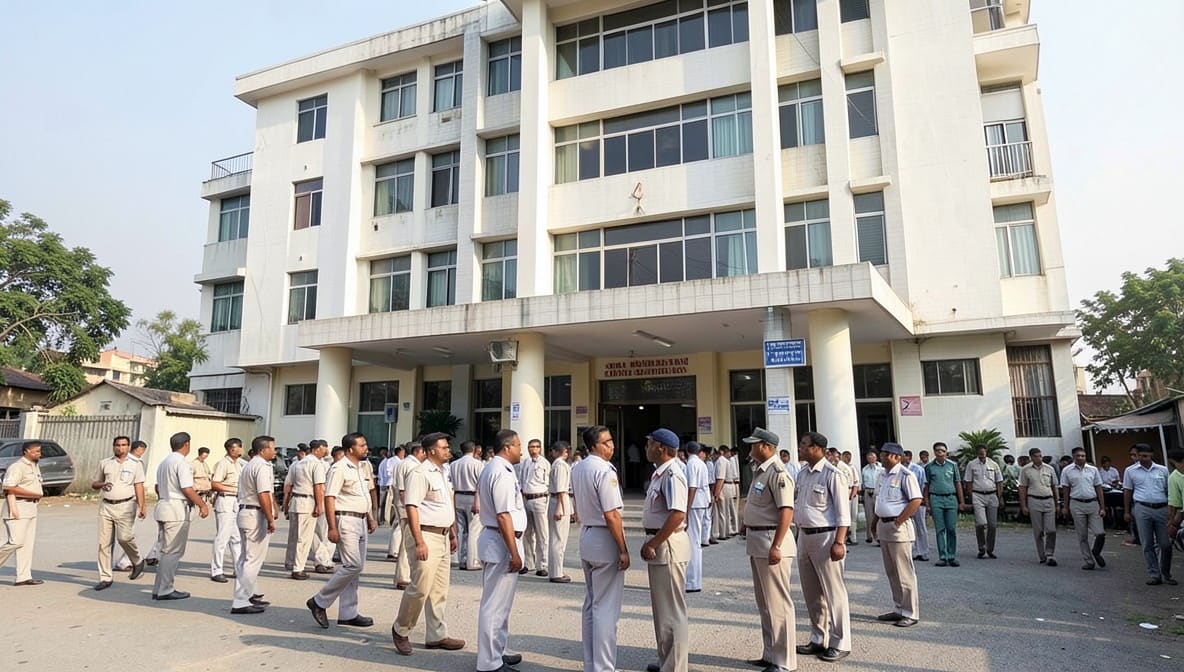
The Bombay High Court has delivered a significant ruling on the entitlement of employees working under autonomous institutions to claim government pension benefits. The judgment clarifies that mere similarity in pay scales or application of government service rules does not confer the status of a government servant upon employees of autonomous bodies like the State Institute of Educational Technology (SIET). The court emphasized that a master-servant relationship with the state, appointment to a civil post under the state, and salary payment from the consolidated fund are essential prerequisites for claiming government pension under the Maharashtra Civil Services (Pension) Rules, 1982.
Background & Facts
The Genesis
The State Institute of Educational Technology (SIET), also known as Balchitravani, was established in 1982 under the "INSAT for Education" Scheme with 100% central government funding. The institution was created to produce educational audio-visual content for telecast on Doordarshan. The Maharashtra government facilitated its establishment through multiple Government Resolutions (GRs):
- 27 January 1984: Creation of 28 posts
- 8 January 1985: Creation of additional 92 posts, totaling 120 posts
- 30 January 1985: Constitution of selection committee for Class-I and II posts
- 28 May 1986: Constitution of selection committee for Class-III and IV posts
On 5 February 1992, SIET was registered as a society under the Societies Registration Act, 1860, and later accorded autonomous status on 31 October 1991. The institution operated without financial assistance from the state government, relying entirely on central government grants until 2003, when funding ceased.
Key Facts
- The petitioners, Ravindra Keshav Bidkar and Ramdas Govind Shendge, were appointed as Floor Assistants in SIET on 18 May 1987 on a temporary basis for one year
- Their appointments were regularized in 1995 under SIET, an autonomous institution
- SIET faced financial distress after central government funding stopped in 2003, leading to non-payment of salaries from April 2014
- 16 employees filed Complaint (ULP) No. 242/2015 before the Industrial Court, Pune, alleging unfair labour practice under Item 9 of Schedule IV of the Maharashtra Recognition of Trade Unions and Prevention of Unfair Labour Practices (MRTU & PULP) Act, 1971
- The Industrial Court, by order dated 3 November 2015, directed SIET to pay earned wages within one month
- SIET challenged this order in Writ Petition No. 1590 of 2016, which was dismissed by the Bombay High Court on 14 March 2016, affirming the Industrial Court's order
- On 3 April 2017, the state government decided to close SIET due to financial constraints
- The impugned Government Resolution dated 31 May 2017 was issued under Section 25FFA of the Industrial Disputes Act, 1947, terminating the services of all SIET employees, including the petitioners
Procedural History
- 2015: 16 employees filed Complaint (ULP) No. 242/2015 before the Industrial Court, Pune
- 3 November 2015: Industrial Court directed payment of earned wages
- 14 March 2016: Bombay High Court dismissed Writ Petition No. 1590 of 2016, affirming the Industrial Court's order
- 2017: Petitioners and 19 other employees filed Original Application No. 570 of 2017 before the Maharashtra Administrative Tribunal (MAT)
- 11 August 2023: MAT dismissed the application, upholding the validity of the GR dated 31 May 2017
- 2024: Present Writ Petition (No. 8405 of 2024) filed before the Bombay High Court
The Parties' Positions
For the Petitioners
- The petitioners contended that their appointments were made against posts created by the state government with the approval of the Finance Department
- Pay scales and service rules applicable to state government employees were extended to SIET employees through various GRs
- Service Books were maintained for the petitioners, a practice exclusive to government servants under the Maharashtra Civil Services Rules, 1981
- The recruitment process mirrored that of government employees, and the petitioners completed over 30 years of service, entitling them to pension under Rule 30 of the Maharashtra Civil Services (Pension) Rules, 1982
- Denial of pension benefits violated their fundamental rights under Articles 14 and 16 of the Constitution of India
- The state government's representation by the Additional Government Pleader indicated that SIET was an integral part of the state government
For the Respondents
- The petitioners were appointed on a temporary basis for one year and later absorbed into SIET, an autonomous institution
- Neither petitioner submitted applications in response to the government advertisement for SIET posts
- The petitioners were never employed by the state government but were always under SIET, which operated as an autonomous body
- SIET's closure was necessitated by financial distress, and the GR dated 31 May 2017 was issued in compliance with Section 25FFA of the Industrial Disputes Act, 1947
- The petitioners accepted closure compensation, indicating their status as workmen, not government servants
- Six other employees who received pension benefits were originally state government employees sent on deputation to SIET, unlike the petitioners
Relief Sought
The petitioners sought:
- Recognition as government servants entitled to pension and other retiral benefits
- Quashing of the MAT's order dated 11 August 2023 and the GR dated 31 May 2017
- Extension of pension benefits at par with state government employees
The Legal Issue
The central question before the court was whether employees of an autonomous institution like SIET, whose pay scales and service rules mirrored those of state government employees, could be treated as government servants for the purpose of claiming pension benefits under the Maharashtra Civil Services (Pension) Rules, 1982.
Arguments Presented
For the Petitioners
The petitioners relied on the following arguments:
- Their appointments were made against posts created by the state government with Finance Department approval
- Pay scales and service rules applicable to state government employees were extended to SIET employees through GRs
- Service Books were maintained for them, a practice exclusive to government servants
- The recruitment process was identical to that of government employees
- The state government's representation by the Additional Government Pleader indicated SIET was an integral part of the state
- Denial of pension benefits violated Articles 14 and 16 of the Constitution
- The doctrine of promissory estoppel applied, as the state had promised to treat them as government servants
For the Respondents
The respondents countered with:
- The petitioners were appointed on a temporary basis and later absorbed into SIET, an autonomous institution
- Neither petitioner applied in response to the government advertisement for SIET posts
- SIET was funded entirely by the central government, with no financial participation from the state
- The petitioners accepted closure compensation, indicating their status as workmen under the Industrial Disputes Act, 1947
- Six employees who received pension benefits were originally state government employees on deputation, unlike the petitioners
- The closure of SIET was necessitated by financial distress and complied with Section 25FFA of the Industrial Disputes Act, 1947
The Court's Analysis
The court conducted a detailed examination of the petitioners' status and the nature of their employment:
"Whether the petitioners were appointed against vacant posts under the Government of Maharashtra or not would primarily depend on what is reflected in their order of appointment."
The court noted that the petitioners' appointment orders were issued by the Director of Vidya Parishad, Pune, not a government department. Vidya Parishad, though created by a government resolution, operated as a distinct corporate entity separate from state government departments.
The court emphasized that to qualify as government servants, the following conditions must be met:
- A master-servant relationship with the state government
- Appointment to a civil post under the state government
- Salary payment from the consolidated fund of the state
The court referred to Rule 2(b) of the Maharashtra Civil Service (Conduct) Rules, 1979, which defines a government servant as:
"(b) 'Government servant' means any person appointed to any civil service or post in connection with the affairs of the State of Maharashtra, and includes a Government servant whose services are placed at the disposal of a company, corporation, organization, local authority or any other Government, notwithstanding that his salary is drawn from sources other than from the Consolidated Fund of the State"
However, the court clarified that this definition applies only if the original appointment was to a civil post under the state government. The petitioners' appointments were exclusively under SIET, a registered society, and not under any state government department.
The court also addressed the petitioners' reliance on promissory estoppel, citing Motilal Padampat Sugar Mills Co. Ltd. v. State of Uttar Pradesh & Ors. (1979) 2 SCC 409. The court held that mere application of government service rules and pay scales did not constitute a promise by the state to treat the petitioners as government servants.
Additionally, the court noted that the petitioners had accepted their status as workmen under the Industrial Disputes Act, 1947 in earlier proceedings, which contradicted their current claim of being government servants. The court observed:
"The Petitioners had never disputed their status as workmen. Therefore, they cannot now turn around and claim the status of the permanent Government Employees as such a stand would be in marked contradiction to the stand taken by the Applicants in Complaint (ULP) No. 242 of 2015."
The court also rejected the petitioners' argument that they should be treated at par with six other employees who received pension benefits, as those employees were originally state government employees sent on deputation to SIET.
The Verdict
The Bombay High Court dismissed the writ petition, upholding the MAT's order dated 11 August 2023 and the GR dated 31 May 2017. The court ruled that the petitioners, as employees of an autonomous institution, were not entitled to government pension benefits. The petitioners had received closure compensation of Rs. 24,75,981 and Rs. 15,91,044 respectively, which they had accepted. The court directed that parties bear their own costs.
What This Means For Similar Cases
Essential Conditions for Government Servant Status
This judgment establishes that the following conditions must be met to claim government servant status:
- Master-servant relationship: The employee must be under the direct control of the state government
- Civil post appointment: The appointment must be to a post created under a state government department
- Salary from consolidated fund: The employee's salary must be paid from the state's consolidated fund
Practitioners should note that similarity in pay scales or application of government service rules alone is insufficient to confer government servant status.
Workmen vs. Government Servants
- Employees of autonomous institutions may be treated as workmen under the Industrial Disputes Act, 1947, even if their pay scales match government employees
- Accepting benefits or compensation as workmen may preclude later claims of government servant status
- The court will not permit contradictory stands, such as claiming workmen status in one proceeding and government servant status in another
Closure of Autonomous Institutions
- Section 25FFA of the Industrial Disputes Act, 1947 permits closure of undertakings with less than 50 workers if they are in financial distress
- Employees terminated due to closure are entitled to closure compensation but not government pension benefits
- The court will not interfere with closure decisions unless there is a clear anomaly or illegality in the process
Promissory Estoppel Limitations
- Mere application of government service rules or pay scales does not constitute a promise by the state to treat employees as government servants
- The doctrine of promissory estoppel will not apply unless there is a clear, unequivocal promise by the state
- Employees cannot rely on promissory estoppel to claim benefits not explicitly promised or legally due