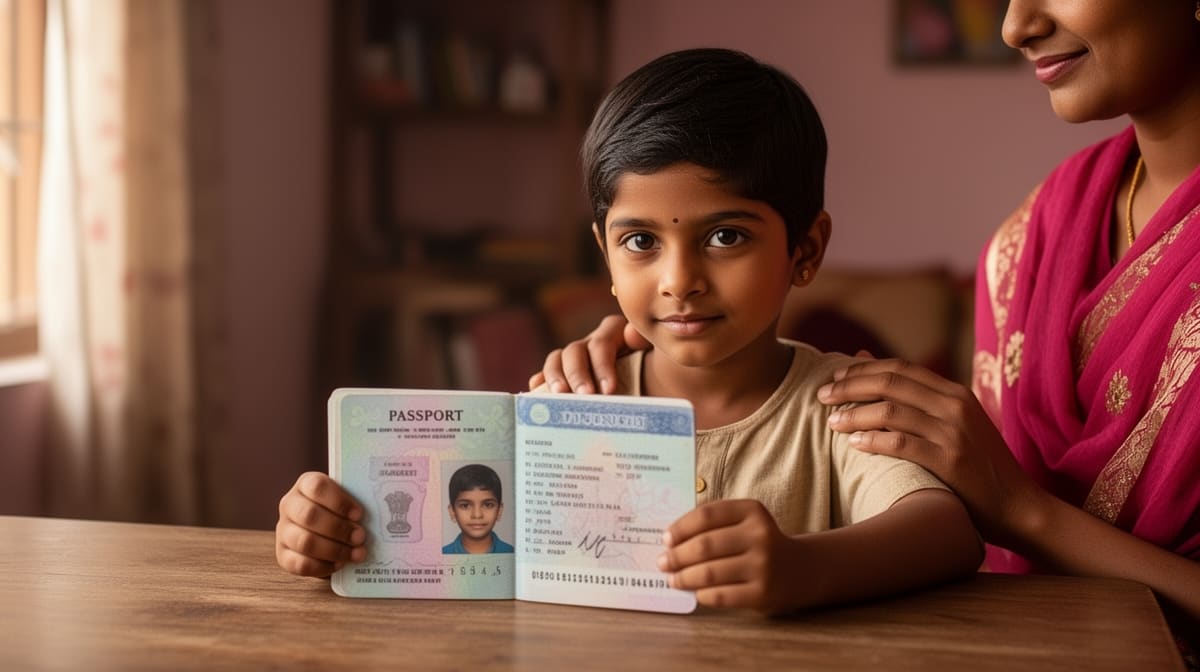
The Rajasthan High Court has clarified that the right of a minor to obtain a passport cannot be withheld due to parental disputes, affirming that custody alone suffices for application purposes. This ruling reinforces the child’s fundamental right to mobility and access to international travel documents, irrespective of ongoing matrimonial litigation.
Background & Facts
The Dispute
The petitioner, a seven-year-old minor named Yuvaan Singh, has resided exclusively with his mother, Smt. Richa Singh, since birth. His parents, married on 11 February 2017, separated in September 2018. A passport application under file number JP2068999155623 was submitted on the minor’s behalf, but the Regional Passport Office refused to process it due to the absence of the father’s signature, despite the father having no physical custody or involvement in the child’s daily life.
Procedural History
- 2018: Parents separated; minor has lived solely with mother since birth
- 2024: Family Court No. 1, Jodhpur, passed an order directing passport authorities to consider the application independently, noting the father cannot be compelled to sign
- 2025: Passport Office closed the file citing non-compliance with procedural norms requiring both parents’ signatures
- 2026: Writ petition filed before the Rajasthan High Court seeking quashing of the closure order and direction for passport issuance
Relief Sought
The petitioner sought quashing of the passport office’s closure order and a direction to issue the passport without requiring the father’s signature, relying on the Family Court’s prior order and the minor’s best interests.
The Legal Issue
The central question was whether the consent of a non-custodial parent is mandatory for issuance of a passport to a minor when the child has been residing exclusively with the other parent, and whether statutory provisions under the Passport Rules, 1980 permit issuance based solely on the custodial parent’s application.
Arguments Presented
For the Petitioner
The petitioner’s counsel relied on the Family Court’s order dated 03.08.2024, which explicitly held that the father cannot be compelled to sign the passport application. It was argued that Rule 5(3) of the Passport Rules, 1980 permits application by the parent having custody, and that the father’s objection, rooted in matrimonial discord, cannot override the child’s right to a passport. The counsel cited S. Sushma v. Union of India to emphasize that passport issuance is an administrative right, not a matter of parental consent.
For the Respondent
The respondents contended that Rule 5(2) of the Passport Rules, 1980, requires signatures of both parents unless one is deceased or declared unfit. They argued that the absence of the father’s signature rendered the application incomplete, and that the Family Court’s order lacked statutory authority to override procedural norms. They further asserted that the passport authority must adhere strictly to prescribed documentation to prevent potential misuse.
The Court's Analysis
The Court examined the Passport Rules, 1980, particularly Rule 5(3), which states: "In case of a minor, the application may be made by the parent having the custody of the minor." The Court held that this provision is unambiguous and operates independently of the father’s consent when custody is established. The Court rejected the respondent’s reliance on Rule 5(2), noting that it applies only where both parents are actively involved and no custody determination exists.
"The conduct of the father cannot be approved by this Court, as issuance of a passport in favour of a minor cannot be equated with issuance of a visa for travelling to a foreign country."
The Court emphasized that the child’s right to a passport is not contingent on parental harmony. It distinguished between passport issuance, which is a document of identity and travel, and visa applications, which involve sovereign entry permissions. The Family Court’s prior observation - that the father cannot be compelled to sign - was affirmed as legally sound and consistent with the child’s best interests under Article 21 of the Constitution.
The Court further noted that the passport authority’s refusal was procedurally inflexible and failed to account for the child’s lived reality: continuous residence with the mother since birth, absence of paternal involvement, and judicial recognition of maternal custody.
The Verdict
The petitioner succeeded. The Court held that a custodial parent may apply for and obtain a passport for a minor without the signature of the non-custodial parent, provided custody is established. The passport authorities were directed to process and issue the passport forthwith, subject only to compliance with other statutory requirements.
What This Means For Similar Cases
Custody Supersedes Dual Consent Requirements
- Practitioners may now rely on Rule 5(3) of the Passport Rules, 1980 to file passport applications for minors without the non-custodial parent’s signature
- A certified copy of the custody order from Family Court or a sworn affidavit of sole custody suffices as prima facie proof
- Passport offices cannot impose additional conditions beyond statutory norms
Judicial Orders Bind Administrative Authorities
- Orders from Family Courts regarding custody and child welfare must be respected by administrative bodies like passport offices
- Refusal to act on such orders constitutes a violation of Article 14 (equality) and Article 21 (right to life and liberty)
- Writ petitions under Article 226 are maintainable where administrative inaction frustrates a child’s fundamental rights
No Automatic Bar Due to Pending Matrimonial Disputes
- Pending divorce or custody proceedings do not justify withholding a passport
- The child’s right to travel documents is independent of parental conflict
- Authorities must prioritize the child’s interest over procedural rigidity or parental disputes