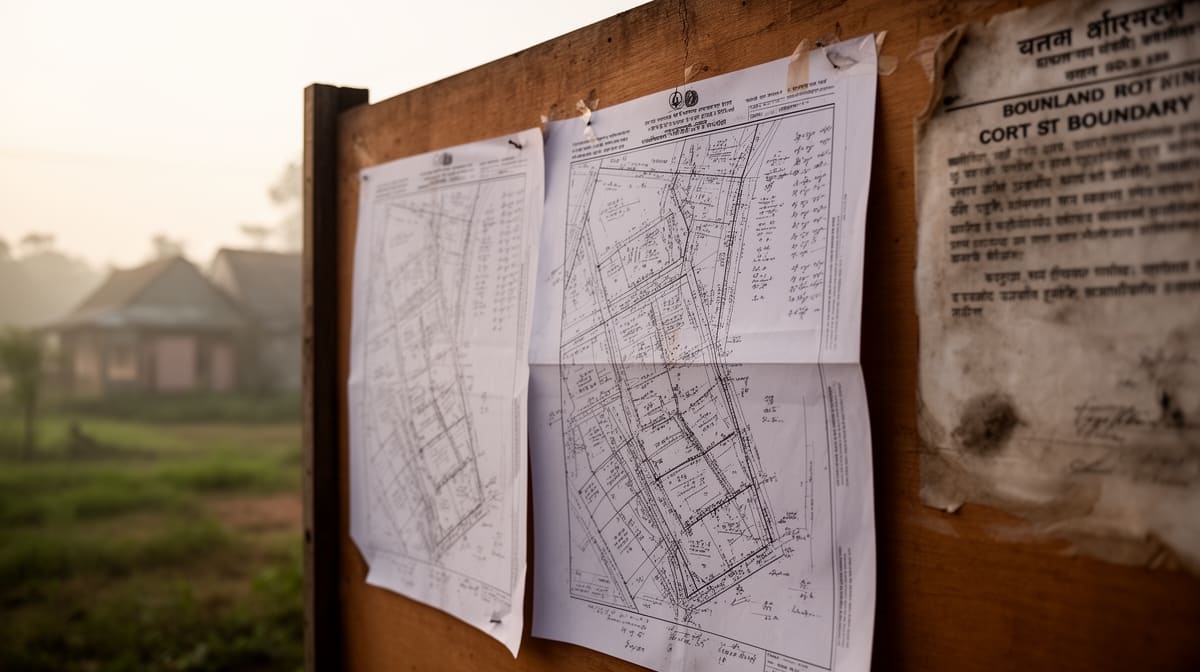
The Calcutta High Court has clarified that Order XXXIX Rule 1(b) of the Code of Civil Procedure empowers courts to grant temporary injunctions restraining a defendant from disposing of any of his properties - not merely suit properties - in a money suit, provided the plaintiff establishes an apprehension that such disposal is intended to defraud creditors. The Court also affirmed that where no written objection is filed to a temporary injunction application, the doctrine of non-traverse renders the averments therein uncontroverted and binding at the final hearing stage, and the trial court cannot deviate from its own ad interim satisfaction without recording reasons.
Background & Facts
The Dispute
The appellant, Vishal Jain, a legal professional, filed a money suit against Rajendra Kumar Parakh (respondent no.1) and another defendant for recovery of Rs. 40,00,000 based on a demand promissory note dated February 12, 2018. The promissory note acknowledged Rs. 31,00,000 as principal and Rs. 9,00,000 as lump sum interest for professional legal services rendered by the appellant. The appellant simultaneously filed an application for temporary injunction under Order XXXIX Rule 1(b) CPC, apprehending that the respondent no.1 would alienate his properties to defraud creditors.
Key Facts
- February 12, 2018: Demand promissory note executed by respondent no.1 in favour of appellant for Rs. 40,00,000 payable on demand
- 2021: Money Suit No. 64 of 2021 filed before Civil Judge (Senior Division), Fourth Court, Alipore, South 24 Parganas
- March 14, 2021: Trial court granted ad interim injunction restraining defendants from alienating properties enumerated in Schedule-A of the injunction application
- The ad interim order subsisted for approximately five years
- No written objection was ever filed by the defendants/respondents to the temporary injunction application
- Paragraph 35 of the plaint contained a chart of three immovable properties, including respondent no.1's residential flat at 13, Kedar Bose Lane, Kolkata - 700 025 and another at Orbit Sky Garden, 30, Bondel Road, Kolkata - 700 019
- Paragraph 36 of the injunction application specifically averred that respondent no.1 was heavily indebted to several persons across the corporate and legal community and was attempting to evade the appellant's dues
- During pendency, appellant filed an application under Order XXXIX Rule 2A alleging violation of ad interim order by sale of another flat in the same building at 13, Kedar Bose Lane
- September 19, 2026: Trial court dismissed the temporary injunction application, holding that Order XXXIX CPC does not apply to money suits as the properties were not "suit properties" and that averments lacked particulars
Procedural History
- 2021: Money Suit No. 64 of 2021 instituted
- March 14, 2021: Ad interim injunction granted by trial court
- September 19, 2026: Trial court dismissed temporary injunction application (impugned order)
- 2026: First Miscellaneous Appeal (F.M.A. No. 1248 of 2026) filed before Calcutta High Court
- November 13, 2026: Appeal heard and reserved for judgment
- November 17, 2026: Judgment delivered by Division Bench (Justice Sabyasachi Bhattacharyya and Justice Md. Shabbar Rashidi)
The Parties' Positions
Appellant (Vishal Jain): Contended that the uncontroverted averments in the injunction application, coupled with the trial court's own ad interim satisfaction, mandated grant of injunction; Order XXXIX Rule 1(b) applies to any property of the defendant in a money suit if disposal is intended to defraud creditors; the promissory note is unqualified and creates an unimpeachable liquidated claim.
Respondent no.1 (Rajendra Kumar Parakh): Argued that Order XXXIX Rule 1 only contemplates injunction in respect of suit properties, not any property; no advocate's lien exists in Indian law; the promissory note is conditional upon sale of Nonadanga property; plaintiff failed to furnish particulars of other creditors and properties; valuation of properties far exceeds the claim amount.
Relief Sought
The appellant sought setting aside of the order dated September 19, 2026, grant of temporary injunction restraining respondent no.1 from alienating the properties in Schedule-A, and alternatively, security for the claim amount.
The Legal Issue
The central questions were: (1) Whether Order XXXIX Rule 1(b) CPC permits grant of temporary injunction in a money suit against properties that are not the subject-matter of the suit, based on an apprehension that the defendant intends to dispose of his properties to defraud creditors; (2) Whether the doctrine of non-traverse applies when no written objection is filed to a temporary injunction application, rendering the averments therein binding at the final hearing stage; (3) Whether the absence of a specific prayer for injunction in the plaint bars a temporary injunction application during pendency of a money suit.
Arguments Presented
For the Appellant
Learned counsel Shounak Mukhopadhyay argued that the trial court had recorded clear prima facie satisfaction on March 14, 2021, and in the absence of any written objection by the defendants, the doctrine of non-traverse required the court to accept the averments in the injunction application as true. He relied on Rahul S. Shah v. Jinendra Kumar Gandhi (2021) 6 SCC 418 for the proposition that courts can secure money claims through disclosure of assets and security under Section 151 CPC. He also cited Tata Chemicals Limited v. Kshitish Bardhan Chunilal Nath (2022) 1 HC (Cal) 275, where a co-ordinate Bench held that courts have inherent power to pass injunction or attachment orders upon demonstration of an unimpeachable liquidated claim and steps by the defendant to improperly deny realisation. The appellant emphasized that the sale of a flat in the same building during pendency of the ad interim order vindicated the fraudulent disposal allegation.
For the Respondent
Senior counsel Probal Mukherjee contended that Order XXXIX Rule 1 CPC only permits injunction in respect of suit properties, and in a money suit, immovable properties cannot be termed "suit properties." He argued there is no concept of advocate's lien in Indian law, rendering the premise of the promissory note invalid. The promissory note, he submitted, was conditional upon receipt of consideration from sale of a Nonadanga property. He further argued that the plaintiff was required to furnish particulars of other creditors, proposed vendors, and properties, and produce accounts or balance sheets to substantiate the allegation of multiple creditors. He cited Shree Vaishnavi Ispat Ltd. v. M/s. Sharp Ferro Alloys Ltd. (FMAT No. 75 of 2025) and Kohinoor Steel Private Limited v. Pravesh Chandra Kapoor (2010 SCC OnLine Cal 1856) for the proposition that vague allegations of inability to pay debts are insufficient without specific averments of intent to defraud creditors.
The Court's Analysis
The Division Bench, through Justice Sabyasachi Bhattacharyya, first addressed the doctrine of non-traverse. The Court held that since no written objection was filed at any point by the defendants to controvert the allegations in the temporary injunction application, the doctrine of non-traverse was squarely applicable. The trial court, at the final disposal stage, was bound to proceed on the basis that the averments in the injunction application were true. The Court observed:
"The cardinal distinction between the ad interim and final stage of an injunction application is the additional facts brought on record by the defendants to resist the injunction application... However, even at the temporary injunction stage, the considerations are at a prima facie level... since the defendants/respondents have not even controverted the pleadings in the injunction application, the tests, on a prima facie footing, remained the same for the trial Court as at the ad interim stage."
The Court found that the trial judge erred in deviating from his own ad interim satisfaction without recording any specific reason, especially when the factual scenario remained unchanged.
On the applicability of Order XXXIX Rule 1(b), the Court undertook a detailed statutory interpretation. It held that the first limb of the second portion of Rule 1(b) - "where in any suit it is proved by affidavit or otherwise that the defendant threatens, or intends, to remove or dispose of his property with a view to defrauding his creditors" - operates irrespective of whether the subject matter of the injunction is the suit property or any other property. The governing rider is whether the defendant threatens or intends to dispose of "his property" "with a view to defrauding his creditors." The Court clarified:
"Applying the said framework, injunction may very well be granted in a money suit as well, provided the parameters of Rule 1(b) are satisfied. Order XXXVIII, Rule 5 of the Code operates in a somewhat different matrix, although there is substantial overlap between the two provisions."
The Court distinguished Order XXXVIII Rule 5 (attachment before judgment), which mandates valuation of property and a higher standard of proof, from Order XXXIX Rule 1(b), which grants blanket power to restrain disposal of any properties without requiring valuation. Therefore, the respondent's argument that the property valuation far exceeds the claim amount is irrelevant under Order XXXIX Rule 1(b).
The Court examined the specific averments in Paragraph 36 of the injunction application, which alleged that the defendant was "heavily indebted to several persons across the corporate and legal community and is attempting to evade the dues of the plaintiff" and that "the defendants will attempt to alienate the assets and/or the properties which can be used to liquidate the dues." In the absence of any rebuttal, these averments were mandatorily accepted as true and satisfied the requirements of Rule 1(b).
The Court distinguished Kohinoor Steel on the ground that there, only a vague allegation of inability to pay debts was made without any specific averment of intent to dispose of property to defraud creditors. In contrast, the present case contained a specific allegation of fraudulent disposal. The Court also clarified that Tata Chemicals and Rahul S. Shah dealt with inherent powers under Section 151 CPC, which are unwarranted when a specific provision (Order XXXIX Rule 1(b)) governs the factual matrix.
On the promissory note, the Court held it was unqualified and unequivocal, mandating payment of Rs. 40,00,000 merely on demand. The reference to the Nonadanga property was merely incidental, furnishing the premise of execution, not a condition qualifying the promise. The Court also rejected the argument that absence of a prayer for permanent injunction in the plaint bars temporary injunction, noting that in a money suit, the final relief is recovery of money, and temporary injunction operates in aid of that relief during pendency.
The Verdict
The appeal was partially allowed. The High Court set aside the trial court's order dated September 19, 2026, and granted a temporary injunction restraining respondent no.1 (Rajendra Kumar Parakh) from selling, transferring, alienating, and/or creating any third-party interest in respect of two properties: (1) the residential flat at Orbit Sky Garden, 30, Bondel Road, Kolkata - 700 019, and (2) the residential flat at 13, Kedar Bose Lane, Police Station Bhowanipur, Kolkata - 700 025, till disposal of Money Suit No. 64 of 2021. The Court gave respondent no.1 the option to deposit Rs. 40,00,000 as security in the trial court within one month from the date of judgment; if deposited, the injunction would stand automatically vacated, with the amount to be invested in a short-term interest-bearing account with a nationalized bank by the Registrar, subject to the suit's outcome. CAN 1 of 2026 was disposed of. No costs were awarded. The observations were clarified as tentative, leaving the trial court to decide the suit independently.
What This Means For Similar Cases
Non-Traverse Doctrine Binds Trial Courts at Final Hearing
When a defendant fails to file a written objection to a temporary injunction application, the averments therein become uncontroverted and must be accepted as true at the final hearing stage. A trial court that has granted ad interim injunction based on those averments cannot later dismiss the application without recording specific reasons for deviating from its own prima facie satisfaction, especially when no new facts have been brought on record. Practitioners should ensure that the absence of a written objection is prominently highlighted at the final hearing.
Order XXXIX Rule 1(b) Is Not Confined to Suit Properties in Money Suits
The first limb of Order XXXIX Rule 1(b) CPC - disposal of property with a view to defrauding creditors - applies to any property of the defendant, not merely properties that are the subject-matter of the suit. This is a critical distinction from Order XXXVIII Rule 5 (attachment before judgment), which requires valuation and a higher standard of proof. In money suits, plaintiffs can seek injunction against any defendant property if they can establish, even through uncontroverted averments, an apprehension of fraudulent disposal to defeat creditors. The valuation of the property relative to the claim amount is irrelevant under Rule 1(b).
Specific Averments of Fraudulent Intent Trump Vague Insolvency Allegations
Kohinoor Steel is distinguished where the injunction application contains specific allegations that the defendant is "attempting to evade dues" and "will attempt to alienate assets" to defraud creditors. A mere allegation that the defendant is unable to pay debts is insufficient. Practitioners must draft injunction applications with precise averments of the defendant's intent to dispose of specific properties with a fraudulent motive, rather than relying on general assertions of financial distress.
Promissory Notes Referencing Underlying Transactions Are Not Conditional
A demand promissory note that promises payment of a settled amount "merely on demand" is unqualified, even if it recites that the sum was arrived at based on the value of an underlying property transaction. The reference to the underlying transaction is incidental, furnishing the premise of execution, not a condition precedent to liability. This protects legal professionals and other creditors who rely on promissory notes as acknowledgments of debt.
Temporary Injunction Does Not Require a Prayer for Permanent Injunction in the Plaint
In a money suit where the final relief is a money decree, the plaintiff need not pray for permanent injunction in the plaint to seek temporary injunction during pendency. Temporary injunction operates to preserve the subject-matter of the suit (the defendant's assets available for decree execution) until final adjudication. The absence of a permanent injunction prayer is not a bar to interim protection.