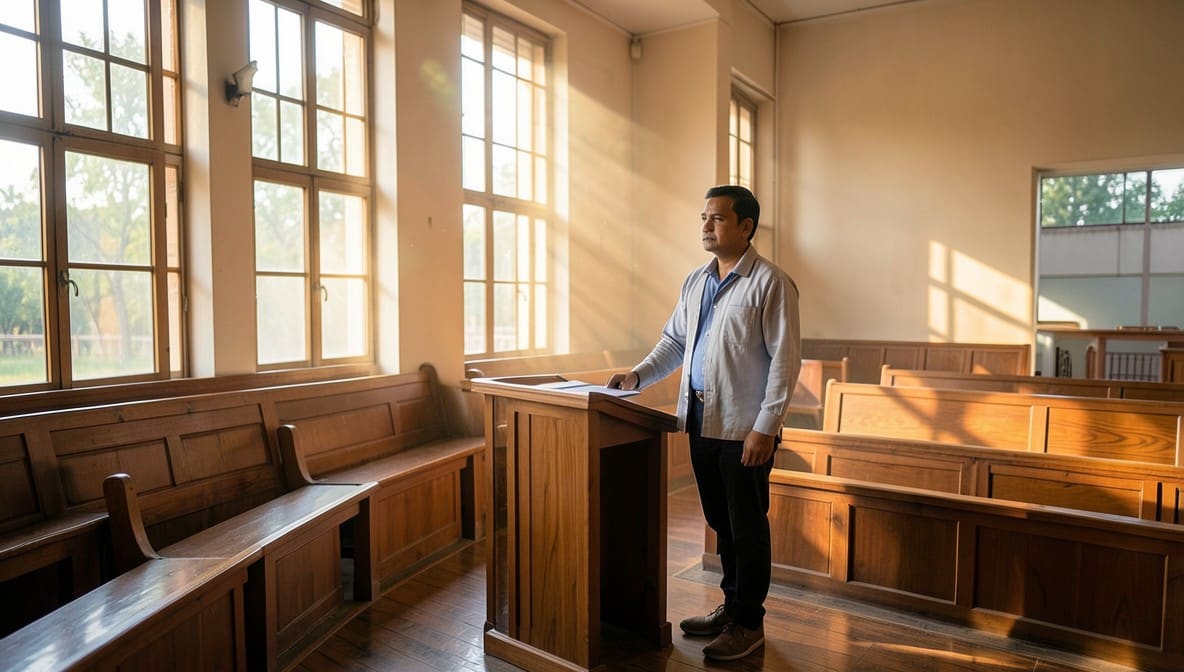
The Madhya Pradesh High Court has reaffirmed that courts must exercise judicial discretion with restraint when closing a plaintiff’s right to lead evidence, particularly where delays stem from circumstances beyond the party’s control. In this case, the Court overturned the trial court’s order terminating evidence collection after nearly eight years, granting one final opportunity under strict conditions.
Background & Facts
The Dispute
The petitioner, Shri Guru Hargovind Society, is the plaintiff in a civil suit filed against the Bhopal Municipal Corporation and others concerning land use rights and municipal permissions. The suit, originally filed years ago, reached the stage of plaintiff’s evidence in 2017. Despite repeated listings, evidence was not led due to a series of procedural and administrative delays.
Key Facts
- The suit was first fixed for plaintiff’s evidence in 2017.
- On 2024, the proceedings were stayed by the Madhya Pradesh High Court in M.P. No. 3586 of 2024.
- The stay was vacated on 12.11.2024.
- On 19.08.2025, the trial court allowed an application filed by the plaintiff under Order 7 Rule 14 CPC seeking clarification on pleadings.
- On 21.08.2025, the matter was listed but no evidence was led.
- On 28.08.2025, the trial court closed the plaintiff’s right to lead evidence, citing repeated adjournments and failure to progress since 2017.
- The petitioner had filed an application under Order 17 Rule 1 CPC seeking adjournment due to the death of the uncle of the main counsel, who was attending funeral rites.
- The presiding officer of the trial court was transferred during the pendency of the suit, resulting in transfer of the case to another court.
Procedural History
- 2017: First listing for plaintiff’s evidence.
- 2024: Proceedings stayed by High Court in M.P. No. 3586 of 2024.
- 12.11.2024: Stay vacated.
- 19.08.2025: Application under Order 7 Rule 14 CPC allowed.
- 21.08.2025: Case listed; no evidence led.
- 28.08.2025: Trial court closed right to lead evidence.
- 07.05.2026: Present writ petition heard and decided by the Madhya Pradesh High Court.
Relief Sought
The petitioner sought quashing of the trial court’s order dated 28.08.2025, restoration of the right to lead evidence, and direction to permit one final opportunity to examine witnesses without further adjournments.
The Legal Issue
The central question was whether a trial court may permanently close a plaintiff’s right to lead evidence under Order 17 Rule 1 CPC after prolonged delays caused by factors including judicial stay, court transfer, and personal circumstances of counsel, without granting a final opportunity.
Arguments Presented
For the Petitioner
The petitioner’s counsel argued that the delay was not attributable to the plaintiff’s negligence. The stay granted by the High Court in 2024 was beyond the plaintiff’s control. The transfer of the presiding officer and the subsequent transfer of the suit further disrupted proceedings. The application for adjournment on account of the counsel’s uncle’s demise was legitimate and fell within the scope of compassionate grounds recognized under Order 17 Rule 1 CPC. The trial court’s decision was arbitrary and violated the principle of fair opportunity.
For the Respondent
The respondent, Bhopal Municipal Corporation, contended that the plaintiff had been given ample opportunities since 2017 to lead evidence. Multiple dates were fixed, and the plaintiff repeatedly failed to appear or produce witnesses. The application under Order 7 Rule 14 CPC was filed only after years of inaction. The trial court’s decision to close evidence was justified under Order 17 Rule 1 CPC to prevent abuse of process and ensure timely disposal.
The Court's Analysis
The High Court examined the nature of delays and distinguished between avoidable and unavoidable causes. It noted that the stay order issued by this Court in 2024, which lasted approximately seven months, was a judicial intervention that suspended all proceedings. The subsequent transfer of the case due to the transfer of the presiding officer was an administrative event outside the plaintiff’s control. The application under Order 7 Rule 14 CPC, though filed belatedly, was decided in the plaintiff’s favor on 19.08.2025, indicating the court’s recognition of procedural irregularities.
"The right to lead evidence is a substantive right, not a procedural formality. Depriving a party of this right on account of delays caused by judicial stays and administrative transfers would amount to punishing the litigant for the system’s inefficiencies."
The Court emphasized that Order 17 Rule 1 CPC permits adjournment for sufficient cause, including personal circumstances of counsel. The death of a close relative and the attendant obligations are recognized as valid grounds. The trial court’s failure to consider these factors rendered its order unsustainable.
The Court further held that while courts must discourage dilatory tactics, they must also ensure that justice is not denied due to systemic delays. The plaintiff had not shown a pattern of deliberate non-cooperation but had been caught in a chain of external disruptions.
The Verdict
The petition was allowed. The High Court set aside the trial court’s order dated 28.08.2025. The plaintiff is granted one final opportunity to lead evidence, subject to payment of a cost of Rs. 3,000 to the defendant before the trial court. No further adjournments shall be permitted except on grounds of paucity of judicial time. The plaintiff must complete evidence within the next 30 days from the date of this order.
What This Means For Similar Cases
Adjournments for Personal Circumstances Are Valid Grounds
- Practitioners may now rely on Order 17 Rule 1 CPC to seek adjournments for the death or serious illness of close relatives of counsel, provided the application is filed promptly with supporting documentation.
- Courts must evaluate such requests on merit, not dismiss them as routine delays.
Systemic Delays Cannot Be Attributed to Litigants
- Delays caused by judicial stays, court transfers, or administrative reassignments cannot be used to terminate a party’s right to lead evidence.
- The burden shifts to the court to account for such delays when assessing whether a party has abused the process.
One Final Opportunity Is the Norm, Not the Exception
- Courts must grant at least one final opportunity to lead evidence before closing the case, especially where the delay is not attributable to the party’s conduct.
- The imposition of costs, as done here, is a balanced mechanism to deter future delays without denying substantive rights.