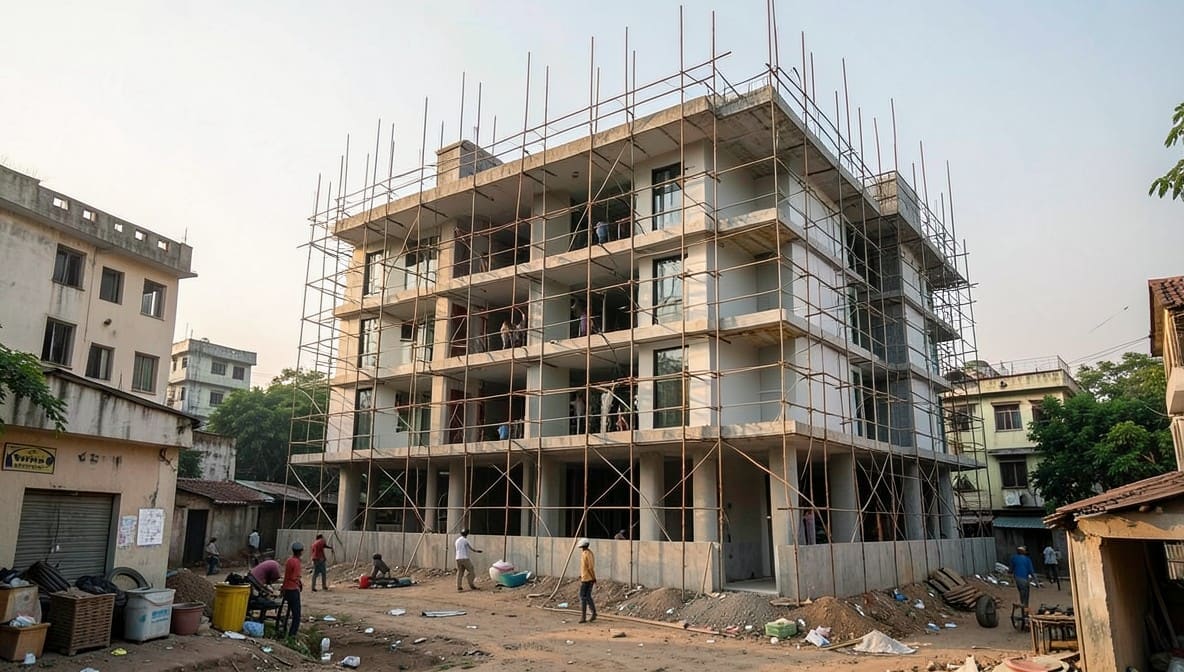
The West Bengal State Consumer Disputes Redressal Commission delivered a significant ruling affirming that oral agreements for sale of immovable property can be legally valid and enforceable under the Consumer Protection Act, 1986. The Commission directed the developer to refund Rs. 19,75,000 with 9% interest and pay compensation for deficiency in service.
Background & Facts
The Dispute
The complainant, Rohit Bhatt, a teacher residing in Varanasi, Uttar Pradesh, alleged that he entered into a verbal agreement with Santosh Kumar Chowdhury (OP), the owner of land and structure at Premises No. 27, Dr. Probodh Kumar Banerjee Road, Howrah, to purchase a flat measuring 790 sq.ft. on the first floor of a newly constructed building for a total consideration of Rs. 19,75,000. The complainant claimed that despite full payment, the OP failed to execute the sale deed or handover possession, leading to mental agony and harassment.
Key Facts
- The complainant’s father, a retired bank employee, had an affinity for Kolkata, prompting the search for a residential flat in or around the city.
- The OP represented that he was authorized to construct and sell flats as per the sanctioned plan by Howrah Municipal Corporation.
- The complainant relied on the OP’s assurances and made full payment of Rs. 19,75,000 through bank transactions between 22.09.2012 and 15.02.2014 in the following manner:
- 22.09.2012: Rs. 5,92,500 via Bank of India cheque
- 17.10.2012: Rs. 5,92,500 via Axis Bank Demand Draft
- 03.08.2013: Rs. 1,97,500 via Axis Bank Demand Draft
- 10.02.2014: Rs. 1,97,500 via Axis Bank Demand Draft
- 15.02.2014: Rs. 3,95,000 via Axis Bank Demand Draft
- The OP assured possession within six months of construction completion and registration by 16.11.2016.
- An electricity connection was taken in the name of the complainant’s father, Vishnu Shankar Bhatt, for the flat in August 2014.
- The complainant sent a letter to the OP on 01.11.2016 requesting compliance with the agreement.
- A legal notice was issued by the complainant’s advocate, Mr. Amitabha Shukla, on 05.12.2018 via speed post, but the OP failed to respond.
Procedural History
- 17.01.2020: Consumer complaint (No. SC/19/CC/51/2020) filed under Section 17 of the Consumer Protection Act, 1986 before the West Bengal State Consumer Disputes Redressal Commission.
- The OP contested the complaint, claiming the flat was given on a licence basis at Rs. 25,000 per month from February 2012 to February 2019 and that Rs. 1,50,000 was outstanding as licence fees.
- The OP denied receiving any legal notice and alleged collusion between the complainant and the postal department.
The Parties' Positions
- Complainant: Argued that the payments were towards the sale consideration of the flat and that the OP’s failure to execute the sale deed amounted to deficiency in service under the Consumer Protection Act. Sought refund of Rs. 19,75,000 with 24% interest, Rs. 10,00,000 as compensation, Rs. 5,00,000 as punitive damages, and Rs. 1,00,000 as litigation costs.
- OP: Contended that the flat was given on a licence basis, no sale agreement existed, and the complainant’s claims were concocted. Asserted that the complainant and his family vacated the flat in February 2019 after repeated requests.
Relief Sought
The complainant prayed for:
- Direction to the OP to execute and register a deed of conveyance for the flat.
- Handover of possession of the flat within a specified timeframe.
- Alternatively, refund of Rs. 19,75,000 with 24% per annum interest from the date of payment.
- Compensation of Rs. 10,00,000 for loss, injury, mental agony, and harassment.
- Punitive damages of Rs. 5,00,000.
- Litigation costs of Rs. 1,00,000.
The Legal Issue
The primary question before the Commission was whether the complainant could establish a valid oral agreement for the sale of the flat and whether the OP’s failure to execute the sale deed constituted deficiency in service under Section 2(1)(g) of the Consumer Protection Act, 1986. Additionally, the Commission had to determine whether the complainant was a consumer under the Act and whether the OP’s defence of a licence agreement was sustainable.
Arguments Presented
For the Complainant
- Argued that the OP’s answers to questionnaires were evasive and that the electricity bills for the flat (in the complainant’s father’s name) from 2012 to 2018 showed zero readings, implying the flat was unoccupied.
- Contended that the manner and quantum of payments (lump sums at irregular intervals) were inconsistent with a licence fee arrangement.
- Relied on the Registration Act, 1908, arguing that any licence or tenancy agreement exceeding one year must be in writing and registered, which was not the case here.
- Asserted that the OP failed to prove the flat was habitable or that the complainant’s family resided there as licensees.
For the Respondent
- Denied the existence of any sale agreement and claimed the payments were licence fees at Rs. 25,000 per month.
- Argued that the complainant suppressed material facts and that no legal notice was served.
- Contended that the complainant’s family occupied the flat from February 2012 to February 2019 and that the OP required the flat for personal use thereafter.
- Asserted that the complainant’s claims were concocted and that the OP was a renowned developer with no obligation to sell the flat.
The Court's Analysis
The Commission analyzed the evidence and arguments to determine the nature of the transaction between the parties. It noted that while no written agreement existed, oral contracts are permissible under Indian law and can be enforced if proven by other evidence.
"In as much as an oral contract is permissible in law so, by establishing the facts of payments of total money of Rs. 19,75,000/- and by linking him with the subject flat through the undisputed existence electricity bill so also by unanswered demand notice sent on behalf the complainant, the complainant has discharged his onus of claiming over the subject flat as proposed purchaser."
The Commission observed:
- The OP’s claim of a licence fee of Rs. 25,000 per month for a 790 sq.ft. flat in Howrah in 2012 was abnormal and absurd, given the prevailing market rates.
- The manner of payments (lump sums at irregular intervals) was inconsistent with a licence arrangement but aligned with part payments for a sale consideration.
- The OP failed to produce any evidence (e.g., local witnesses) to prove the complainant’s family resided in the flat as licensees.
- The Registration Act, 1908 mandates that any agreement for immovable property exceeding one year must be in writing and registered. The absence of a written licence agreement rendered the OP’s defence unsustainable.
- The electricity bill in the complainant’s father’s name established a link between the complainant and the flat, supporting the complainant’s claim of a sale agreement.
The Commission held that the complainant had discharged his burden of proof by demonstrating the payments and linking them to the flat, while the OP failed to substantiate his claim of a licence agreement.
The Verdict
The Commission allowed the complaint and held the OP guilty of deficiency in service. It directed the OP to:
- Refund Rs. 19,75,000 to the complainant with 9% per annum interest from the date of filing the complaint (17.01.2020) until realization.
- Pay Rs. 1,00,000 as compensation for mental agony and harassment.
- Pay Rs. 30,000 as litigation costs.
- Comply with the order within 60 days from 27.07.2026, failing which the complainant could execute the order as per law.
What This Means For Similar Cases
Oral Agreements Can Be Enforced
- Courts may uphold oral agreements for sale of immovable property if supported by circumstantial evidence, such as payment records, possession links, and demand notices.
- The burden of proof shifts to the party denying the agreement once the complainant establishes a prima facie case.
Deficiency in Service Under Consumer Protection Act
- Developers or sellers who fail to honor oral agreements may be held liable for deficiency in service under Section 2(1)(g) of the Consumer Protection Act, 1986.
- Consumers can seek refunds, compensation, and interest for such deficiencies.
Licence Agreements Must Comply with Registration Act
- Any licence or tenancy agreement for immovable property exceeding one year must be in writing and registered under the Registration Act, 1908.
- Oral licence agreements for long-term occupancy are legally unsustainable and cannot be enforced.
Payment Patterns Matter
- Lump sum payments at irregular intervals are more consistent with sale consideration than licence fees.
- Courts may scrutinize the manner, quantum, and timing of payments to determine the nature of the transaction.