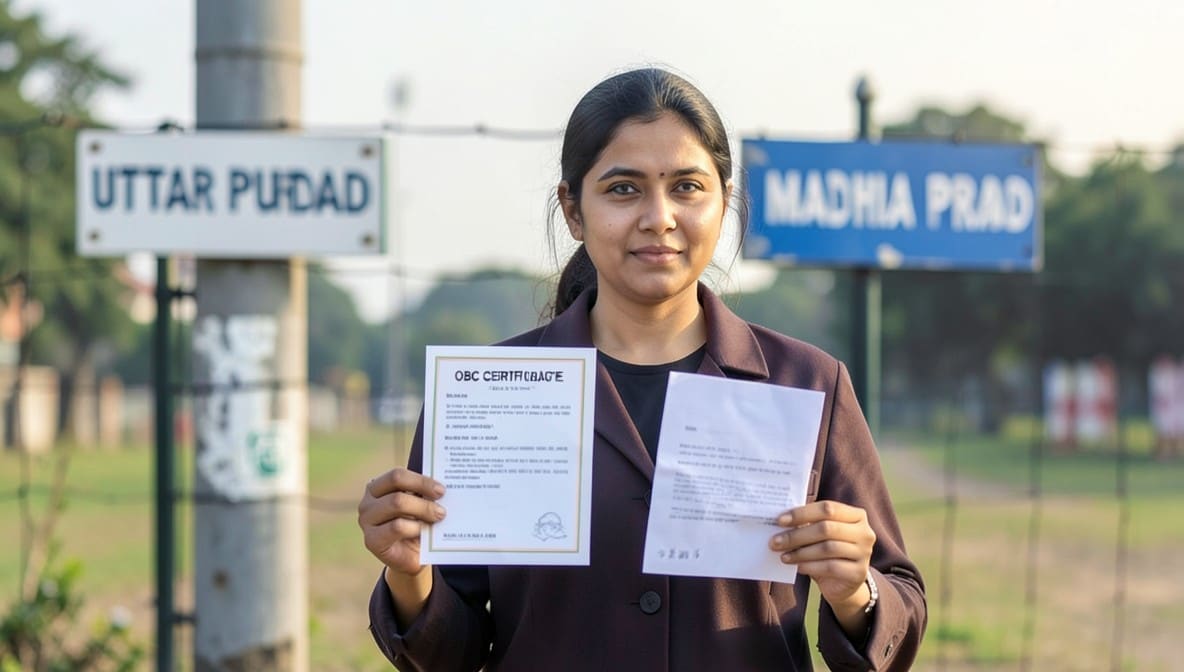
The Madhya Pradesh High Court has reaffirmed that reservation benefits under OBC quotas are strictly state-specific, and migration across state borders - whether for marriage or employment - does not transfer caste-based entitlements. This ruling clarifies a persistent ambiguity in public employment and education admissions, reinforcing the territorial limits of constitutional reservations.
Background & Facts
The Dispute
The petitioner, Archana Dangi, is a resident of District Jalaun in Uttar Pradesh, belonging to the Dangi community, which is notified as Other Backward Class (OBC) in Uttar Pradesh. She obtained an OBC caste certificate from the competent authority in Jalaun on 18/08/2005. After marrying Majbut Singh Dangi, a resident of District Datia in Madhya Pradesh, she migrated to Madhya Pradesh. The Dangi community is also recognized as OBC in Madhya Pradesh. In 2018, she appeared for and qualified the Uchcha Madhyamik Shikshak Eligibility Test conducted by the School Education Department, Madhya Pradesh, for appointment as a Sanskrit teacher. During document verification on 07/03/2020, her candidature was rejected because her OBC certificate was issued by Uttar Pradesh, not Madhya Pradesh.
Key Facts
- The petitioner’s OBC certificate was issued by District Jalaun, Uttar Pradesh, on 18/08/2005.
- The Dangi community is recognized as OBC in both Uttar Pradesh and Madhya Pradesh.
- The petitioner migrated to Madhya Pradesh after marriage in 2005.
- Her husband belongs to the same Dangi community and is a resident of Datia, Madhya Pradesh.
- The rejection was based on Annexure P/2, the document verification slip dated 07/03/2020, which cited the certificate’s origin in another state.
- The petitioner filed representations seeking reconsideration, which were not addressed.
Procedural History
- 07/03/2020: Document verification conducted by District Education Officer, Datia; candidature rejected.
- 24/06/2021: Writ Petition No. 24696/2021 filed before the High Court of Madhya Pradesh at Gwalior.
- 20/03/2026: Case reserved for judgment.
- 31/03/2026: Judgment delivered by Justice Ashish Shroti.
The Parties' Positions
For the Petitioner: Argued that since the Dangi community is recognized as OBC in both states, and she migrated due to marriage to a member of the same community, she should be entitled to OBC benefits in Madhya Pradesh. Relied on Smt. Anusuiya Prajapati v. State of M.P. (W.P. No. 10277/2021) to support her claim.
For the Respondent/State: Contended that caste status for reservation purposes is determined by birth and domicile, not marriage or migration. Cited Government circular dated 06/04/2021 and binding precedents including Seema Devi v. Union of India (2024(2) MPLJ 71) and Sadhna Sau v. State of M.P. (W.P. No. 81/2023). Emphasized that reservation is state-specific under Presidential Orders under Articles 341 and 342.
Relief Sought
The petitioner sought: (i) quashing of Annexure P/2; (ii) declaration that she is a duly qualified candidate; (iii) direction to conduct re-verification of documents; (iv) appointment as Sanskrit teacher; and (v) costs.
The Legal Issue
Can a person who migrates from one state to another, even upon marriage to a member of the same OBC community recognized in both states, claim reservation benefits in the new state based on a caste certificate issued by the home state?
Arguments Presented
For the Petitioner
The petitioner’s counsel argued that the Dangi community is recognized as OBC in both Uttar Pradesh and Madhya Pradesh, and therefore, the certificate should be accepted across state lines. He contended that marriage to a member of the same community in Madhya Pradesh should entitle her to OBC status in the new state, citing Smt. Anusuiya Prajapati v. State of M.P. as binding precedent. He further argued that denying her benefit defeats the purpose of social justice and is discriminatory.
For the Respondent/State
The State’s counsel countered that reservation is constitutionally and administratively confined to the state where the caste is notified as OBC. He cited the General Administration Department circular dated 06/04/2021, which explicitly bars recognition of inter-state OBC certificates for reservation purposes. He relied on Seema Devi v. Union of India and Bir Singh v. Delhi Jal Board to establish that caste status does not migrate with the individual. He also emphasized that marriage does not alter one’s birth-based caste identity for reservation purposes, citing Sobha Hymavathi Devi v. Setti Gangadhara Swamy and Sandhya Thakur v. Vimla Devi Kushwah.
The Court's Analysis
The Court undertook a comprehensive review of constitutional principles, statutory frameworks, and binding precedents. It noted that while the Dangi community is recognized as OBC in both Uttar Pradesh and Madhya Pradesh, the legal entitlement to reservation is not determined by the mere similarity of caste names but by the social, economic, and educational backwardness specific to that state.
"The recognition of a caste in a particular State as OBC is directly relatable to social, economic and educational backwardness faced by that caste in the home State. This geographical, social and educational backwardness existing in the home State cannot necessarily be the same in the other State."
The Court emphasized that Presidential Orders under Articles 341 and 342 of the Constitution notify caste lists separately for each state, and there is no pan-India OBC list. Therefore, a person cannot claim reservation benefits in a new state merely because their caste is recognized there, unless they themselves are notified as OBC by the authorities of that state.
The Court further held that marriage does not confer caste status for reservation purposes. Citing Sobha Hymavathi Devi v. Setti Gangadhara Swamy, it reaffirmed that even if a woman marries into a backward community, she cannot claim reservation unless she was born into it. The Court rejected the petitioner’s reliance on Smt. Anusuiya Prajapati, holding that it was rendered per incuriam because it failed to consider binding Supreme Court judgments in Bir Singh, Sobha Hymavathi Devi, and Sandhya Thakur.
The Court also clarified that the doctrine of sub silentio does not apply here, as the precedents relied upon by the State were directly on point and had been consistently followed. The petitioner’s claim, therefore, lacked legal foundation.
The Verdict
The petition was dismissed. The Court upheld the rejection of the petitioner’s candidature on the ground that her OBC certificate issued by Uttar Pradesh could not be accepted for reservation purposes in Madhya Pradesh. The Court confirmed that caste-based reservation benefits are strictly territorial and cannot be transferred by migration or marriage. No relief was granted.
What This Means For Similar Cases
Caste Status Is Birth-Based, Not Marriage-Based
- Practitioners must advise clients that marriage to a member of an OBC community does not confer OBC status for reservation purposes, regardless of community recognition in the new state.
- Applications for jobs or admissions must be supported by caste certificates issued by the state of domicile or origin, not by marriage ties.
Inter-State OBC Certificates Are Not Valid for Reservation
- State governments and selection bodies may lawfully reject OBC certificates issued by other states, even if the caste is recognized in both.
- Candidates migrating from one state to another must apply for a new OBC certificate from the authorities of the new state, if eligible under local criteria.
Precedents Must Be Reviewed for Per Incuriam Status
- Courts will disregard coordinate bench judgments that fail to consider binding Supreme Court or Division Bench precedents.
- Advocates must conduct thorough precedent checks before relying on lower court decisions, especially in reservation matters.
Reservation Is Not Pan-India
- The principle that reservation is state-specific is now firmly entrenched in jurisprudence.
- Any argument seeking uniform national OBC lists or cross-state benefit transfer will be legally unsustainable.