The Chhattisgarh High Court has reaffirmed that administrative penalties against contractors cannot be imposed based on conditions introduced after the fact, especially where there is no deliberate intent to deceive. This judgment clarifies the limits of regulatory discretion and reinforces the principle that procedural fairness must precede punitive action.
Background & Facts
The Dispute
The petitioner, M/s Shring Constructions, is a Class-A registered contractor under the Public Works Department (PWD) of Chhattisgarh, with registration number CGeR06806, valid from 10.11.2020 to 09.11.2025. The dispute arose from allegations of non-disclosure of "sublet work in hand" in tenders submitted to the Water Resources Department. The State authorities initiated proceedings under Clause 7.1 of the Unified Registration System Guidelines dated 29.10.2014, alleging suppression of material information.
Key Facts
- The petitioner submitted tenders between January 2024 and March 2025.
- Annexure-III of the tender documents at the time of submission contained no requirement to disclose sublet work.
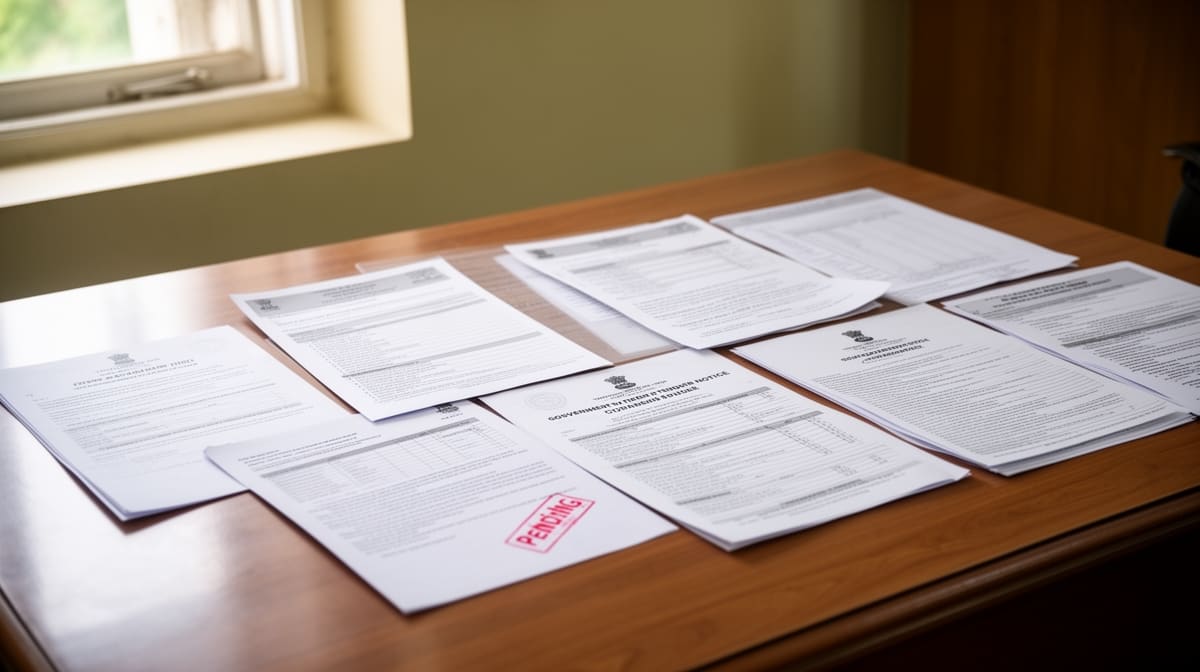
- A new requirement mandating disclosure of "sublet work in hand" was introduced via amendment dated 16.04.2025.
- A show cause notice dated 08.05.2025 was issued, alleging non-disclosure in multiple tenders.
- The petitioner submitted a detailed reply on 21.05.2025, explaining that the disclosure requirement did not exist at the time of tender submission.
- The Engineer-in-Chief, PWD, passed an order dated 25.11.2025 directing non-renewal of the petitioner’s Class-A registration for two years.
- The petitioner filed an appeal under Clause 7.3 of the Unified Registration System.
Procedural History
- 08.05.2025: Show cause notice issued by PWD.
- 21.05.2025: Petitioner submitted reply explaining absence of disclosure requirement at time of tender submission.
- 25.11.2025: Engineer-in-Chief ordered non-renewal of Class-A registration for two years.
- 30.03.2026: Appeal Committee, while setting aside the two-year non-renewal, downgraded petitioner to Class-B for one year.
- 15.04.2026: Writ Petition No. 1968 of 2026 filed before the Chhattisgarh High Court.
- 24.04.2026: Hearing before the Division Bench.
The Parties' Positions
Petitioner’s Position: The petitioner argued that the requirement to disclose sublet work was introduced retrospectively on 16.04.2025, after the tenders in question were submitted. It further contended that the appellate authority itself acknowledged the lapse was a human error without mens rea, making the penalty arbitrary and disproportionate.
Respondent’s Position: The State defended the downgrade as a legitimate exercise of regulatory authority under the Unified Registration System, asserting that non-disclosure of material information, even if inadvertent, warranted corrective action to maintain integrity in public procurement.
Relief Sought
The petitioner sought:
- Quashing of the order dated 30.03.2026 downgrading its registration from Class-A to Class-B.
- Immediate restoration of its Class-A contractor status.
- All consequential benefits, including eligibility to bid on Class-A tenders.
The Legal Issue
The central question was whether an administrative authority may impose a penalty for non-disclosure of information when the disclosure requirement was introduced retrospectively, and whether a finding of mere human error without mens rea justifies a civil penalty affecting business eligibility.
Arguments Presented
For the Petitioner
The petitioner relied on the principle that retrospective application of regulatory conditions is impermissible under administrative law. It cited the appellate authority’s own finding that the lapse was a human error, not a deliberate concealment, to argue that the penalty was disproportionate and violative of natural justice. It further contended that the appellate proceedings were vitiated by repeated non-appearance of the State’s representatives, denying the petitioner a fair hearing.
For the Respondent
The State argued that the Unified Registration System grants broad powers to ensure transparency and accountability in contractor conduct. It maintained that non-disclosure of sublet work, even if unintentional, undermines the integrity of the tender process and that the downgrade was a proportionate corrective measure.
The Court's Analysis
The Court conducted a meticulous review of the tender documents and the timeline of regulatory amendments. It found that the requirement to disclose "sublet work in hand" was absent from Annexure-III of the tender forms at the time the petitioner submitted its bids. The amendment introducing this requirement was dated 16.04.2025, months after the relevant tenders were filed.
"The petitioner cannot be faulted for non-compliance of a condition which was not in existence at the relevant time, and any action based on such subsequent amendment would amount to retrospective application of a condition, which is impermissible in law."
The Court emphasized that the appellate authority itself recorded that the lapse was "merely a human error" and reflected no deliberate attempt to suppress information. This finding, the Court held, fundamentally undermines the justification for a penalty of such magnitude. The imposition of a downgrade - which directly impacts commercial opportunity, reputation, and livelihood - without any element of dishonesty or intent, violates the doctrine of proportionality and the principle of audi alteram partem.
The Court further noted the procedural irregularity in the appellate proceedings, where the concerned authority failed to appear on multiple occasions, depriving the petitioner of a meaningful opportunity to be heard. The absence of reasoned justification for substituting a two-year non-renewal with a one-year downgrade, without any new evidence or aggravating circumstances, rendered the order arbitrary.
The Verdict
The writ petition was allowed. The impugned order dated 30.03.2026 downgrading the petitioner from Class-A to Class-B contractor is quashed and set aside. The respondents are directed to restore the petitioner’s registration as a Class-A contractor forthwith, with all consequential benefits, including eligibility to participate in all Class-A tenders. No order as to costs.
What This Means For Similar Cases
Retrospective Application of Tender Conditions Is Invalid
- Practitioners must challenge any penalty based on conditions introduced after tender submission.
- Regulatory bodies cannot retroactively impose disclosure obligations to penalize past conduct.
- Tender documents must be interpreted as they existed at the time of submission.
Human Error Without Mens Rea Cannot Justify Civil Penalties
- Administrative authorities must distinguish between negligence and deliberate misconduct.
- Penalties affecting business eligibility (e.g., downgrading, debarment) require proof of intent or gross negligence.
- Findings of "human error" must preclude punitive action unless the regulation explicitly permits it.
Procedural Fairness Is Non-Negotiable
- Non-appearance of the State’s representative in appellate proceedings vitiates the entire process.
- Fair hearing under Article 14 and natural justice requires active participation by both sides.
- Courts will intervene where procedural lapses deprive parties of meaningful opportunity to defend.