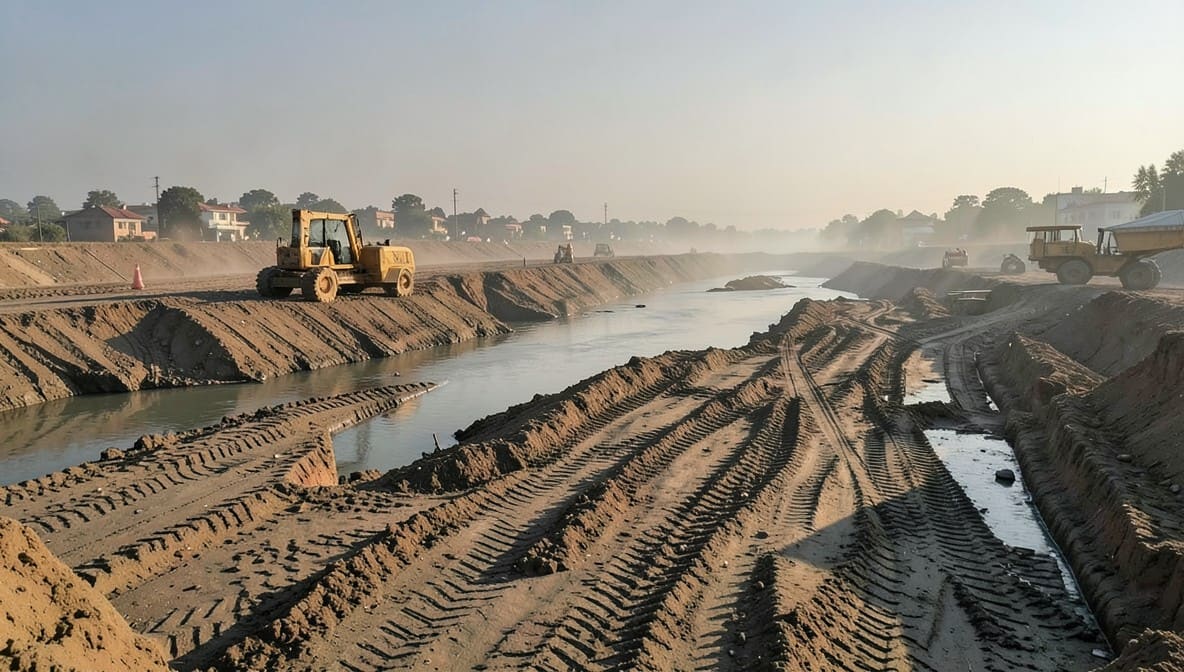
The National Green Tribunal has issued notice in a critical environmental matter concerning illegal sand mining in the Yamuna riverbed, raising serious concerns over systemic violations of statutory guidelines and environmental clearances. The Tribunal has constituted a multi-agency joint committee to investigate alleged breaches and ordered immediate preservation of surveillance footage, signaling a robust procedural response to ecological degradation.
Background & Facts
The Dispute
The applicant, Amir Hasanain, challenges the restoration of Environmental Clearance (EC) dated 17.03.2021 granted to M/s P.C. Gupta & Company (PCGC) for riverbed sand and morrum mining at Gata Nos. 621ma and 622ma in Village Mandawar, Tehsil Kairana, District Shamli, Uttar Pradesh. The EC was initially cancelled on 07.03.2025 by the State Level Environment Impact Assessment Authority (SEIAA), Uttar Pradesh, following findings of widespread violations. However, the Tribunal, in Appeal No. 39/2025 dated 15.10.2025, set aside the cancellation on grounds of violation of natural justice and directed SEIAA to reissue a reasoned order after providing PCGC a fresh hearing. SEIAA subsequently restored the EC on 31.12.2025, prompting this Original Application.
Key Facts
- EC dated 17.03.2021 granted for mining on 20.34 hectares of Yamuna riverbed
- Original EC cancelled on 07.03.2025 after findings of illegal mining in O.A. No. 528/2024
- Tribunal’s order dated 15.10.2025 quashed cancellation for procedural defect, not substantive violation
- SEIAA restored EC on 31.12.2025 without addressing underlying environmental breaches
- CTO granted by UPPCB on 20.01.2026, valid until 31.12.2026
- Complaints filed by Mr. Sarwar with Haryana’s Department of Mining & Geology alleging cross-border illegal mining in Karnal and Panipat districts
- Alleged violations include use of heavy machinery (excavators, JCBs), mining beyond lease boundaries, failure to install CCTV/PTZ systems, and non-compliance with permissible depth limits
- Transportation of sand via uncovered trucks causing severe dust pollution in Village Mandawar
- Construction of bunds and artificial obstructions in river channel disrupting natural flow and irrigation
Procedural History
- 17.03.2021: EC granted to M/s P.C. Gupta & Company for riverbed mining
- 2024: O.A. No. 528/2024 filed by Farukh Chauhan alleging large-scale illegal mining
- 13.05.2024: NGT constituted a Joint Committee to investigate
- 07.03.2025: SEIAA cancelled EC due to violations
- 15.10.2025: NGT set aside cancellation in Appeal No. 39/2025 for violation of natural justice
- 31.12.2025: SEIAA restored EC without addressing substantive violations
- 20.01.2026: UPPCB granted CTO to PCGC
- 04.05.2026: Original Application No. 274/2026 filed before NGT
- 04.05.2026: I.A. No. 358/2026 allowed for additional documents
The Parties' Positions
Applicant: Alleges that the restoration of EC was arbitrary, based on a post-facto replenishment study, and ignored persistent violations of the Sustainable Sand Mining Management Guidelines, 2016 and Enforcement and Monitoring Guidelines for Sand Mining, 2020. Claims mining is causing ecological harm, air pollution, disruption of river morphology, and livelihood loss to farmers and fisherfolk.
Respondents: Did not file written submissions prior to hearing. Advocate for respondents 1 - 4 accepted notice. No substantive defence presented at the interim stage.
Relief Sought
The applicant seeks:
- Immediate cessation of mining operations
- Quashing of EC restoration order dated 31.12.2025
- Constitution of a joint committee to inspect the site and submit a factual report
- Assessment and recovery of environmental compensation
- Strict enforcement of EC conditions and statutory guidelines
- Preparation and implementation of an environmental restoration plan for the affected stretch of Yamuna
The Legal Issue
The central question is whether the restoration of an Environmental Clearance, after its prior cancellation for substantive violations of statutory mining guidelines, can be lawfully reinstated without addressing the underlying environmental damage, ensuring compliance with the Sustainable Sand Mining Management Guidelines, 2016, and the Enforcement and Monitoring Guidelines for Sand Mining, 2020.
Arguments Presented
For the Appellant
The applicant argued that the restoration of EC was procedurally and substantively flawed. The SEIAA relied on a post-facto replenishment study that lacked scientific rigor and failed to assess sediment dynamics or river morphology, violating the SSMG-2016. The applicant cited repeated use of prohibited heavy machinery, mining beyond lease boundaries, absence of CCTV monitoring, and cross-border mining into Haryana as clear breaches of the EMGSM-2020. The applicant emphasized that belated compliance after detection cannot cure prior violations, citing M.C. Mehta v. Union of India on the principle of preventive environmental justice.
For the Respondent
No substantive arguments were presented by the respondents prior to or during the hearing. The advocate for respondents 1 - 4 merely accepted notice, indicating no opposition to the Tribunal’s procedural directions.
The Court's Analysis
The Tribunal found that the applicant’s allegations raised prima facie substantial questions relating to environmental degradation under Schedule I of the National Green Tribunal Act, 2010. The Court noted that while the earlier cancellation of EC was set aside on procedural grounds - failure to afford hearing - the substantive violations remained unaddressed. The restoration of EC without remedying these violations rendered the process legally unsustainable.
"The principles of environmental justice demand that procedural regularity cannot be used as a shield to perpetuate ecological harm. A restoration order that ignores the very violations that led to cancellation is legally indefensible."
The Tribunal emphasized that the Sustainable Sand Mining Management Guidelines, 2016, and the Enforcement and Monitoring Guidelines for Sand Mining, 2020, are not advisory but binding statutory instruments under the Environment (Protection) Act, 1986. The use of excavators and JCBs, mining beyond lease limits, and absence of real-time monitoring systems directly contravene these guidelines.
The Tribunal further observed that the cross-border nature of the alleged violations - spanning Uttar Pradesh and Haryana - necessitated a coordinated, inter-state response. The lack of oversight by Haryana authorities and the absence of CCTV footage from the mining site indicated systemic regulatory failure.
The Verdict
The Tribunal allowed the application for additional documents and issued notice to all respondents. It constituted a Joint Committee comprising representatives of the Central Pollution Control Board, Uttar Pradesh Pollution Control Board, Integrated Regional Office of MoEF&CC (Lucknow), District Magistrate of Shamli (U.P.), District Magistrate of Karnal (Haryana), and District Magistrate of Panipat (Haryana). The Committee is directed to visit the site, hear the applicant and the project proponent, verify compliance with EC conditions and statutory guidelines, and submit a report within 15 days. The UPPCB is designated as the nodal agency. The District Magistrate of Shamli must provide 30 days of CCTV footage from the mining site. The matter is listed for hearing on 28.05.2026.
What This Means For Similar Cases
Environmental Restoration Cannot Be a Formality
- Practitioners must challenge EC restorations that ignore prior substantive violations, even if the original cancellation was set aside on procedural grounds
- Courts and tribunals will not permit regulatory agencies to use procedural technicalities to circumvent environmental obligations
Inter-State Environmental Violations Require Joint Action
- Cross-border environmental harms, especially in shared river systems like the Yamuna, necessitate multi-jurisdictional oversight
- District Magistrates of adjoining states must be included in enforcement committees to prevent jurisdictional evasion
Real-Time Monitoring Is Non-Negotiable
- Absence of CCTV/PTZ systems constitutes a per se violation of EMGSM-2020
- Regulatory authorities must proactively demand and preserve surveillance data; failure to do so invites adverse inference
Preemptive Enforcement Trumps Post-Facto Compliance
- Belated corrective measures after detection of violations cannot absolve prior environmental damage
- Environmental compensation must be assessed independently of future compliance