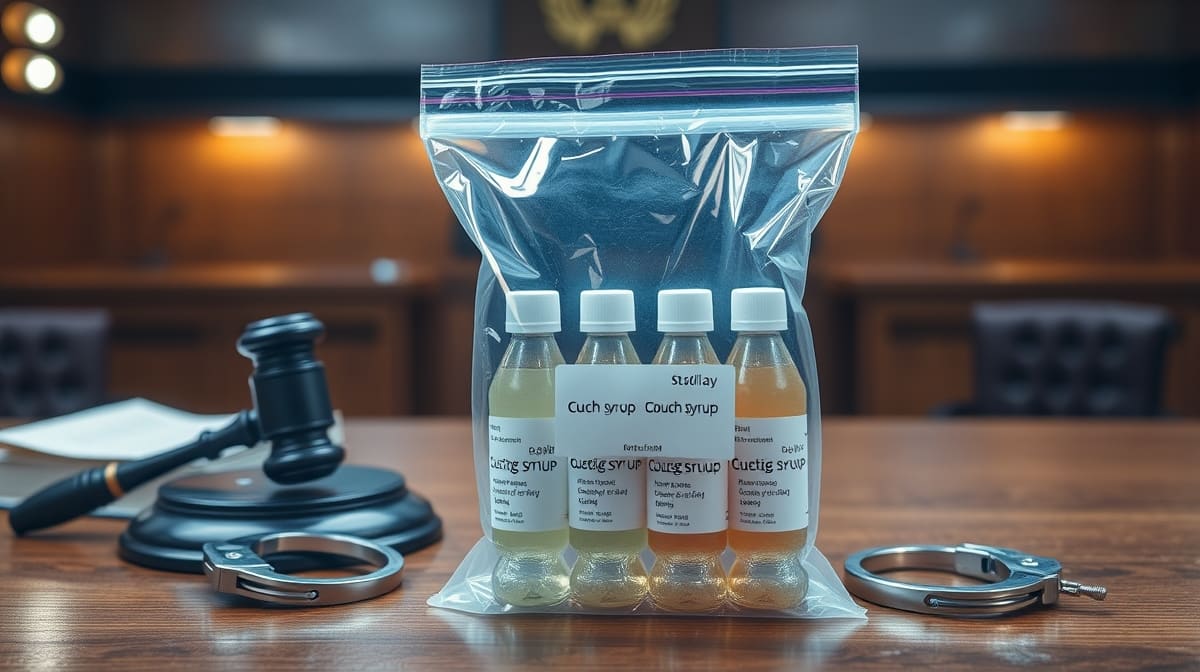
The Madhya Pradesh High Court has reaffirmed that concealment of criminal antecedents in bail applications under the NDPS Act is a decisive factor against granting relief, particularly when large quantities of controlled substances are involved. The judgment underscores the judiciary’s strict stance on procedural transparency in drug-related offences.
Background & Facts
The Dispute
The applicant, Vijay Sahu, is accused in Crime No. 417/2024 registered at Police Station Chorhata, District Rewa, for offences under Sections 8, 21, 22, 25, 25A, 29, 8A/27B of the Narcotic Drugs and Psychotropic Substances Act, 1985, and Sections 5 and 13 of the Drugs Control Act, 1950. The prosecution alleges that 2400 bottles of Onrex Cough Syrup containing Codeine Phosphate were seized from the conscious possession of the applicant and co-accused persons.
Key Facts
- The applicant has been in judicial custody since 30.05.2025.
- The prosecution claims the seized quantity of Codeine Phosphate constitutes a commercial quantity under the NDPS Act.
- The applicant disclosed details of only eight criminal cases against him in his bail application.
- The State, through its counsel, revealed that 36 criminal cases are registered against the applicant across various jurisdictions, including multiple cases under the NDPS Act.
- The charge sheet filed by the police does not contain details of all 36 cases.
- The applicant’s counsel admitted that the applicant lacks access to complete records of all cases and has not sought to amend the bail application to include full particulars.
Procedural History
- 30.05.2025: Applicant taken into custody following seizure of contraband.
- 30.04.2026: Application under Section 483 of the Bharatiya Nagarik Suraksha Sanhita (BNSS) filed seeking bail.
- 30.04.2026: Hearing conducted before the High Court at Jabalpur.
The Parties' Positions
For the Applicant:
- Argued that he is unaware of the full extent of criminal cases registered against him.
- Contended that the charge sheet does not disclose all 36 cases, making it impossible to provide complete particulars.
- Stated he has no intention to amend the bail application and requested adjudication on the existing record.
For the Respondent/State:
- Asserted that the applicant has deliberately concealed his extensive criminal history.
- Highlighted that 36 cases, including multiple NDPS Act violations, demonstrate a pattern of recidivism.
- Emphasized that the quantity of contraband (2400 bottles) is indicative of commercial trafficking.
Relief Sought
The applicant seeks bail pending trial, arguing that his detention is prolonged and that he is not a flight risk.
The Legal Issue
Is the failure to disclose a substantial portion of one’s criminal antecedents - particularly when multiple prior NDPS Act cases are involved - a valid ground for denying bail under Section 483 BNSS, even in the absence of full documentation in the charge sheet?
Arguments Presented
For the Appellant/Petitioner
The applicant’s counsel relied on the principle that an accused is not obligated to prove innocence but only to present a prima facie case for bail. He argued that since the charge sheet does not contain details of all 36 cases, the applicant cannot be faulted for omitting them. He further contended that the burden of proving criminal history lies with the prosecution, not the accused, and that the court should not penalize the applicant for lack of access to police records.
For the Respondent/State
The State countered that Section 483 BNSS requires full disclosure of criminal antecedents as a precondition for bail consideration. It cited Zeba Khan v. State of U.P., 2026 SCC Online SC 188, to establish that concealment of prior offences, especially under the NDPS Act, is a material circumstance justifying denial of bail. The State emphasized that the applicant’s repeated involvement in drug offences, coupled with the large quantity of contraband, indicates a high risk of reoffending and undermines public interest.
The Court's Analysis
The Court examined the obligation of an accused to disclose criminal antecedents under Section 483 BNSS, noting that while the statute does not explicitly mandate disclosure, judicial precedent imposes this as a necessary condition for fair adjudication of bail applications. The Court relied on the Supreme Court’s recent ruling in Zeba Khan v. State of U.P., 2026 SCC Online SC 188, which held that failure to disclose prior criminal cases is a serious omission that defeats the very purpose of bail scrutiny.
"The applicant cannot be permitted to play hide-and-seek with the court by disclosing only a fraction of his criminal history while the prosecution reveals a far more extensive record. This is not mere oversight - it is a deliberate omission that reflects a lack of candour."
The Court further noted that the applicant did not seek to amend his application despite being given an opportunity, and that the charge sheet’s incompleteness does not absolve the accused of the duty to disclose known or reasonably ascertainable antecedents. The Court observed that the applicant’s prior record, including multiple NDPS Act cases, establishes a pattern of recidivism. The seizure of 2400 bottles of codeine-containing syrup, a substance with high potential for abuse and diversion, further elevates the seriousness of the offence.
The Court held that in cases involving commercial quantities under the NDPS Act, the threshold for bail is exceptionally high. The combination of large-scale contraband and undisclosed criminal history renders the applicant a significant risk to society and a potential threat to the integrity of the investigation.
The Verdict
The bail application under Section 483 BNSS is dismissed. The applicant remains in custody pending trial. The Court found that the concealment of 28 out of 36 criminal cases, including multiple NDPS Act offences, and the seizure of 2400 bottles of codeine-containing syrup, collectively justify denial of bail. No conditions for bail are granted.
What This Means For Similar Cases
Disclosure of Criminal Antecedents Is Non-Negotiable
- Practitioners must ensure bail applications under the NDPS Act include a complete list of all prior cases, even if not reflected in the charge sheet.
- Failure to disclose known cases - even if records are inaccessible - may be construed as bad faith and result in automatic denial.
- Courts will treat omissions as deliberate, especially in repeat offender scenarios.
Quantity of Contraband Amplifies Bail Denial Risk
- Possession of 2400 bottles or more of codeine syrup is now a de facto indicator of commercial trafficking under NDPS Act.
- Any accused facing such quantities must anticipate near-certain bail denial unless extraordinary mitigating circumstances are proven.
- Defence counsel must prepare detailed affidavits explaining the nature of possession (e.g., personal use vs. trafficking) to counter the presumption of commercial intent.
Judicial Scrutiny of Prosecution Records Is Limited
- Courts will not excuse non-disclosure on grounds that the charge sheet is incomplete.
- The burden to disclose remains with the accused; the prosecution’s failure to document all cases does not shift this duty.
- Applications must be amended proactively if new information emerges, even post-filing.