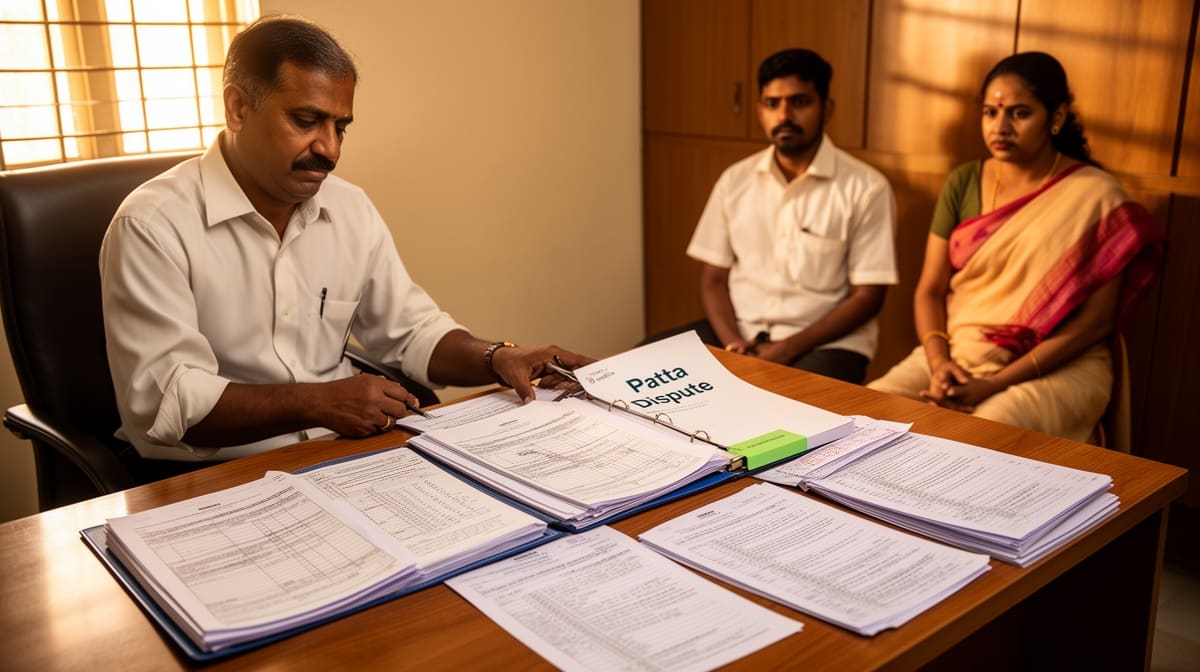
A writ petition before the Madras High Court has clarified that revenue authorities cannot ignore representations challenging pattas issued in the name of deceased persons. The Court emphasized the duty of the Revenue Divisional Officer to conduct a fair, lawful inquiry when such irregularities are brought to light, reinforcing administrative accountability in land record management.
Background & Facts
The Dispute
The petitioner, Sattanathan S/o Kasinathan, resides in Achutharayapuram Village, Mayiladuthurai Taluk, and claims continuous possession of Survey No. 116/10 for several years. He alleges that a patta (land record title document) was issued in the name of Mr. Dakshinamoorthy, who had died on 29.01.1996. The petitioner asserts that no notice or opportunity was given to him prior to the issuance of this patta, despite his long-standing possession and claim over the property.
Key Facts
- The petitioner has been in physical possession of Survey No. 116/10 for an extended period.
- Mr. Dakshinamoorthy, the person named in the patta, died on 29.01.1996.
- The patta in the name of the deceased was issued without any inquiry or notice to the petitioner or other potential claimants.
- On 30.09.2024, the petitioner submitted a formal representation to the third respondent, the Revenue Divisional Officer, seeking cancellation of the patta.
- No response or action was taken on the representation within a reasonable time.
Procedural History
- 29.01.1996: Mr. Dakshinamoorthy died.
- Date unknown: Patta issued in the name of the deceased, Mr. Dakshinamoorthy, for Survey No. 116/10.
- 30.09.2024: Petitioner submitted representation to the Revenue Divisional Officer seeking cancellation of the patta.
- No response received: No order or communication issued by any respondent to the representation.
- 09.04.2026: Writ Petition No. 12480 of 2026 filed before the Madras High Court.
The Parties' Positions
Petitioner: Argued that issuance of a patta to a deceased person is legally invalid and violates the principles of natural justice. He sought cancellation of the patta and a direction for a fresh inquiry to determine rightful ownership.
Respondents 1 to 5 (Government authorities): Accepted notice but did not file a detailed counter-affidavit. The Government Advocate conceded that the representation deserved consideration.
Respondents 6 and 7 (Private individuals): Were not served notice as no adverse order was passed against them, but the Court directed their objections to be heard during the inquiry.
Relief Sought
The petitioner sought a direction to the third respondent (Revenue Divisional Officer) to consider his representation dated 30.09.2024, conduct a proper inquiry, and cancel the patta issued in the name of the deceased Mr. Dakshinamoorthy.
The Legal Issue
The central question was whether a revenue authority is legally obligated to consider and adjudicate a representation challenging a patta issued in the name of a deceased person, even in the absence of a formal appeal or petition under specific land revenue statutes.
Arguments Presented
For the Petitioner
The petitioner contended that issuing a patta to a deceased person is a patent illegality under land record laws. He relied on the principle that no title can vest in a dead person and that such an error undermines the integrity of land records. He argued that the failure to act on his representation amounted to administrative inaction, violating his right to property and due process.
For the Respondent
The Government Advocate, appearing for Respondents 1 to 5, did not contest the petitioner’s factual assertions. He accepted that the representation deserved consideration and acknowledged that the Revenue Divisional Officer had a duty to examine the validity of the patta in light of the death of the named holder.
The Court's Analysis
The Court observed that the issuance of a patta to a deceased person is not merely an administrative oversight but a fundamental defect in the land record system. A patta is not merely a revenue document; it serves as a prima facie evidence of possession and title, and its issuance to a non-existent person creates legal uncertainty for actual occupants.
"The Revenue Divisional Officer, as the custodian of land records, cannot remain indifferent to a representation pointing out such a glaring irregularity."
The Court emphasized that while it was not expressing any opinion on the merits of the petitioner’s claim to ownership, the procedural obligation to investigate and respond to the representation was clear. The Court noted that the respondents had not disputed the fact of death or the absence of notice to the petitioner. The failure to act on the representation dated 30.09.2024 rendered the administrative process incomplete.
The Court further held that the interests of Respondents 6 and 7, as well as any other third parties who may have a stake in the property, must be heard before any final order is passed. This ensures that the inquiry is fair, transparent, and in accordance with the principles of natural justice.
The Verdict
The writ petition was disposed of by directing the third respondent, the Revenue Divisional Officer, to pass final orders on the petitioner’s representation dated 30.09.2024, after hearing the objections of Respondents 6 and 7 and any other third parties deemed necessary. The authority must decide the matter on merits and in accordance with law within a period of 12 weeks from the date of receipt of a copy of this order. No costs were awarded.
What This Means For Similar Cases
Administrative Inaction on Land Records Is Not Permissible
- Practitioners must now treat representations challenging pattas issued to deceased persons as actionable grievances, not mere complaints.
- Revenue authorities cannot delay or ignore such representations on grounds of procedural technicality.
- Failure to respond within a reasonable time may invite writ jurisdiction under Article 226 of the Constitution.
Due Process Must Precede Final Orders on Land Titles
- Any inquiry into the validity of a patta must include notice to all persons with a potential interest in the property, including adverse possessors.
- The mere existence of a patta does not confer conclusive title; it is rebuttable evidence subject to verification.
- Courts will not hesitate to intervene when land records reflect patently illegal entries, especially where death of the titleholder is established.
The Role of the Revenue Divisional Officer Is Procedural and Fiduciary
- The Revenue Divisional Officer acts as a quasi-judicial authority in land record disputes.
- The duty to investigate irregularities is not discretionary but mandatory under the Tamil Nadu Land Revenue Code and general principles of administrative law.
- Orders must be reasoned, and decisions must be based on evidence gathered during a fair hearing.