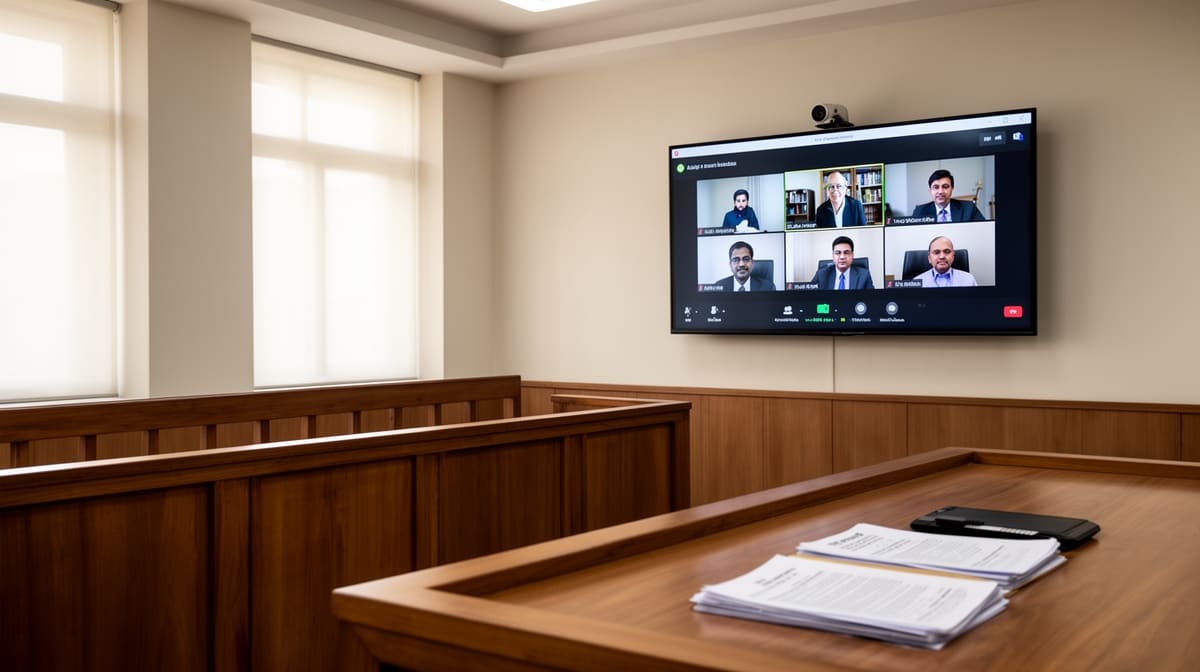
The ITAT Ahmedabad has reaffirmed that procedural fairness is non-negotiable in tax appellate proceedings, particularly when substantial additions are made and a taxpayer explicitly requests a video hearing. The tribunal’s decision underscores that the right to be heard is not a formality but a constitutional imperative under the principles of natural justice, even in technical domains like income tax.
Background & Facts
The Dispute
The appellant, Vikas Chandrakantbhai Shah, filed his income tax return for A.Y. 2019-20 declaring income of ₹6,53,890. The Income Tax Department reopened the assessment under Section 147 based on intelligence from a search operation targeting Shri Sanjay Tibrewal, who allegedly operated a network of shell entities providing accommodation entries. The Assessing Officer alleged that the appellant received ₹99,80,000 through such transactions and treated it as unexplained income.
Procedural History
- 2023: Notice under Section 148A(b) issued; appellant filed return on 24.04.2023
- 2024: Assessment completed under Section 69C, adding ₹99,80,000; total income assessed at ₹1,06,33,890
- 2025: Appeal filed before CIT(A), National Faceless Appeal Centre, Delhi
- 12.11.2025: CIT(A) dismissed appeal on grounds of delay and on merits, modifying the addition from Section 69C to Section 68
- 09.03.2026: Hearing before ITAT Ahmedabad
- 12.03.2026: ITAT pronounces order
Relief Sought
The appellant sought setting aside of the CIT(A)’s order on grounds of violation of natural justice, specifically the denial of a requested video conference hearing despite written submission dated 06.07.2025. He also challenged the validity of reopening, jurisdictional issues, and the sufficiency of evidence for the addition.
The Legal Issue
The central question was whether the Commissioner of Income Tax (Appeals) violates Section 250 of the Income-tax Act and the principles of natural justice by failing to grant a requested video hearing, even when the appeal involves substantial tax liability and complex factual issues.
Arguments Presented
For the Appellant
The appellant’s counsel argued that the CIT(A) issued only one hearing notice and proceeded to pass the order without considering the written request for a video conference. Reliance was placed on State of Haryana v. Bhajan Lal and Maneka Gandhi v. Union of India to assert that the right to be heard includes meaningful opportunity, not just procedural compliance. The counsel emphasized that video conferencing is now standard practice under the Faceless Assessment regime and denying it without reason undermines fairness.
For the Respondent
The Revenue contended that the appeal was rightly dismissed for delay and that the merits were correctly decided. It argued that written submissions were considered and that physical or virtual hearing was not mandatory under Section 250. The Revenue cited CIT v. Suresh Kumar to assert that appellate tribunals have discretion in conducting hearings, provided the record is complete.
The Court's Analysis
The ITAT rejected the Revenue’s technical argument that written submissions suffice in lieu of oral hearing. The tribunal emphasized that Section 250 mandates an opportunity of being heard, which must be effective and not illusory. The court noted that the appellant had raised multiple substantial grounds - including jurisdictional validity of notice, validity of approval under Section 151, and the nature of the addition - all of which required detailed oral explanation.
"The request for video conference was not a mere formality but a reasonable accommodation in the context of the Faceless Assessment regime, where digital interaction is the norm. Denial of such a request without any reasoning amounts to denial of natural justice."
The tribunal distinguished CIT v. Suresh Kumar, noting that case involved minor additions and no specific request for personal hearing. Here, the amount involved was nearly ₹1 crore, and the request was explicit and documented. The ITAT held that the CIT(A)’s failure to even acknowledge the request, let alone consider it, rendered the order legally unsustainable.
The Verdict
The appellant succeeded. The ITAT set aside the CIT(A)’s order, holding that the denial of a video hearing request violated Section 250 and the principles of natural justice. The matter was restored to the CIT(A) for fresh adjudication with a proper opportunity for hearing, including video conferencing if requested.
What This Means For Similar Cases
Video Hearing Requests Cannot Be Ignored
- Practitioners must now document and formally request video hearings in writing, especially in faceless assessment appeals
- Tribunals must record reasons if such requests are denied - silence or non-response is legally untenable
- Failure to consider such requests will result in automatic setting aside of orders, regardless of merits
Natural Justice Trumps Procedural Delays
- Even if an appeal is filed late, courts must examine whether substantive injustice occurred
- Delay dismissal cannot override fundamental rights to fair hearing when the record shows prejudice
- This judgment reinforces that Section 250 is not a procedural formality but a substantive safeguard
Documentary Evidence Alone Is Insufficient for High-Value Additions
- When additions exceed ₹50 lakh, oral explanation becomes critical
- Tribunals must not rely solely on written submissions when complex factual disputes exist
- Practitioners should prepare for oral arguments even in faceless appellate forums