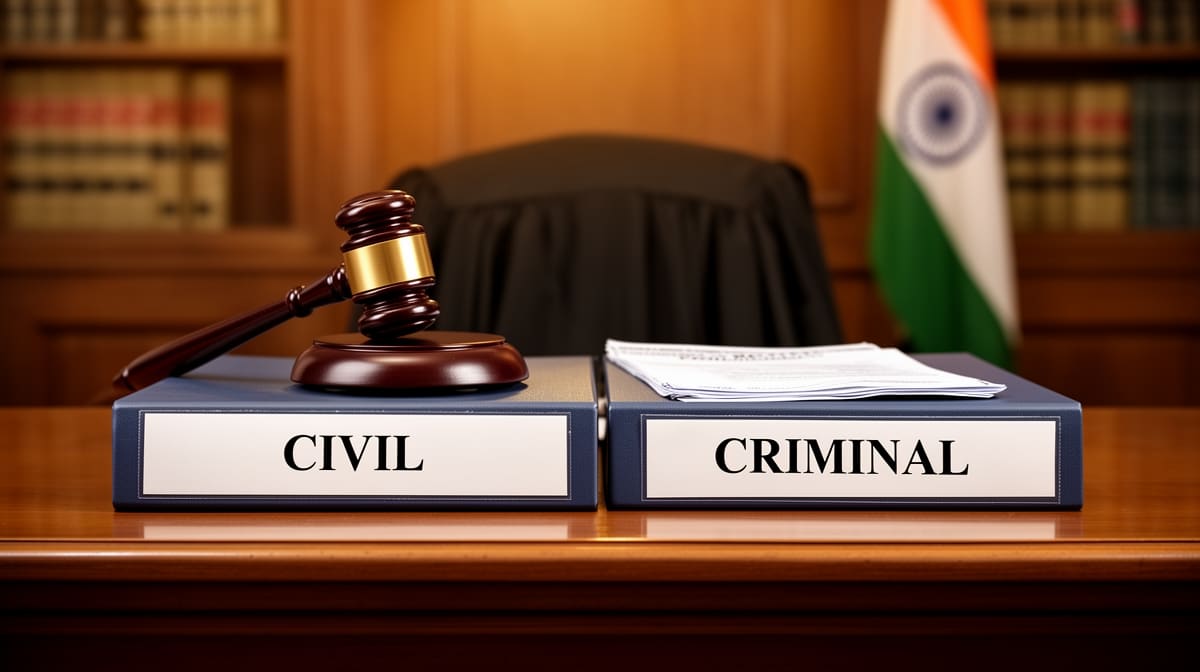
The dismissal of a motor accident claim despite the filing of a charge-sheet against the alleged driver underscores a critical principle: procedural filings do not substitute for evidentiary proof in civil compensation proceedings. The Bombay High Court, Nagpur Bench, reaffirmed that claimants bear the affirmative duty to establish negligence and causation, regardless of criminal proceedings.
Background & Facts
The Dispute
The appellants, family members of Dinkar Sawle, sought compensation after he died in a motor vehicle accident on 28 November 2009. They alleged that the accident occurred due to the rash and negligent driving of a tractor-trolley owned by Respondent Nos. 2 and 3 and operated by Respondent No. 1. The insurance company had been deleted from the proceedings before the Tribunal.
Procedural History
- 28 November 2009: Accident occurred on Alegaon-Mehkar Road; Dinkar Sawle died at the scene.
- 2009: FIR registered against "unknown vehicle"; no driver identified initially.
- 3 February 2010: Two individuals, Vishal Tale and Sunil Ambhore, submitted statements to police alleging the tractor-trolley and its driver were responsible.
- 2010: Charge-sheet filed against Respondent No. 1 based on these statements.
- 2010: Claim Petition No. 129/2010 filed before Motor Accident Claims Tribunal, Akola.
- 2015: Tribunal dismissed the claim, finding insufficient evidence to prove negligence or identify the driver.
- 2016: First Appeal filed before Bombay High Court, Nagpur Bench.
Relief Sought
The appellants sought compensation for wrongful death and requested remand of the case to the Tribunal for re-examination, arguing that non-examination of two eyewitnesses was due to their advocate’s error.
The Legal Issue
The central question was whether the mere filing of a charge-sheet against a driver, without examination of eyewitnesses or independent corroboration, is sufficient to establish liability for compensation under Section 166 of the Motor Vehicles Act.
Arguments Presented
For the Appellant
The appellants’ counsel argued that the charge-sheet filed against Respondent No. 1, based on statements of Vishal Tale and Sunil Ambhore, should be treated as prima facie evidence of negligence. Relying on Lala Mata Din v. A. Narayanan, they contended that the failure to examine the two eyewitnesses was due to their advocate’s oversight and the appellants should not suffer for this procedural lapse.
For the Respondent
The respondents’ counsel countered that the charge-sheet was filed against an accused who was later acquitted in criminal court. The police FIR named no vehicle or driver, and the statements of the two witnesses did not explicitly identify Respondent No. 1 as the driver at the time of the accident. Citing Nadakerappa v. Pillamma, they argued that remand cannot be granted as a matter of course without cogent reasons.
The Court's Analysis
The Court examined the evidentiary record and emphasized that while motor accident claims do not require proof beyond reasonable doubt, the claimant must still establish a prima facie case linking the defendant’s negligence to the accident. The Tribunal correctly noted that the FIR did not name the offending vehicle or driver, and the charge-sheet was based on delayed statements recorded over two months after the incident.
"The accident had occurred on 29.11.2009 and the statements of these two alleged witnesses were recorded on 03.02.2010 i.e. after about more than two months. In such circumstances, it appears somewhat doubtful that those alleged eye witnesses have stated about the numbers of the tractor and trolley after about two months of the accident..."
The Court held that unexamined police statements cannot be admitted as evidence in civil claims. Even if accepted, those statements did not affirmatively state that Respondent No. 1 was driving the vehicle or that he was negligent. The acquittal of Respondent No. 1 in the criminal trial further weakened the claim’s credibility.
The Court rejected the argument that the appellants should be excused for their advocate’s failure to examine witnesses. It held that parties are bound by the conduct of their counsel in adversarial proceedings, and no exception applies merely because the lapse was unintentional.
The Verdict
The appeal was dismissed. The Court held that the burden of proving negligence rests squarely on the claimants, and a charge-sheet alone, without corroborative testimony or documentary proof, cannot sustain a claim for compensation under the Motor Vehicles Act.
What This Means For Similar Cases
Charge-Sheet Alone Is Not Proof of Negligence
- Practitioners must not rely on criminal charge-sheets as standalone evidence in civil compensation claims.
- Even if a driver is charged, claimants must independently prove: (a) identity of the offending vehicle, (b) identity of the driver at the time, and (c) negligent conduct.
- Police statements not examined in court are inadmissible as evidence under Section 3 of the Indian Evidence Act.
Delayed Witness Statements Undermine Credibility
- Witnesses who come forward months after an accident require rigorous scrutiny.
- Tribunals may treat such delays as suspicious unless explained with credible reasons.
- Claimants should secure witness statements and examine them at the earliest opportunity.
Advocate’s Error Does Not Justify Remand
- Courts will not remand cases merely because counsel failed to call witnesses.
- Remand is discretionary and requires a showing of substantial prejudice or miscarriage of justice.
- Practitioners must ensure all material witnesses are examined during the initial hearing to avoid fatal procedural gaps.