The High Court of Karnataka partly allowed cross-appeals challenging an arbitral award in a metro rail construction contract, setting aside monetary claims where the contract expressly limited relief to time extensions only, while upholding the rejection of a time-related costs claim for insufficient proof of quantum.
Background & Facts
The Dispute
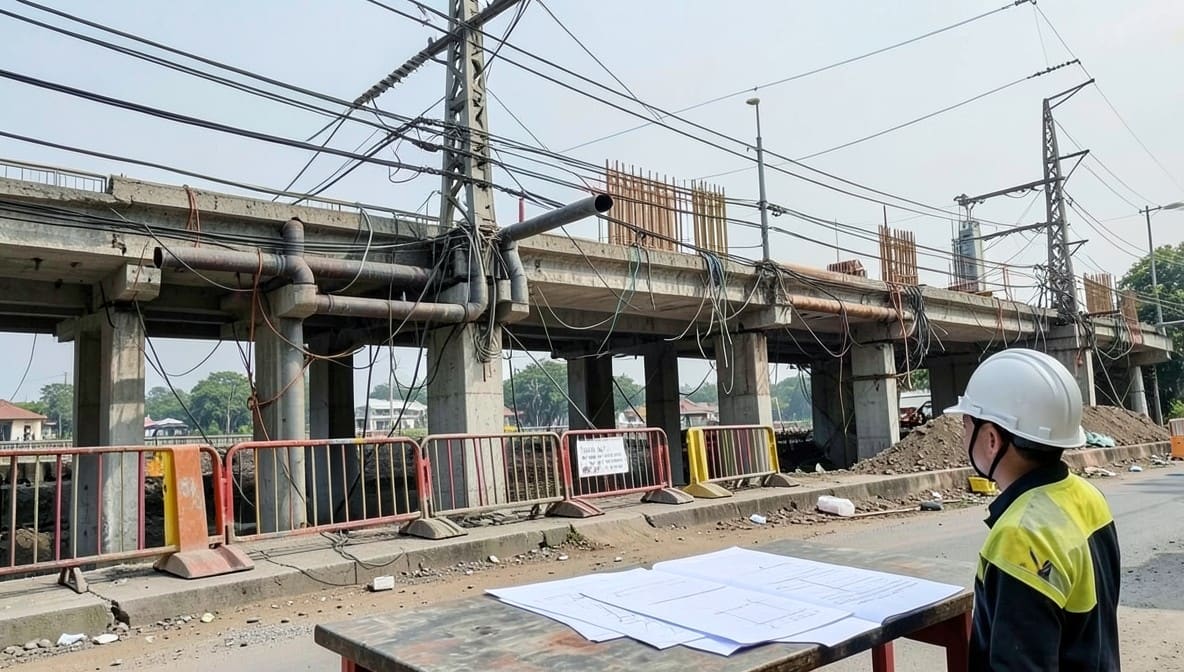
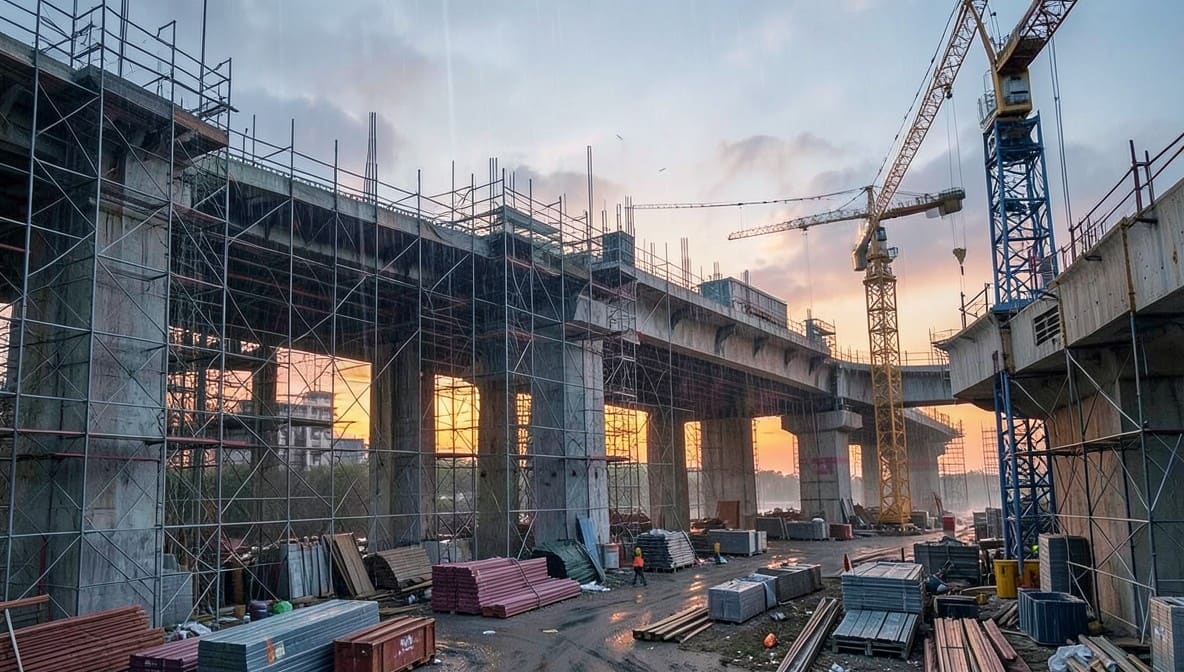
The dispute arose from a Contract Agreement dated 05.03.2010 between Bangalore Metro Rail Corporation Limited (BMRCL) as Employer and Larsen and Toubro Limited (L&T) as Contractor for constructing elevated structures (viaduct) of approximately 4.80 kilometres from Yeshwanthpur Station to Peenya Depot, together with three elevated stations - Outer Ring Road (ORR), Peenya Industrial Area (PIA) and Peenya Village (PV) Stations - on Reach R3A of the Bangalore Metro Rail Project.
Key Facts
- BMRCL awarded the work to L&T by Letter of Acceptance (LOA) dated 17.12.2009 at a contract price of `303,29,55,778/- (Rupees Three Hundred and Three Crores Twenty Nine Lakhs Fifty Five Thousand Seven Hundred and Seventy Eight only)
- The Contract was executed on 05.03.2010 for a period of twenty-four months from the date of the LOA, ending on 16.12.2011
- In terms of Annexure-B to the LOA, the entire site was to be handed over to L&T in stretches between 17.12.2009 and 16.04.2010
- The Contract specified ten Key Dates (KD) for the viaduct and five for each station, with final Key Dates being KD-10 (viaduct) and KD-5 (stations), coterminous with completion of the Works
- Admittedly, the Works were not completed within the original contract period; BMRCL granted four extensions of time (EOTs)
- The last portion was handed over on 09.10.2013, and hindrance-free land for the eighteen pier locations of the loop line was handed over on 04.01.2014, approximately twenty-five months after the end of the original contract period
- The commercial operation of the metro on Reach R3A commenced on 01.03.2014, though certain minor works were pending
- The balance viaduct works were completed by 10.07.2014, and by letter dated 24.02.2015, L&T notified completion of all balance works and requested issuance of the Taking Over Certificate
- Disputes arose on account of variations, extended stay, amounts recovered/withheld as penalty/liquidated damages (LD), and freezing of price variation (PVC)
- L&T issued a Notice of Dispute dated 31.12.2013 (Ex. C-61) crystallising its claims
- The parties waived the requirement of engaging in conciliation and proceeded to arbitration under the General Conditions of Contract (GCC)
Procedural History
- 06.06.2014: Arbitral Tribunal entered upon the reference
- 04.08.2018: Arbitral Tribunal rendered the impugned award
- Com.A.S.No.221 of 2018: L&T's petition under Section 34 of Arbitration & Conciliation Act, 1996 challenging quantification of Claim (iii)
- Com.A.S.No.222 of 2018: BMRCL's petition under Section 34 seeking to set aside the entire impugned award
- 09.12.2021: Commercial Court stayed operation of impugned award subject to BMRCL depositing 60% of awarded amount and furnishing bank guarantee for balance
- 21.04.2022: L&T permitted to withdraw deposited amount of `10,46,36,916/-
- 24.06.2023: Both petitions transferred from Court of LXXXIII Additional City Civil and Sessions Judge (CCH-84) to Court of LXXXVII Additional City Civil and Sessions Judge (CCH-88)
- 13.12.2024: Learned Commercial Court dismissed both petitions by impugned orders
- 21.02.2025: COMAP No.116 of 2025 filed (L&T's appeal against impugned order in Com.A.S.No.221 of 2018)
- 25.02.2025: COMAP No.124 of 2025 filed (BMRCL's appeal against impugned order in Com.A.S.No.222 of 2018)
- 16.09.2026: Judgment pronounced in the present cross-appeals
Relief Sought
- L&T sought setting aside of the impugned order in Com.A.S.No.221 of 2018 to the extent it rejected Claim (iii) for time-related costs (`103,30,00,000/- with interest at 18% per annum)
- BMRCL sought setting aside of the impugned order in Com.A.S.No.222 of 2018 in its entirety, including the awards for Claims (ii), (iv) and (v) in favour of L&T
The Legal Issue
The central question was whether the Commercial Court correctly dismissed the petitions under Section 34 of the Arbitration and Conciliation Act, 1996, specifically: (1) whether the Arbitral Tribunal erred in awarding amounts for Claims (ii), (iv) and (v) in favour of L&T despite contractual limitations on monetary claims; (2) whether the Arbitral Tribunal erred in rejecting Claim (iii) for time-related costs due to want of proof of quantum; and (3) whether the Arbitral Tribunal properly considered the contractual provisions, particularly Clauses 2.2 and 8.3 of the GCC.
Arguments Presented
For L&T (Appellant in COMAP 116/2025, Respondent in COMAP 124/2025)
L&T contended that the Arbitral Tribunal erroneously rejected its claim for damages for time-related costs (Claim iii) on the erroneous premise that it was wholly premised on Ex C-98 (American Appraisal report). It asserted that the record was replete with materials substantiating the claim, including Ex. C-61 (notice dated 31.12.2013), Ex. C-60, Ex. C-385, Ex. C-386, Exs. C-360 and C-382 (monthly progress reports), Ex. C-366 (audited ledger summary), and the auditor's certificate (Ex. C-360), all of which were ignored by the Arbitral Tribunal. L&T argued that the law required only a reasonable estimate of loss, and the difficulty in assessing damages with precision could not be a ground for rejecting the claim. It further contended that it had presented an alternate quantification based on the Hudson formula approved by the Supreme Court in McDermott International Inc. v. Burn Standard Co. Ltd., and that the Arbitral Tribunal had ignored vital evidence, rendering the arbitral award liable to be set aside. L&T relied on National Highways Authority of India v. M. Hakeem to support the permissibility of partial setting aside of an arbitral award.
For BMRCL (Appellant in COMAP 124/2025, Respondent in COMAP 116/2025)
BMRCL contended that the Arbitral Tribunal erred in awarding amounts for Claims (ii), (iv) and (v) in favour of L&T. Regarding Claim (ii), it argued that the reduction in quantity of parapet wall did not exceed the 25% threshold as the parapet wall is one item in section (E) of the Viaduct BOQ, and the reduction was less than 7% of the quantity of the said group. Regarding Claim (iv), BMRCL asserted that the award was contrary to the express terms of the agreement, as Clauses 2.2 and 8.3 of the GCC entitle the contractor only to reasonable extension of time and no monetary claims whatsoever, with the Engineer empowered to extend the time period for completion of the contract. Regarding Claim (v), BMRCL contended that the award was based on CPWD specifications, but MORTH specifications have precedence under Sub-Clause 6.3 of the Scope of Work, and the Arbitral Tribunal had erroneously allowed claims for piling-guide rings/spacers despite the Engineer's letter (Ex.C-107) stating these were included in the rates. BMRCL further submitted that the Arbitral Tribunal failed to consider its defense that a claim for compensation on the ground of delay was not available per the contractual provisions (Clauses 2.2 and 8.3 of GCC), relying on Larsen and Toubro Limited v. Bangalore Metro Rail Corporation Limited (2025 SCC OnLine Kar 1315) where the court rejected L&T's contention that clauses 2.2 and 8.3 of the GCC are void.
The Court's Analysis
The Court examined the Arbitral Tribunal's findings on each claim. On Claim (ii) (parapet works quantity variation), the Court agreed with the Arbitral Tribunal that Clause 26 of the Special Conditions of Contract (SCC) was applicable, as the reduction in quantity (75.62%) exceeded 25% and the cost of the item exceeded 1% of the original contract price. The Court found no error in the Arbitral Tribunal's methodology of awarding 20% of the cost of the reduced quantity beyond 25% as loss of profits, and upheld the award of `96,43,811/- for this claim.
On Claim (iv) (revised BOQ rates for 18 pier locations), the Court acknowledged the Arbitral Tribunal's finding that delay in handing over land was attributable to BMRCL, with hindrance-free land for the eighteen pier locations last handed over on 04.01.2014 (twenty-five months beyond the original contract period). However, the Court held that the Arbitral Tribunal failed to consider BMRCL's defense that Clauses 2.2 and 8.3 of the GCC expressly limit the contractor's entitlement to reasonable extension of time only, with no monetary claims whatsoever permissible. The Court concluded that the award of `9,27,17,850/- for Claim (iv) was contrary to the express terms of the contract and liable to be set aside.
On Claim (v) (reinforcement unpaid quantities), the Court noted that the Arbitral Tribunal allowed the claim based on the GC-BMRCL's letter (Ex.C-107) accepting payment for authorized chairs/spacer bars and lap/butt welding if done as per approved GFC/BBS. However, the Court observed that the Arbitral Tribunal also allowed claims for piling-guide rings/spacers despite the Engineer's letter explicitly stating that these items were deemed to be included in the rates. Since the amount awarded included `2,84,61,516/- for piling-guide rings/spacers (which the Engineer stated were covered by the BOQ rates), the Court found the award unsustainable and liable to be set aside.
On Claim (iii) (time-related costs), the Court accepted the Arbitral Tribunal's finding that L&T was entitled to compensation in principle for time-dependent costs during the extended period, as the delays were attributable to BMRCL. However, the Court agreed with the Arbitral Tribunal that L&T failed to establish the quantum of damages. The claim of `103,30,00,000/- rested wholly on Ex.C-98 (American Appraisal report), whose author was never examined for cross-examination. The Court found no merit in L&T's contention that vital evidence was ignored, noting that the Arbitral Tribunal properly evaluated the evidence and found Ex.C-98 insufficient as it lacked foundational methodology and relied on irrational profit components. The Court held that mere entitlement in principle is insufficient without proof of quantum, and upheld the rejection of Claim (iii) for want of proof of quantum.
The Verdict
The impugned award is set aside to the extent it awards amounts in favour of L&T in respect of Claims (ii) (96,43,811/-), (iv) (9,27,17,850/-) and (v) (`2,84,61,516/-). The impugned award is upheld to the extent it holds that L&T is entitled to compensation for time-related costs during prolongation of the contract under Claim (iii) but rejects the said claim for want of proof of quantum. The appeals are partly allowed in the aforesaid terms, and the pending application stands disposed of.
What This Means For Similar Cases
Contractual Limitations on Monetary Claims Are Binding
Where a contract expressly limits relief for delay to extension of time only (as in Clauses 2.2 and 8.3 of the GCC), arbitral tribunals cannot award monetary compensation. Parties seeking monetary relief must first establish that the contract permits such claims; otherwise, their remedy is restricted to time extensions. This principle applies equally to claims for revised rates due to delay in handing over site.
Quantum of Damages Must Be Rigorously Proved
Mere entitlement to compensation in principle is insufficient; claimants must prove the quantum of damages with admissible evidence. Reports commissioned by a party cannot be relied upon for quantification if the author is not made available for cross-examination. Alternate quantification methods must be grounded in the contract and avoid irrational components (such as time-dependent profit claims). The burden of proving quantum rests squarely on the claimant.
Severability Preserves Valid Portions of Arbitral Awards
An arbitral award may be set aside in part while upholding other portions. Tribunals and courts should examine each claim independently, severing only those portions that are erroneous or contrary to contract, rather than rejecting the entire award where only specific claims are flawed. This approach promotes efficiency and respects the parties' arbitration agreement.