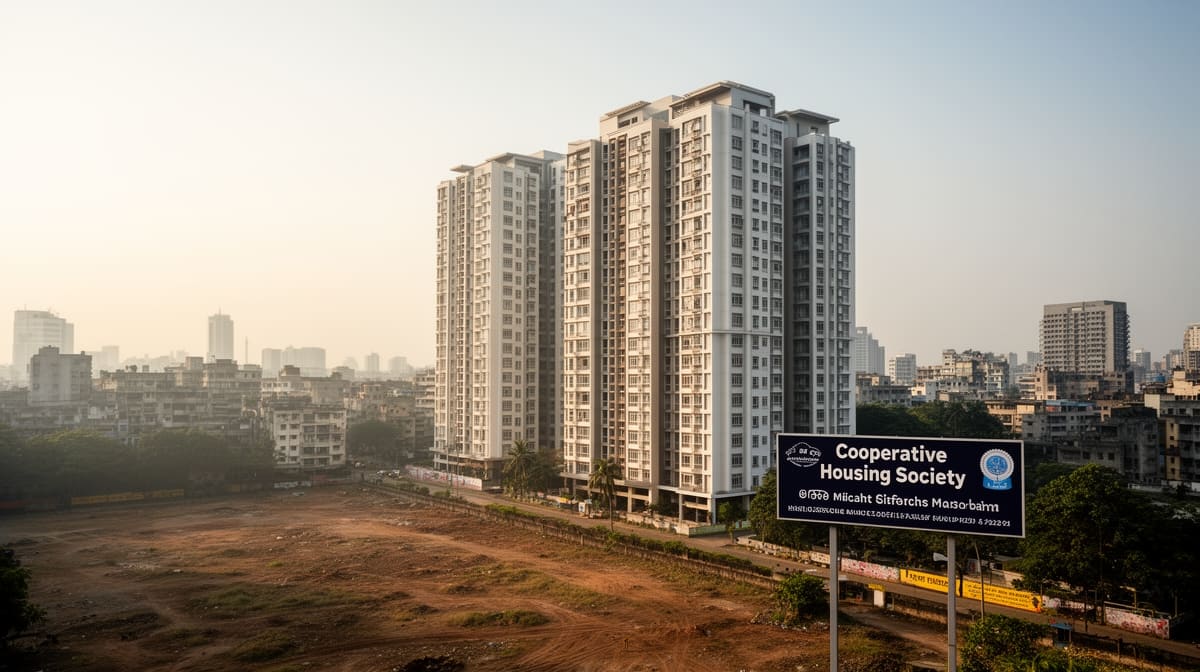
The Bombay High Court has clarified that promoters cannot benefit from combined land parcels to maximize Floor Space Index for construction and then refuse to transfer title to flat purchasers under the Maharashtra Ownership Flats Act, 1963. This judgment reinforces the consumer protection mandate of MOFA and rejects attempts to evade statutory obligations by invoking slum rehabilitation claims.
Background & Facts
The Dispute
The petitioner, Jai Santoshi Maa Tower Cooperative Housing Society Limited, sought deemed conveyance of land comprising Final Plot No.91 (980.82 sq.m.) and Final Plot No.93/B (630.32 sq.m.) under Section 11 of the Maharashtra Ownership Flats (Regulation of Promotion, Construction, Sale, Management and Transfer) Act, 1963 (MOFA). The respondents, including the promoter Solanki Developers and Tulsi Enterprises, had developed a residential building with 35 flats on the combined plots but failed to execute conveyance in favor of the society despite receiving full consideration from flat purchasers.
Key Facts
- Final Plot No.91 and Final Plot No.93/B are contiguous and were jointly developed under a Joint Venture Agreement dated 08.08.2003
- Sanctioned plan V.P. No.95/100/TMC/TDD/719 dated 27.06.2002 initially permitted construction on 1161.570 sq.m.
- An unauthorized encroachment of 449.260 sq.m. was later incorporated into the Floor Space Index (FSI) calculation
- Revised sanctioned plan V.P. No.95/100/TMC/TDD/4314 dated 23.12.2004 approved a total built-up area of 1610.830 sq.m. based on combined plots
- Part Occupation Certificate V.P. No.95/100/TMC/TDD/396 dated 12.09.2007 was issued for stilt plus six floors, with FSI of 1 applied to Final Plot No.91
- The seventh floor was constructed without a valid occupation certificate
- The petitioner society obtained its own Occupation Certificate V.P. No.95/100/TMC/TDD/5 dated 29.04.2015 under Thane Municipal Corporation’s Amnesty Scheme
- Agreements for sale under Section 4 of MOFA were executed with all 35 flat purchasers, duly stamped and registered
- Legal notice dated 14.12.2017 demanding conveyance was served but ignored
- Final Plot No.91 was declared a slum area under Section 3C of the Maharashtra Slum Areas (Improvement, Clearance and Redevelopment) Act, 1971
- Respondent No.11, a proposed society, claimed occupancy rights over Final Plot No.91 since 1974 with 64 members
Procedural History
- 08.08.2003: Joint Venture Agreement executed between Solanki Developers and Tulsi Enterprises
- 27.06.2002: Initial sanctioned plan issued for 1161.570 sq.m.
- 12.03.2003: Commencement certificate issued for stilt plus five floors
- 23.12.2004: Revised sanctioned plan approved for 1610.830 sq.m. covering both plots
- 12.09.2007: Part Occupation Certificate issued for stilt plus six floors
- 29.04.2015: Petitioner society obtained Occupation Certificate under Amnesty Scheme
- 14.12.2017: Legal notice issued demanding conveyance
- 2018: Deemed Conveyance Application No.124 of 2018 filed before Competent Authority
- 04.09.2018: Competent Authority granted deemed conveyance only for Final Plot No.93/B (630.32 sq.m.) and rejected claim for Final Plot No.91 (980.82 sq.m.)
- 2021: Writ Petition No.8150 of 2021 filed before Bombay High Court
- 20.04.2026: Judgment reserved
- 28.04.2026: Judgment pronounced
Relief Sought
The petitioner sought quashing of the Competent Authority’s order dated 04.09.2018 and a direction for deemed conveyance of the entire property comprising Final Plot No.91 and Final Plot No.93/B, aggregating 1611.14 sq.m., along with execution and registration of the unilateral conveyance deed.
The Legal Issue
The central question was whether a promoter who has utilized combined land parcels to maximize Floor Space Index under sanctioned plans can lawfully refuse to execute conveyance of the entire developed area under Section 11 of MOFA, merely because part of the land is declared a slum area under the Maharashtra Slum Areas Act, 1971.
Arguments Presented
For the Petitioner
The petitioner’s counsel argued that the entire land area of 1611.14 sq.m. was treated as a single development unit in all sanctioned plans, agreements, and FSI calculations. The promoter had obtained development benefits by including the encroached portion of Final Plot No.91 and could not now deny conveyance of that portion. Reliance was placed on the Third Schedule of sale agreements, which described the entire land as the subject matter of sale. It was contended that the declaration of Final Plot No.91 as a slum area under the Slum Act does not extinguish the promoter’s statutory obligation under MOFA to transfer title to flat purchasers.
For the Respondent
Respondent No.2 contended that conveyance could not be directed until the entire development was completed, citing Clause 19 of the agreement. Respondent No.11 argued that granting conveyance to the society would prejudice the rights of slum dwellers occupying Final Plot No.91 since 1974 and interfere with the implementation of a potential slum rehabilitation scheme under Section 3B of the Slum Act. The State argued that the Competent Authority acted within its discretion by limiting conveyance to Final Plot No.93/B.
The Court's Analysis
The Court examined the statutory framework of MOFA and the Maharashtra Slum Areas Act, emphasizing that both statutes serve distinct but potentially overlapping objectives. MOFA is a consumer protection law designed to ensure that promoters transfer title to flat purchasers upon receipt of consideration and completion of construction. The Slum Act, by contrast, seeks to protect the rights of occupants in slum areas and facilitate their rehabilitation.
"A promoter cannot take advantage of larger land area for construction and thereafter deny corresponding benefit to flat purchasers."
The Court held that the promoter’s conduct - obtaining sanctioned plans, FSI benefits, and occupation certificates based on the combined area of both plots - created a binding obligation under Section 11 of MOFA to transfer the entire land. The fact that the promoter had incorporated Final Plot No.91 into the development plan and consumed its FSI entitlement rendered any attempt to retain it legally untenable.
The Court rejected the argument that slum declaration under Section 3C of the Slum Act negated MOFA’s mandate. It observed:
"The two enactments operate in separate fields. The Slum Act is enacted for improvement, clearance, redevelopment, and protection of occupiers in slum areas. Its concern is housing and rehabilitation. MOFA is consumer protective legislation intended to regulate promotion, sale, and transfer of flats and to secure conveyance of title in favour of flat purchasers."
The Court clarified that while the Slum Act may impose restrictions on redevelopment and recognize occupancy rights, it does not extinguish the promoter’s obligation to transfer title. The rights of slum dwellers under the Slum Act are not incompatible with the conveyance of title under MOFA; they coexist, subject to adjudication by competent forums.
"Conveyance proceeding is not forum for extinguishing slum rights."
The Court emphasized that deemed conveyance transfers only the promoter’s interest, subject to all existing encumbrances, including lawful claims of occupants. The order does not determine the validity of occupancy claims, which remain open for adjudication under the Slum Act.
The Verdict
The writ petition was allowed. The order dated 04.09.2018 of the Competent Authority was quashed to the extent it denied conveyance of Final Plot No.91. The petitioner society is entitled to deemed conveyance of the entire property comprising Final Plot No.91 (980.82 sq.m.) and Final Plot No.93/B (630.32 sq.m.), aggregating 1611.14 sq.m. The Competent Authority is directed to issue a fresh certificate of deemed conveyance and complete all consequential steps, including execution and registration of the unilateral conveyance deed, within eight weeks from receipt of the authenticated copy of this order. The grant of conveyance is expressly subject to the rights of respondent Nos.2 and 11 and any eligible occupants under the Maharashtra Slum Areas Act, 1971. No order as to costs.
What This Means For Similar Cases
Promoter’s FSI Benefit Triggers Full Conveyance Obligation
- Practitioners must argue that any use of combined land parcels to enhance FSI or built-up area under sanctioned plans creates an irrevocable obligation under MOFA to transfer the entire land
- Developers cannot selectively retain portions of land used for commercial gain while denying title to purchasers
- Sale agreements and sanctioned plans are conclusive evidence of the developer’s representation of the property’s scope
Slum Declaration Does Not Override MOFA
- A slum declaration under the Maharashtra Slum Areas Act does not nullify the promoter’s duty under MOFA
- Rights of slum occupants are protected but must be adjudicated separately under the Slum Act, not in conveyance proceedings
- Conveyance certificates must include clarifications preserving statutory rights of occupants
Deemed Conveyance Is Not a Title Determination
- MOFA conveyance transfers only the promoter’s interest, not adjudicates third-party claims
- Occupancy, tenancy, or rehabilitation claims must be raised before competent authorities under the Slum Act
- Practitioners should avoid conflating conveyance proceedings with possession disputes