The Bombay High Court has clarified that proceedings under Section 11 of the Maharashtra Ownership Flats Act, 1963, are strictly confined to the land actually developed by the promoter named in the flat purchase agreements. The judgment reinforces that deemed conveyance cannot be extended to land controlled by a separate corporate entity, even if both entities share common directors and operate under a unified layout.
Background & Facts
The Dispute
The petitioner, Kapil Upavan A & B Co-operative Housing Society Limited, sought deemed conveyance of land corresponding to the residential buildings (Wings A and B) constructed on a larger plot in Bibwewadi, Pune. The society contended that the entire land area required to generate the sanctioned Floor Space Index (FSI) for its residential units - 7,269.90 square meters - should be conveyed, despite the fact that only 4,100.60 square meters of land was directly developed by the promoter named in its flat purchase agreements.
Key Facts
- The original land, comprising Survey No. 662/1+2 (13 acres 24 gunthas) and Survey No. 665 (11 acres 5 gunthas), totaling 24 acres 32 gunthas, was owned by Mr. Pandurang B. Kadam.
- On 03.06.1981, the land was sold to Western India Erectors Ltd., later renamed Western India Enterprises Ltd.
- On 12.04.1989, Western India Enterprises Ltd. executed a 999-year lease in favor of respondent No. 2, Mr. Avinash Shridhar Wardekar.
- On 31.03.1999, a portion of the land (5.60 acres) was mortgaged to Janata Sahakari Bank Ltd., with registration completed on 25.08.2000.
- On 05.04.2006, two separate development agreements were registered:
- One in favor of respondent No. 1, Monroe Impex Private Limited, covering 4,100.60 square meters of land.
- One in favor of respondent No. 3, Pankaj Dyes & Chemicals Pvt. Ltd., covering a separate portion of the land.
- Both agreements were executed by the same individuals - Mr. Sharad Bal and Mrs. Vrinda Bal - as directors of their respective companies.
- The Pune Municipal Corporation issued Commencement Certificate No. 426/2006 on 20.07.2019, later revised on 25.06.2009, permitting:
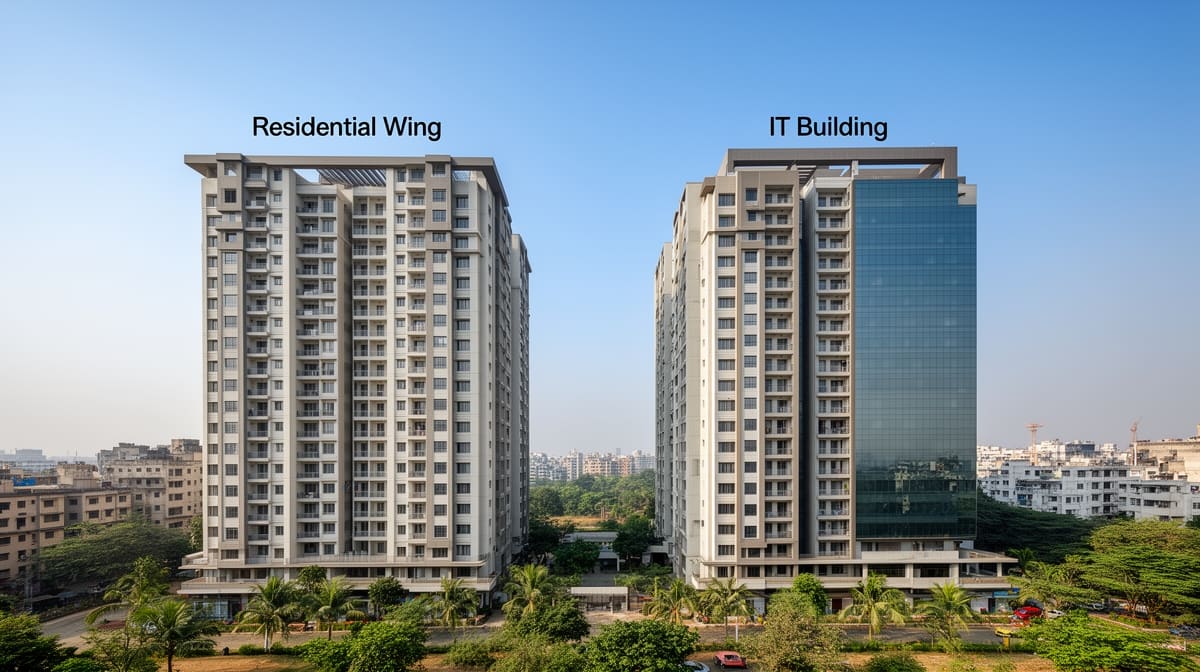
- Residential built-up area of 7,269.90 sq.m. (Wings A and B)
- Commercial (IT) built-up area of 4,675.20 sq.m. (Wing C)
- The FSI for residential construction was 1, while the IT building benefited from an incentive FSI multiplier of 2.
- Flat purchase agreements were executed only by Monroe Impex Pvt. Ltd. with the society’s members.
- Respondent No. 3 executed a Deed of Declaration dated 06.11.2019 under the Maharashtra Apartment Ownership Act for Wing C.
Procedural History
- 22.03.2021: Respondent No. 4 (District Deputy Registrar, Co-operative Housing Society, Pune) passed an order granting deemed conveyance to the petitioner society over 4,100.60 square meters of land corresponding to 7,269.90 square meters of residential built-up area.
- 12.06.2022: Writ Petition No. 12638 of 2022 filed under Article 227 of the Constitution challenging the order.
- 12.02.2026: Judgment reserved.
- 17.03.2026: Judgment pronounced.
The Parties' Positions
Petitioner (Kapil Upavan Society): Argued that the entire land required to generate the sanctioned FSI for its residential buildings - 7,269.90 sq.m. - must be conveyed, regardless of which promoter executed the development agreement. Relied on the unified layout, common directors, and the principle that conveyance must reflect the actual land used for construction.
Respondents (Monroe Impex, Pankaj Dyes, Wardekar heirs, State): Contended that the competent authority must restrict conveyance to the land specifically developed by the promoter named in the flat purchase agreements - Monroe Impex. Asserted that Pankaj Dyes is a separate legal entity with its own development rights and a separate Deed of Declaration for Wing C.
Relief Sought
The petitioner sought:
- Setting aside of the order dated 22.03.2021
- Direction to grant deemed conveyance over 7,269.90 square meters of land (the full FSI-generated area)
- Costs of litigation
The Legal Issue
The central question was whether the competent authority under Section 11 of the Maharashtra Ownership Flats Act, 1963, may grant deemed conveyance over land area corresponding to the total built-up area generated by FSI, even when only a portion of that land was developed by the promoter named in the flat purchase agreements, and another corporate entity developed the remainder under a separate agreement.
Arguments Presented
For the Petitioner
The petitioner relied on the sanctioned building plans and flat purchase agreements to argue that the land required to generate the residential FSI of 7,269.90 sq.m. must be conveyed. It contended that the joint layout, common directors, and unified development plan rendered Monroe Impex and Pankaj Dyes as a single economic unit. It cited Marathon Era Co-operative Housing Society Ltd. v. Competent Authority to argue that conveyance must reflect the actual land used for construction, not merely the nominal plot under the promoter’s agreement. It further argued that the Deed of Declaration by Pankaj Dyes was executed during pendency of proceedings and thus barred by lis pendens.
For the Respondent
Respondents argued that Section 11 proceedings are summary in nature and cannot adjudicate title disputes or corporate structures. They emphasized that Monroe Impex and Pankaj Dyes are distinct legal entities with separate registered development agreements. The flat purchase agreements were executed only by Monroe Impex, and Pankaj Dyes had already created separate ownership rights in Wing C via the Deed of Declaration. They relied on Government Resolution dated 22.06.2018, which limits conveyance to plinth area and appurtenant land when TDR/incentive FSI is used.
The Court's Analysis
The Court began by affirming the foundational principle of corporate personality: a company is a distinct legal entity, separate from its shareholders or directors. The mere fact that the same individuals controlled both Monroe Impex and Pankaj Dyes did not, by itself, merge their legal identities. The Court emphasized that the development agreements were executed in separate names, registered independently, and referenced distinct portions of the land.
"The documents do not show a single combined grant of development rights in favour of both companies together. Instead, each company appears in the record with its own agreement and with rights referable to specific parts of the project land."
The Court held that proceedings under Section 11 of the Maharashtra Ownership Flats Act are summary in nature and not intended to resolve complex title disputes or corporate veil issues. The competent authority’s mandate is limited to examining the flat purchase agreements and the sanctioned building plans to determine the land corresponding to the units sold to the purchasers.
The Court rejected the petitioner’s argument that FSI generated through incentive mechanisms (such as IT incentives) should entitle the society to conveyance of the entire land area required to generate that FSI. It noted that the Government Resolution dated 22.06.2018 explicitly limits conveyance to the plinth area and appurtenant land in such cases, a principle upheld in Marathon Era.
The Court further held that the Deed of Declaration executed by Pankaj Dyes on 06.11.2019, while filed during pendency of proceedings, did not automatically invalidate the petitioner’s claim. However, its existence underscored that the land in question was subject to competing legal arrangements, which could only be adjudicated in a civil suit.
"A competent authority acting under Section 11 does not exercise such wide powers. The authority’s function is confined to deciding whether the society is entitled to conveyance of the land connected with the building constructed and sold to flat purchasers."
The Court concluded that expanding the scope of conveyance beyond the promoter’s own land area would require a full trial on title, corporate structure, and third-party rights - matters beyond the jurisdiction of the competent authority under Section 11.
The Verdict
The writ petition was dismissed. The order dated 22.03.2021 granting deemed conveyance over 4,100.60 square meters of land corresponding to 7,269.90 square meters of residential built-up area was confirmed. The Court clarified that any claim by the petitioner for additional land beyond 4,100.60 square meters must be pursued in a civil court, where all parties, including Pankaj Dyes and its legal heirs, can be joined. The dismissal does not prejudice any independent rights of the parties, and any future civil proceedings must be decided on their own merits, uninfluenced by this judgment. No costs were awarded.
What This Means For Similar Cases
Deemed Conveyance Is Tied to the Promoter’s Actual Land
- Practitioners must now limit claims under Section 11 MOFA to the land area explicitly developed by the promoter named in the flat purchase agreements.
- FSI generated through incentives (TDR, IT, etc.) cannot be used to justify conveyance of land developed by a third party.
- The sanctioned FSI figures are relevant only to determine the extent of construction, not the extent of land to be conveyed.
Corporate Veil Cannot Be Lifted in Summary Proceedings
- The doctrine of lifting the corporate veil is inapplicable in Section 11 proceedings.
- Common directors or shared management do not merge separate corporate entities for the purpose of conveyance.
- Any attempt to treat multiple promoters as one must be raised in a civil suit with full evidence and joinder of parties.
Deed of Declaration Does Not Automatically Bar Conveyance, But Complicates It
- A Deed of Declaration under the Maharashtra Apartment Ownership Act creates independent ownership rights.
- Such instruments do not automatically nullify a Section 11 claim, but they signal the presence of competing title claims.
- Practitioners must anticipate that such documents will require civil litigation to resolve, not summary proceedings.