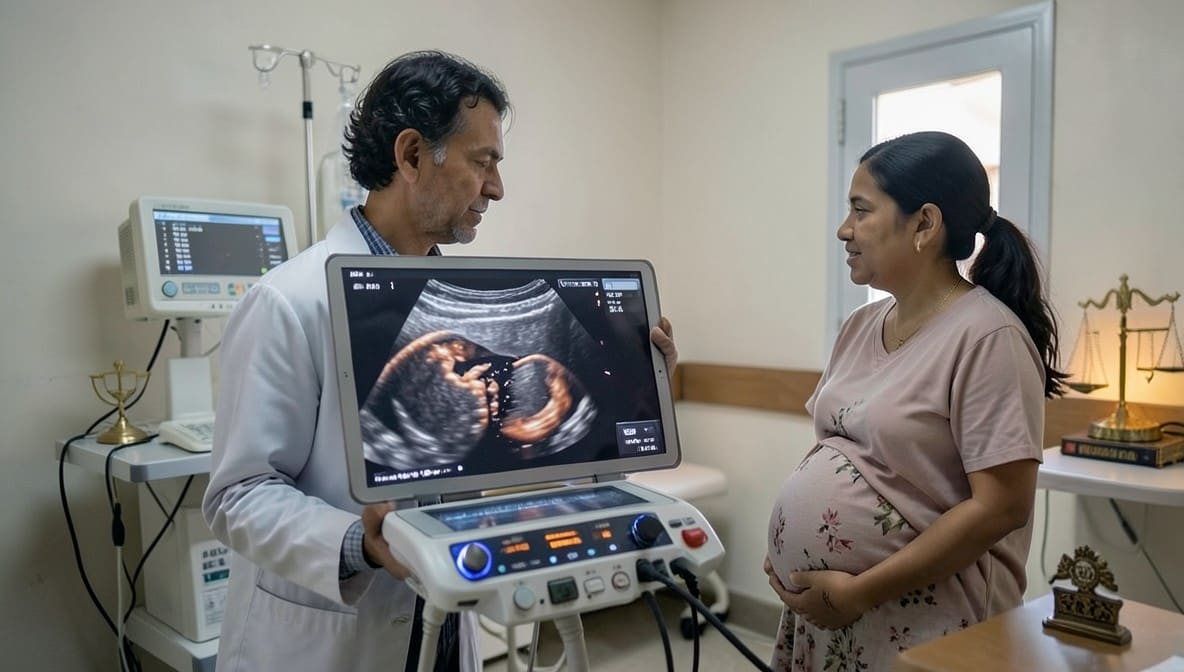
The Kerala High Court has affirmed that the right to reproductive autonomy under Article 21 of the Constitution overrides rigid gestational limits when a fetus is diagnosed with substantial abnormalities, establishing a clear pathway for termination beyond 24 weeks under the Medical Termination of Pregnancy Act, 1971.
Background & Facts
The Dispute
The petitioners, a married couple from Thrissur, sought termination of a 27-week and 2-day pregnancy after prenatal testing revealed that the fetus suffered from Trisomy 21 (Down’s Syndrome), accompanied by multiple severe congenital anomalies including micrognathia, polyhydramnios, bilateral renal pelvis dilation, echogenic intracardiac foci, and moderate pleural effusion. The Chromosomal Microarray Cytoscan Optima test confirmed a gain of 33,091 kbp on chromosome 21, consistent with Trisomy 21 - a condition associated with intellectual disability, congenital heart defects, immune deficiencies, increased risk of childhood leukemia, and early-onset Alzheimer’s disease.
Procedural History
- The petitioners filed the writ petition on 9 February 2026, seeking permission to terminate the pregnancy beyond the statutory 24-week limit.
- On 9 February 2026, the Court directed the fifth respondent, Medical College Hospital Kottayam, to constitute a Medical Board under Rule 3A of the MTP Rules, 2003.
- The Medical Board, comprising specialists in Obstetrics, Neurology, Radiology, Pediatrics, Psychiatry, and Cardiology, submitted its report on 11 February 2026.
- The Board unanimously concluded that the fetus had substantial abnormalities and that continuation of the pregnancy posed significant risk to the mother’s mental health.
Relief Sought
The petitioners sought a direction to the respondents to permit the termination of pregnancy under Section 3(2-B) of the Medical Termination of Pregnancy Act, 1971, arguing that the fetal abnormalities met the threshold of substantial risk to the child’s physical and mental health, thereby exempting the case from the 24-week gestational cap.
The Legal Issue
The central question was whether Section 3(2-B) of the Medical Termination of Pregnancy Act, 1971 permits termination of pregnancy beyond 24 weeks when a Medical Board confirms substantial fetal abnormalities, even if the pregnancy exceeds the statutory limit, and whether the pregnant woman’s right to reproductive autonomy under Article 21 overrides procedural delays or administrative hesitation.
Arguments Presented
For the Petitioner
The petitioners relied on Suchita Srivastava v. Chandigarh Administration and A v. State of Maharashtra to argue that reproductive autonomy is a fundamental right under Article 21, and that Section 3(2-B) was enacted precisely to remove gestational barriers in cases of severe fetal anomalies. They emphasized that the Medical Board’s unanimous opinion, supported by diagnostic reports, satisfied the statutory criteria. They further cited XYZ v. State of Gujarat to assert that courts must not deny relief merely due to gestational age, especially when medical evidence is conclusive.
For the Respondent
The State did not oppose the petition. The learned Additional Solicitor General acknowledged the Medical Board’s findings and conceded that the case fell squarely within the scope of Section 3(2-B). No substantive counter-argument was advanced, as the Board’s opinion aligned with the statutory mandate and Supreme Court precedents.
The Court's Analysis
The Court undertook a comprehensive review of the statutory framework under the MTP Act, 1971, and relevant judicial precedents. It emphasized that Section 3(2-B) explicitly removes the gestational limit for termination when a Medical Board confirms substantial fetal abnormalities. The Court held that the legislative intent behind this provision is to prioritize the woman’s physical and mental health over arbitrary timeframes.
"The legislation has made a value judgment in Section 3(2-B) of the Act, that a substantially abnormal foetus would be more injurious to the mental and physical health of a woman than any other circumstance."
The Court noted that the Medical Board’s report was thorough, multidisciplinary, and grounded in objective diagnostic evidence - including CMA, ultrasound, and psychiatric evaluation. The Board explicitly concluded that the child, if born, would suffer from serious physical and mental handicaps, and that continuation of the pregnancy posed a significant risk to the petitioner’s mental health.
The Court distinguished this case from those involving mere fetal anomalies without conclusive evidence of substantial disability. Here, the diagnosis of Trisomy 21 with multiple associated malformations met the threshold of "serious physical or mental abnormality" as contemplated under Section 3(2-B). The Court further held that delays in obtaining reports or procedural formalities cannot frustrate the fundamental right to reproductive autonomy, as affirmed in A v. State of Maharashtra.
The Court also rejected any notion that the woman’s consent must be scrutinized beyond her demonstrated capacity to make an informed decision. The psychiatric evaluation confirmed her cognitive competence, absence of delusions, and clear understanding of the consequences - thereby satisfying the requirement of voluntary consent under Section 3(4).
The Verdict
The petitioners succeeded. The Court held that Section 3(2-B) of the MTP Act permits termination beyond 24 weeks when a Medical Board confirms substantial fetal abnormalities, and that the petitioner’s right to reproductive autonomy under Article 21 is paramount. The Court directed immediate termination of the pregnancy under medical supervision, subject to final confirmation of abnormalities and execution of an undertaking by the petitioners.
What This Means For Similar Cases
Substantial Abnormality Must Be Medically Confirmed, Not Assumed
- Practitioners must ensure that Medical Board reports include detailed diagnostic evidence (CMA, advanced ultrasound, specialist opinions) to substantiate claims of "substantial abnormality."
- Generic diagnoses like "Down’s Syndrome" alone are insufficient; associated anomalies (e.g., cardiac defects, renal dilation, micrognathia) must be documented to meet the statutory threshold.
Medical Boards Must Address Mental Health Risk Explicitly
- The Court emphasized that Medical Boards must opine on the risk to the pregnant woman’s mental health, not just fetal prognosis.
- Psychiatric evaluation is now a de facto requirement in cases involving severe fetal anomalies, even if the woman appears cooperative.
Courts Cannot Delay Relief on Procedural Grounds
-
Delays caused by administrative inaction or procedural formalities cannot be used to deny relief under Section 3(2-B).
-
Writ petitions under Article 226 are not to be dismissed merely because the pregnancy exceeds 24 weeks; the focus must remain on medical evidence and fundamental rights.
-
Practitioners should file writ petitions promptly upon receipt of conclusive diagnostic reports.
-
Always include a certified copy of the Medical Board’s report and psychiatric evaluation in the petition.
-
Advocate for immediate interim directions to constitute the Board if delays are anticipated.