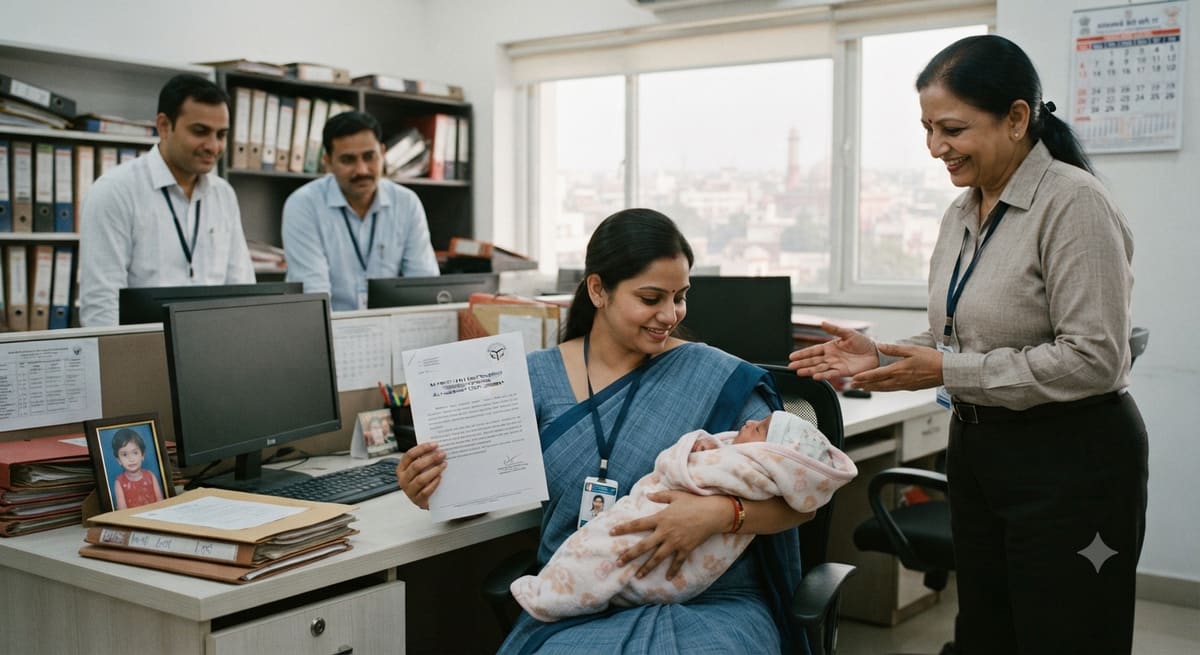
The Madhya Pradesh High Court has affirmed that guest faculty members, despite their contractual status, are entitled to the full statutory benefit of 26 weeks of paid maternity leave. This ruling resolves a recurring dispute over the applicability of maternity protections to non-permanent employees in government educational institutions, reinforcing the principle that fundamental rights to maternity benefits cannot be denied on the basis of employment classification alone.
Background & Facts
The Dispute
The petitioner, Smt. Kamla Patel, was engaged as a Guest Faculty member at Government Arts College, Khurai, District Sagar, Madhya Pradesh. Her engagement was on a contractual basis, compensated through honorarium payments, and not classified as regular service under government service rules. On 30.06.2025, she went on maternity leave and formally intimated the college authorities. Despite this, she was not permitted to resume her duties after the leave period, and her representation seeking reinstatement and payment of honorarium during maternity leave was dismissed by an order dated 06.04.2026 (Annexure-P/9).
Key Facts
- The petitioner was appointed as Guest Faculty on a contractual basis, with no formal appointment letter specifying tenure or benefits
- She was paid honorarium for teaching assignments, with no statutory or contractual guarantee of maternity benefits
- She informed the college authorities of her pregnancy and commenced maternity leave on 30.06.2025
- Her representation dated 15.03.2026 seeking continuation of honorarium during maternity leave was rejected on 06.04.2026
- Prior to this, she had filed WP No. 96/2026, which was disposed of on 14.01.2026 with a direction to the authorities to decide her representation
- A similar case, WP No. 9877/2026, was decided by this Court on 24.03.2026, granting 26 weeks of paid maternity leave to a guest faculty member
Procedural History
- 30.06.2025: Petitioner commenced maternity leave
- 15.03.2026: Petitioner submitted representation seeking continuation of honorarium during maternity leave
- 06.04.2026: Representation dismissed by respondent authority (impugned order)
- 14.01.2026: WP No. 96/2026 disposed of with direction to decide representation
- 24.03.2026: WP No. 9877/2026 decided by this Court, granting 26 weeks paid maternity leave to guest faculty
- 22.06.2026: Present writ petition (WP No. 20572/2026) heard and disposed of
Relief Sought
The petitioner sought quashing of the order dated 06.04.2026, reinstatement to her position, payment of honorarium for the entire maternity leave period, and a direction to treat her service as continuous for all future benefits.
The Legal Issue
The central question was whether a contractual guest faculty member is entitled to 26 weeks of paid maternity leave under the Maternity Benefit Act, 1961, or under constitutional principles of equality and dignity, despite the absence of formal employment status.
Arguments Presented
For the Petitioner
The petitioner’s counsel argued that the denial of maternity leave violated Article 14 and Article 21 of the Constitution, as it discriminated against women based on employment status. He relied on the *Supreme Court’s judgment in Bharat Forge Co. Ltd. v. Uttam Manohar Nakate and the Maternity Benefit (Amendment) Act, 2017, which extended 26 weeks of paid leave to all women employees, regardless of contract or permanency. He emphasized that the petitioner’s role involved essential public service and that denying her leave undermined gender equity in education.
For the Respondent
The Government Advocate contended that the petitioner was not a regular employee and was engaged only on a temporary, honorarium-based basis. He argued that the CCS (Pension) Rules and other service regulations did not extend maternity benefits to such appointments, and that granting such benefits would set a precedent affecting thousands of similar contractual appointments across the state.
The Court's Analysis
The Court examined the constitutional and statutory framework governing maternity rights and found that the distinction between regular and contractual employees cannot override the fundamental right to maternity protection. The Court noted that the Maternity Benefit (Amendment) Act, 2017 applies to "every woman employed in any establishment," and does not distinguish between permanent and contractual workers. The Court further held that denying maternity leave to women engaged in public education services violates the principle of substantive equality under Article 14.
"The right to maternity leave is not a privilege conferred by service rules, but a constitutional entitlement flowing from the dignity and health of women. To deny it on the basis of employment status is to perpetuate systemic gender discrimination."
The Court explicitly relied on its own earlier decision in WP No. 9877/2026, dated 24.03.2026, which had held that guest faculty are entitled to 26 weeks of paid maternity leave, with 8 weeks before and 18 weeks after delivery, and that honorarium must be paid during this period. The Court found no material distinction between the two cases and applied the same reasoning.
The Court also rejected the argument that the 80-day work requirement in the previous 12 months was a bar, noting that the petitioner had been regularly engaged and had fulfilled the condition.
The Verdict
The writ petition is allowed. The impugned order dated 06.04.2026 is quashed. The respondent is directed to grant the petitioner 26 weeks of paid maternity leave, with 8 weeks before and 18 weeks after delivery, and to pay her full honorarium for the entire period. The petitioner’s service shall be deemed continuous for the purpose of maternity leave benefits. Compliance is to be completed within 4 weeks from the date of this order.
What This Means For Similar Cases
Maternity Leave Is a Constitutional Right, Not a Service Privilege
- Practitioners representing female contractual employees in government institutions must now argue that denial of maternity leave violates Article 14 and Article 21, irrespective of appointment type
- The Maternity Benefit (Amendment) Act, 2017 applies to all women engaged in teaching, nursing, or administrative roles in state-funded institutions, even on honorarium
- Any policy or order excluding contractual staff from maternity benefits is now legally unsustainable
Honorarium Payments Must Continue During Maternity Leave
- Institutions cannot withhold honorarium during maternity leave on grounds of "non-regular" status
- The payment obligation arises from the nature of the work performed and the statutory mandate, not from formal employment contracts
- Failure to pay honorarium during leave may attract liability under the Maternity Benefit Act and constitutional remedies
Precedent Binding Across State Institutions
- This judgment, coupled with WP No. 9877/2026, creates a binding precedent for all government colleges and universities in Madhya Pradesh
- Similar petitions in other states may now cite this judgment to challenge discriminatory maternity policies
- Educational departments must immediately revise guidelines to include contractual faculty in maternity benefit schemes